
Brake Fluid Reservoir level check?
Discussion


Quick question for those that have done this before...
I am planning on taking the Cerbera up to Silverstone on Friday for the Williams preview day, and the brakes have been getting a little spongy after getting hot on long journeys so I am thinking of bleeding them today with replacement new dot 5.1 brake fluid
I've WD-40'd the bleed nipples ready to do this (other brand names may apply) but wondered how to check what level the fluid is at as the whole top of the brake fluid reservoir seems to be bathroom sealed to the top of the inner wheel arch?
Also - quick check - but it is the Ford reservoir with the yellow top - the other one under the 'knee pad' type cover is the clutch master cylinder AFAIK
Thanks!

I am planning on taking the Cerbera up to Silverstone on Friday for the Williams preview day, and the brakes have been getting a little spongy after getting hot on long journeys so I am thinking of bleeding them today with replacement new dot 5.1 brake fluid
I've WD-40'd the bleed nipples ready to do this (other brand names may apply) but wondered how to check what level the fluid is at as the whole top of the brake fluid reservoir seems to be bathroom sealed to the top of the inner wheel arch?
Also - quick check - but it is the Ford reservoir with the yellow top - the other one under the 'knee pad' type cover is the clutch master cylinder AFAIK
Thanks!
Edited by Juddder on Wednesday 31st May 09:27
Byker28i said:
yup exactly that. Handbook says to fill to the MAX level 
Thanks Byker28i for the reply and now if I could only remove the bleed nipples!Lots of WD40 over a couple of hours and a 11mm ring spanner but without feeling like I was going to snap them in half no easy movement from them yet :-/
Any tips from those in the know?
Use a modern synthetic releasing agent rather than a product invented 70 years ago, based on fish guts and with zero lubricity (JMHO).
The following suggestions assume a degree of mechanical sympathy and 'feel', I accept no responsibility blah blah blah:
Tap the nipple squarely on its end using a soft (brass, copper or aluminium) drift.
Use a little heat to warm the nipple, tap it, allow to cool, re-apply fish guts, repeat etc etc.
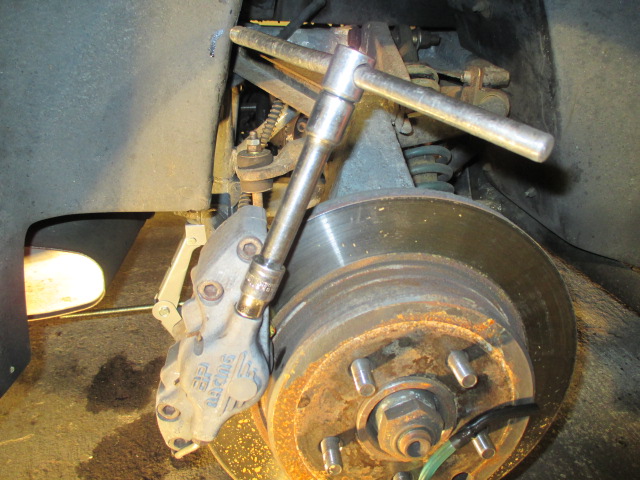
Use a 6 sided socket and 3/8" drive socketry, a breaker bar or preferably a T-bar, not in order to exert extreme force but so that you can be smooth and better feel what you're doing (rather than jerking it with lesser leverage). Try very slightly tightening too. Once you get some movement, gently work it back and forth while reapplying fish guts and increasing the range of movement.
Be patient and remember it's a one-way ticket, if it breaks, you've overdone it!
The following suggestions assume a degree of mechanical sympathy and 'feel', I accept no responsibility blah blah blah:
Tap the nipple squarely on its end using a soft (brass, copper or aluminium) drift.
Use a little heat to warm the nipple, tap it, allow to cool, re-apply fish guts, repeat etc etc.
Use a 6 sided socket and 3/8" drive socketry, a breaker bar or preferably a T-bar, not in order to exert extreme force but so that you can be smooth and better feel what you're doing (rather than jerking it with lesser leverage). Try very slightly tightening too. Once you get some movement, gently work it back and forth while reapplying fish guts and increasing the range of movement.
Be patient and remember it's a one-way ticket, if it breaks, you've overdone it!
Juddder said:
I am thinking of bleeding them today with replacement new dot 5.0 brake fluid
Brake fluid flush is always a good idea, but you did mean DOT 5.1, not 5.0 which is the silcone based fluid used mainly by Citroens.They do not mix, if you use any by mistake you will need to do a lot of research to find out whether it is possible to simply flush it through with a gallon or more of cheap DOT 4, or whether you may need to replace a bunch of seals as well.
Juddder said:
Thanks Byker28i for the reply and now if I could only remove the bleed nipples!
Lots of WD40 over a couple of hours and a 11mm ring spanner but without feeling like I was going to snap them in half no easy movement from them yet :-/
Any tips from those in the know?
Never use a ring spanner on a seized brake nipple.Lots of WD40 over a couple of hours and a 11mm ring spanner but without feeling like I was going to snap them in half no easy movement from them yet :-/
Any tips from those in the know?
Only ever use a socket on a T Bar.
The T bar will remove the nipple, and possibly a lot of thread from the caliper as well, but it is very unlikely to snap.
Once the nipple is out you can chase the threads in the caliper with a tap, and then fit a new nipple. It won't be perfect, but it will most likely work.
A couple of mine weep a little, but nothing that will contaminate the pads/discs.
Alternatively budget several hundred quid on replacement calipers.
ukkid35 said:
Never use a ring spanner on a seized brake nipple.
Only ever use a socket or a T Bar.
Alternatively budget several hundred quid on replacement calipers.
Thanks Paul!Only ever use a socket or a T Bar.
Alternatively budget several hundred quid on replacement calipers.
Yes from looking today it's £1,500 for a replacement set of AP Racing CP9200 front callipers so not a cheap replacement by any means!
My local mechanic just gave me a canister of Wurth Rost-Off Black ("Rust releasing agent on the basis of graphite") which he said is great and to spray on and leave for a day, and then spray again before attempting to unscrew the brake nipples
As you suggest I have a T-Bar, which looks ideal with even pressure either side, and a big torque wrench which I can use if I need too
Also just read through an old post from 2008 (!) from TT Tim and Julian64 where Julian's suggestion of heating up the calliper followed by pipe freeze seems to be quite a winner... one to try if I'm still having no luck...
Will update the post with progress as I get on!
Regards, Alex
P.S. Yes, 5.1
Edited by Juddder on Tuesday 30th May 23:58
Alex, don't forget that there are 8 nipples...one inner and one outer per caliper...
Although not ideal, if you can only open one nipple per caliper you will still be changing the vast majority of the fluid, just not the little pocket in that side of the caliper, and even this can be minimised by retracting that piston fully back into the caliper.
Rik
Although not ideal, if you can only open one nipple per caliper you will still be changing the vast majority of the fluid, just not the little pocket in that side of the caliper, and even this can be minimised by retracting that piston fully back into the caliper.
Rik
Gassing Station | Cerbera | Top of Page | What's New | My Stuff