
Air fuel ratios.
Discussion


I suppose this is a question for those running aftermarket ecu`s.
Just wondering what afr`s you are running in the shunt area of
1000rpm to say 1800rpm. I know camshaft choice will be a big factor here and i`m assuming you are still on the standard plenum. For the record i`m running a Kent 218 cam.
When i say shunt let me just expand. My engine will run fine in 4th or 5th gear down to as little as 1000rpm if i so wish with pretty much zero shunt and will happily do this with a 13.5 afr. My problem comes about say in 2nd or 3rd gear at a constant very light load and low rpm say 1500rpm, here it will get a bit shunty at 13.5 afr. Bring it down to 12.5 and things improve to an acceptable level that i am happyish with.
The problem with bringing it down to 12.5 for 2nd gear work is that it then hits the same load / speed sites when pootling around in 5th and so its then at 12.5 when i doesnt need it to be.
So my question really is; is 12.5 afr too rich for prolonged periods. Is this getting into bore wash territory. To my mind 12.5 is too rich for an rpm range where the engine spends a lot of its time.
I know its a sports car and hear when people say drive it as such and dont spend time in the problem rpm range. The thing is as i get older i enjoy just cruising around in it and the in town problem bit really gets to me.
Such is my obsession for low down smoothness i am seriously considering a 4 barrel carb with a dual plane manifold as i know this will sort it as i have done it and seen it many times before on the RV8. My previous carbed rv8`s were just so smooth low down. Easy to set up at home with a Wideband and no more rolling road mapping time and money. And no, i wont also be putting a distributor back in with points
Just wondering what afr`s you are running in the shunt area of
1000rpm to say 1800rpm. I know camshaft choice will be a big factor here and i`m assuming you are still on the standard plenum. For the record i`m running a Kent 218 cam.
When i say shunt let me just expand. My engine will run fine in 4th or 5th gear down to as little as 1000rpm if i so wish with pretty much zero shunt and will happily do this with a 13.5 afr. My problem comes about say in 2nd or 3rd gear at a constant very light load and low rpm say 1500rpm, here it will get a bit shunty at 13.5 afr. Bring it down to 12.5 and things improve to an acceptable level that i am happyish with.
The problem with bringing it down to 12.5 for 2nd gear work is that it then hits the same load / speed sites when pootling around in 5th and so its then at 12.5 when i doesnt need it to be.
So my question really is; is 12.5 afr too rich for prolonged periods. Is this getting into bore wash territory. To my mind 12.5 is too rich for an rpm range where the engine spends a lot of its time.
I know its a sports car and hear when people say drive it as such and dont spend time in the problem rpm range. The thing is as i get older i enjoy just cruising around in it and the in town problem bit really gets to me.
Such is my obsession for low down smoothness i am seriously considering a 4 barrel carb with a dual plane manifold as i know this will sort it as i have done it and seen it many times before on the RV8. My previous carbed rv8`s were just so smooth low down. Easy to set up at home with a Wideband and no more rolling road mapping time and money. And no, i wont also be putting a distributor back in with points
Well in case you dont know I run a more severe mech grind and have to have my target closed loop values of 12.8 at around 1700/2000 (the dreaded zone) otherwise in shunts like s t, open loop was inconsistant with temp changes in this RPM area, a richer AFR here is not a cause for concern I knew what I was doing and there would be trade offs, ign timing is not the issue here either it wants this area richer downsides of running a common plenum on the Rover and a radical or not so radical cam, I have no complaints
t, open loop was inconsistant with temp changes in this RPM area, a richer AFR here is not a cause for concern I knew what I was doing and there would be trade offs, ign timing is not the issue here either it wants this area richer downsides of running a common plenum on the Rover and a radical or not so radical cam, I have no complaints Edited by Sardonicus on Saturday 5th August 17:30
Simon knows absolutely everything about anything worth knowing so it sounds ok to me.
I'd just keep an eye on plug colour.
I can't tell you what mine are and this thread has made me sit up .
It's been so good and Powers are not far away I've been lazy and just let Jay plug in, I havnt got AFR gauge, I need a laptop to check. It's time I got one!
It's as economical as ever and runs great so I'm assuming the map and AFR are good!!!!
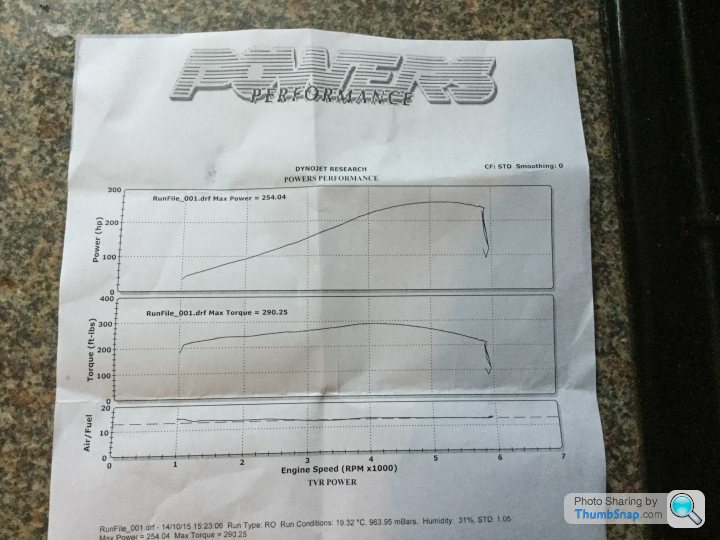
What a dyno read out tells you I'm not sure but this is on the dyno. What I don't know is this WOT or progressive throttle when doing these power runs.
What I do remember is Dom telling me how hard it is to remove shunt at 1400-1600 on any system. he had my car weeks when it was running and used it everyday I think, took a bit to get rid of it on mine and my induction must be as good as any with long thin 38 mm trumpets thrusting air in which I think helps me at these low revs. Not so fast but great for a road car.
I'd just keep an eye on plug colour.
I can't tell you what mine are and this thread has made me sit up .
It's been so good and Powers are not far away I've been lazy and just let Jay plug in, I havnt got AFR gauge, I need a laptop to check. It's time I got one!
It's as economical as ever and runs great so I'm assuming the map and AFR are good!!!!
What a dyno read out tells you I'm not sure but this is on the dyno. What I don't know is this WOT or progressive throttle when doing these power runs.
What I do remember is Dom telling me how hard it is to remove shunt at 1400-1600 on any system. he had my car weeks when it was running and used it everyday I think, took a bit to get rid of it on mine and my induction must be as good as any with long thin 38 mm trumpets thrusting air in which I think helps me at these low revs. Not so fast but great for a road car.
Does your MBE (for services to TVR owners) come with software and a lead, Alun?
If it does, and if you are popping over to Snetterton on the 23rd, whether taklng part or not, then we could do some slow rev driving round the service roads with the laptop plugged in to analyse what is happening regarding AFRs.
Mine comes with sottware and lead, and I have an AFR gauge on the dash these days. What I don't know is what cam i have. All I know is that it is a standard Range Rover cam, to avoid valve overlap. I watched the AFR gauge while following a 1930s Austin at 35mph late this afternoon, with me in 4th gear, and they were high 13s to low 14s. No hunting. Couldn't believe the tyres on that pre-war Austin - couldn't have been more than about 3-4 inches wide.
For those who don't know my car, it's a standard Range Rover 4.6 engine, but with a Whalley turbo install. Hence all the power is generated by farcical induction, and the engine is as basic, low compression and strong as it can be.
If it does, and if you are popping over to Snetterton on the 23rd, whether taklng part or not, then we could do some slow rev driving round the service roads with the laptop plugged in to analyse what is happening regarding AFRs.
Mine comes with sottware and lead, and I have an AFR gauge on the dash these days. What I don't know is what cam i have. All I know is that it is a standard Range Rover cam, to avoid valve overlap. I watched the AFR gauge while following a 1930s Austin at 35mph late this afternoon, with me in 4th gear, and they were high 13s to low 14s. No hunting. Couldn't believe the tyres on that pre-war Austin - couldn't have been more than about 3-4 inches wide.
For those who don't know my car, it's a standard Range Rover 4.6 engine, but with a Whalley turbo install. Hence all the power is generated by farcical induction, and the engine is as basic, low compression and strong as it can be.
carsy said:
I suppose i could always go forced induction to help matters, keep that plenum under pressure and keep those damn exhaust gases where they should be, in the exhaust manifolds
That depends on your compression ratio. Generally speaking, you need a low compression ratio to get the best out of a turbo. I turbocharged mine when I broke my five litre engine. So after thinking through what I wanted, I built a low compression 4.6 specifically to turbocharge.
QBee said:
That depends on your compression ratio. Generally speaking, you need a low compression ratio to get the best out of a turbo. I turbocharged mine when I broke my five litre engine. So after thinking through what I wanted, I built a low compression 4.6 specifically to turbocharge.
Didnt realise you broke your old engine Anthony, what went wrong.carsy said:
Didnt realise you broke your old engine Anthony, what went wrong.
It hadn't been right for about a year before it expired. It was a long stroke, small journal 5 litre, and they do tend to suffer from piston slap, so when it started electing a new Pope I took advice from Mat Smith and we sent it to have its piston rings replaced by V8D. But as soon as he started on it, Rob realised that the while engine had warped, probably due to overheating. The only time I could remember noticing 100 degrees and low oil pressure was on a hot summer's track day at Cadwell Park.....Rob quoted me £3k for a full rebuild, but that would only have given me the same as before, and I wanted to move on and try something more, rather than have another rebuild in a couple of years time. Considered and priced up an LS conversion, and actually had it booked in with Sportmotive. But then Brexit came along, the job got £3-4000 more expensive and I pulled the plug at a cost of well over £20k. 4.6, turbo and Emerald were less than half that and can give me similar performance if I want to map it that way. I am starting at 400 bhp/525 ft lbs at 7.5 psi boost to try to protect all my standard drive train components.
QBee said:
Does your MBE (for services to TVR owners) come with software and a lead, Alun?
If it does, and if you are popping over to Snetterton on the 23rd, whether taklng part or not, then we could do some slow rev driving round the service roads with the laptop plugged in to analyse what is happening regarding AFRs.
Mine comes with sottware and lead, and I have an AFR gauge on the dash these days. What I don't know is what cam i have. All I know is that it is a standard Range Rover cam, to avoid valve overlap. I watched the AFR gauge while following a 1930s Austin at 35mph late this afternoon, with me in 4th gear, and they were high 13s to low 14s. No hunting. Couldn't believe the tyres on that pre-war Austin - couldn't have been more than about 3-4 inches wide.
For those who don't know my car, it's a standard Range Rover 4.6 engine, but with a Whalley turbo install. Hence all the power is generated by farcical induction, and the engine is as basic, low compression and strong as it can be.
No it doesn't come with the lead. It's awhile since I spoke to Jason. I'll contact him and ask. I can get the software but as I'm on iPad need to buy a small laptop. It's ODB so no Biggy there. If it does, and if you are popping over to Snetterton on the 23rd, whether taklng part or not, then we could do some slow rev driving round the service roads with the laptop plugged in to analyse what is happening regarding AFRs.
Mine comes with sottware and lead, and I have an AFR gauge on the dash these days. What I don't know is what cam i have. All I know is that it is a standard Range Rover cam, to avoid valve overlap. I watched the AFR gauge while following a 1930s Austin at 35mph late this afternoon, with me in 4th gear, and they were high 13s to low 14s. No hunting. Couldn't believe the tyres on that pre-war Austin - couldn't have been more than about 3-4 inches wide.
For those who don't know my car, it's a standard Range Rover 4.6 engine, but with a Whalley turbo install. Hence all the power is generated by farcical induction, and the engine is as basic, low compression and strong as it can be.
The software isn't user friendly as in a few gauges telling you things it's what jay uses

He's showed me around it though and with a bit of practice I could navigate easily enough.
Hmm starting to get interested in this more since reading about and actually understanding the Gems set up.
Jason told me he could get a bit more power out of it at the drag strip for a few runs via laptop.
I regretting not getting an AFR gauge but also glad I'm not fixated on the thing, but just today I'm driving thinking I need to know this.
I can use any car diagnostics with ODB to check base settings but I don't think that includes AFR ratios but I might be wrong.
You can get an analogue one from Caerbont to match your other TVR dials, and it's not expensive. But it is calibrated 9, 12, 15, 18, so you will spend all your time trying to work out what it is saying and whether it is accurate.
Digital dials are available, just not matching the other dials, and you need to wire it into the lambda.
Digital dials are available, just not matching the other dials, and you need to wire it into the lambda.
QBee said:
You can get an analogue one from Caerbont to match your other TVR dials, and it's not expensive. But it is calibrated 9, 12, 15, 18, so you will spend all your time trying to work out what it is saying and whether it is accurate.
Digital dials are available, just not matching the other dials, and you need to wire it into the lambda.
Exactly. I think plugging direct to Ecu just removes any doubt Digital dials are available, just not matching the other dials, and you need to wire it into the lambda.
That's quite cool you can get it in the correct gauge spec I must say.
My weekly service checks are all a bit boring now as there's nothing much to do. I think with a laptop I can check once a week and be reasonably happy.
This shunting I'd suspect as road train slack that just showing itself at those revs as before my new diff I could still get shunt, not shunt but road train slack but Carsy has a new diff.
It's much better now and the engine doesn't shunt at all at any revs down to stalling it. I'll try getting a vid up on YouTube as I'm sick of going on about it. If my cam is higher lift,, Dom said his own ordered 885 have a quick lift and drop off spec not the same as off the shelf, been working and effecting it for years for his engines only,,, sales patter who knows but I don't seem to have any scavaging problems.
Mine normally runs in between 12.8 and 13 AFR.
Joolz had to richen low running because of the dreaded shunting which is now minimal considering the H414 cam.
Of course when you're driving slowly you are running in the slightly richer area and therefore when you think you're driving very economical you are actually using more fuel than you would need with the a milder camshaft!
Joolz had to richen low running because of the dreaded shunting which is now minimal considering the H414 cam.
Of course when you're driving slowly you are running in the slightly richer area and therefore when you think you're driving very economical you are actually using more fuel than you would need with the a milder camshaft!
I run a Stealth cam and low 13's from idle to 2,000rpm, my best advice would be to "give the engine what it wants", rather than shooting for an arbitrary AFR figure.
Avoid the temptation to run the engine leaner than it's happy with in the pursuit of best fuel economy because at these lower engine speeds the economy difference between a nice healthy 12.7 and 14.7:1 will in practice be the best part of cock all.
The one element no one has mentioned yet is ignition timing, this is as important if not more important than your AFR figures. The truth is one will have a bearing on the other and vice versa, if you take your AFR down from the mid 13's into the high 12's you will need to make changes to your timing too to take full advantage of the richer mixture.
Leaner mixtures are harder to burn so require you initiate combustion earlier, conversely as you richen things up you should look to retard your timing, as with your AFRs follow the principle of "give it what it wants" remembering mixture and timing work hand in hand.
While 14.7:1 is stoich, in practice you should view it as a lean condition, this is especially true in the old Rover V8 where manifold and combustion chamber design are laughably inefficient by modern standards. Air speeds play an important role here too and air speeds are directly linked to piston speeds as it's the piston falling in the bore that generates your induction. If you take a moment to consider the individual piston speed of a V8 at 1,750rpm and compare it with the individual piston speed of a four cylinder engine at 1,750rpm then combine this with the poor volumetric efficiency of the Rover V8 you shouldn't be surprised our engine greatly benefits from a richer mixture.
A liquid fuel is actually very resistant to mixing with air, it has a given mass and gravity is ever present, consider a leaf blown from a tree and the factors dictating how long it stays suspended in the wind before it eventually falls to the ground. The leaf is your droplet of fuel and the strength of the wind is your manifold air speed, what tends to happen at low air speeds (lower rpm) is some of your liquid fuel will fall out of suspension with the air and form puddles on the floor of your inlet manifold, under these conditions the last thing you want to do is shoot for a leaner AFR.
To improve the situation a faster idle speed is clearly advantageous as is reducing the size of the droplets of fuel you're trying to suspend in the slow moving air. Modern multi port pintel injectors do a much better job of atomising fuel than the dreadful old Lucas disc type hose pipes, raising the pressure of the fuel at the back of the injector before it opens will help here too but we must accept we're Woking with port injection here and our inlet manifold design does not lend itself to efficiency at low air speeds.
Finally it's worth remembering that while the most complete burn of your fuel is achieved when 14.7 parts of air by mass is present for every 1 part of fuel by mass, best torque is actually fond when you mix 12.8 parts of air by mass with 1 part of fuel by mass. Emissions are a completely different subject altogether but if you are looking to achieve best drivability and smooth engine operation I would encourage you to ignore emissions altogether, it's important to remind ourselves here when the Rover V8 was designed there was no real thought given to emissions.
Set your idle speed as high as you feel comfortable with and run the AFR your engine feels happiest with, set your timing to suit the AFR working on the principle of "give it what it wants", and forget all about fuel economy and emissions as allowing these elements to play a part in what you're trying to achieve will only serve to frustrate for sure.
Avoid the temptation to run the engine leaner than it's happy with in the pursuit of best fuel economy because at these lower engine speeds the economy difference between a nice healthy 12.7 and 14.7:1 will in practice be the best part of cock all.
The one element no one has mentioned yet is ignition timing, this is as important if not more important than your AFR figures. The truth is one will have a bearing on the other and vice versa, if you take your AFR down from the mid 13's into the high 12's you will need to make changes to your timing too to take full advantage of the richer mixture.
Leaner mixtures are harder to burn so require you initiate combustion earlier, conversely as you richen things up you should look to retard your timing, as with your AFRs follow the principle of "give it what it wants" remembering mixture and timing work hand in hand.
While 14.7:1 is stoich, in practice you should view it as a lean condition, this is especially true in the old Rover V8 where manifold and combustion chamber design are laughably inefficient by modern standards. Air speeds play an important role here too and air speeds are directly linked to piston speeds as it's the piston falling in the bore that generates your induction. If you take a moment to consider the individual piston speed of a V8 at 1,750rpm and compare it with the individual piston speed of a four cylinder engine at 1,750rpm then combine this with the poor volumetric efficiency of the Rover V8 you shouldn't be surprised our engine greatly benefits from a richer mixture.
A liquid fuel is actually very resistant to mixing with air, it has a given mass and gravity is ever present, consider a leaf blown from a tree and the factors dictating how long it stays suspended in the wind before it eventually falls to the ground. The leaf is your droplet of fuel and the strength of the wind is your manifold air speed, what tends to happen at low air speeds (lower rpm) is some of your liquid fuel will fall out of suspension with the air and form puddles on the floor of your inlet manifold, under these conditions the last thing you want to do is shoot for a leaner AFR.
To improve the situation a faster idle speed is clearly advantageous as is reducing the size of the droplets of fuel you're trying to suspend in the slow moving air. Modern multi port pintel injectors do a much better job of atomising fuel than the dreadful old Lucas disc type hose pipes, raising the pressure of the fuel at the back of the injector before it opens will help here too but we must accept we're Woking with port injection here and our inlet manifold design does not lend itself to efficiency at low air speeds.
Finally it's worth remembering that while the most complete burn of your fuel is achieved when 14.7 parts of air by mass is present for every 1 part of fuel by mass, best torque is actually fond when you mix 12.8 parts of air by mass with 1 part of fuel by mass. Emissions are a completely different subject altogether but if you are looking to achieve best drivability and smooth engine operation I would encourage you to ignore emissions altogether, it's important to remind ourselves here when the Rover V8 was designed there was no real thought given to emissions.
Set your idle speed as high as you feel comfortable with and run the AFR your engine feels happiest with, set your timing to suit the AFR working on the principle of "give it what it wants", and forget all about fuel economy and emissions as allowing these elements to play a part in what you're trying to achieve will only serve to frustrate for sure.
Edited by ChimpOnGas on Sunday 6th August 07:43
Gassing Station | Chimaera | Top of Page | What's New | My Stuff