
Oil Temperature - Can I correctly assume this is not right?
Discussion


Morning all,
I have recently had an oil temperature gauge fitted to my Griff. The sender is located in the sump. Cruising at motorways speeds the gauge used to read around 120 degrees which I thought was high, recently this has gone up to 140+.
The coolant temperature it sat at a steady 90 degrees.
The idea of the oil temperature gauge was to monitor the oil temperature and then decide whether I needed to fit an oil cooler. It is my understanding the oil temperature should be around 110 degrees? Please correct me if I am wrong.
What is the consensus here, I am thinking faulty sender or incorrectly calibrated gauge? I have not had it long enough to understand what is normal. Any thoughts would be greatly appreciated.
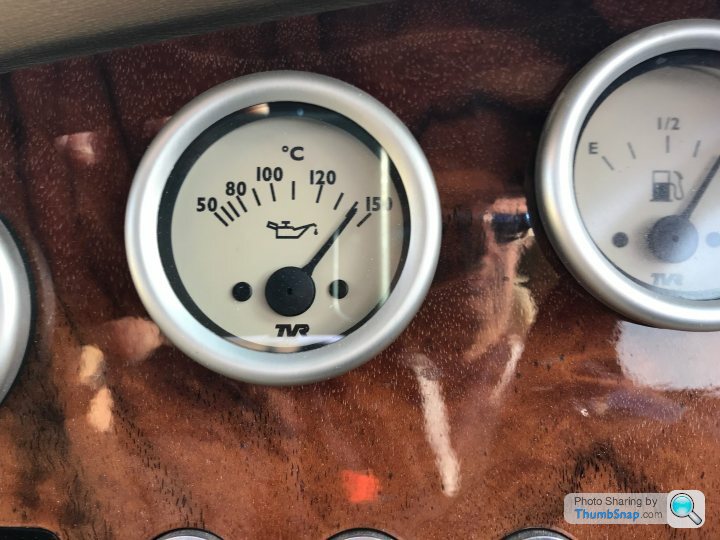
I have recently had an oil temperature gauge fitted to my Griff. The sender is located in the sump. Cruising at motorways speeds the gauge used to read around 120 degrees which I thought was high, recently this has gone up to 140+.
The coolant temperature it sat at a steady 90 degrees.
The idea of the oil temperature gauge was to monitor the oil temperature and then decide whether I needed to fit an oil cooler. It is my understanding the oil temperature should be around 110 degrees? Please correct me if I am wrong.
What is the consensus here, I am thinking faulty sender or incorrectly calibrated gauge? I have not had it long enough to understand what is normal. Any thoughts would be greatly appreciated.
Hi Matthew.
I have an accurate spa gauge fitted and my temperature readings are as follows.
If I am cruising fairly fast then water temperature is about 85° and oil temperature about 90°
If I am cruising slowly, 60 miles an hour, water temperature and oil temperature are about the same, 84/85° Or thereabouts.
If I am on track then water temperature still stays at about 85° and oil temperature goes up to about 105/108°.
This is with a large oil cooler fitted.
I would expect your cruising temperatures to be fairly similar. At about 70 to 80 miles an hour even if your water temperature is 90° I wouldn't expect that oil temperature to be any more than 100° maximum.
Just out of interest when Alex, (Gasmonkey) and I went for a Surrey lanes spin some years ago, he was using a lot of revs in lower gears and he managed to get his oil temperature up to 115° Possibly more iirc and that was without an oil cooler.
Higher revs and slow forward momentum will always give you a higher oil temperature.
I have an accurate spa gauge fitted and my temperature readings are as follows.
If I am cruising fairly fast then water temperature is about 85° and oil temperature about 90°
If I am cruising slowly, 60 miles an hour, water temperature and oil temperature are about the same, 84/85° Or thereabouts.
If I am on track then water temperature still stays at about 85° and oil temperature goes up to about 105/108°.
This is with a large oil cooler fitted.
I would expect your cruising temperatures to be fairly similar. At about 70 to 80 miles an hour even if your water temperature is 90° I wouldn't expect that oil temperature to be any more than 100° maximum.
Just out of interest when Alex, (Gasmonkey) and I went for a Surrey lanes spin some years ago, he was using a lot of revs in lower gears and he managed to get his oil temperature up to 115° Possibly more iirc and that was without an oil cooler.
Higher revs and slow forward momentum will always give you a higher oil temperature.

phazed said:
Hi Matthew.
I have an accurate spa gauge fitted and my temperature readings are as follows.
If I am cruising fairly fast then water temperature is about 85° and oil temperature about 90°
If I am cruising slowly, 60 miles an hour, water temperature and oil temperature are about the same, 84/85° Or thereabouts.
If I am on track then water temperature still stays at about 85° and oil temperature goes up to about 105/108°.
This is with a large oil cooler fitted.
I would expect your cruising temperatures to be fairly similar. At about 70 to 80 miles an hour even if your water temperature is 90° I wouldn't expect that oil temperature to be any more than 100° maximum.
Just out of interest when Alex, (Gasmonkey) and I went for a Surrey lanes spin some years ago, he was using a lot of revs in lower gears and he managed to get his oil temperature up to 115° Possibly more iirc and that was without an oil cooler.
Higher revs and slow forward momentum will always give you a higher oil temperature.
I am similar to Peter Matthew I have an accurate spa gauge fitted and my temperature readings are as follows.
If I am cruising fairly fast then water temperature is about 85° and oil temperature about 90°
If I am cruising slowly, 60 miles an hour, water temperature and oil temperature are about the same, 84/85° Or thereabouts.
If I am on track then water temperature still stays at about 85° and oil temperature goes up to about 105/108°.
This is with a large oil cooler fitted.
I would expect your cruising temperatures to be fairly similar. At about 70 to 80 miles an hour even if your water temperature is 90° I wouldn't expect that oil temperature to be any more than 100° maximum.
Just out of interest when Alex, (Gasmonkey) and I went for a Surrey lanes spin some years ago, he was using a lot of revs in lower gears and he managed to get his oil temperature up to 115° Possibly more iirc and that was without an oil cooler.
Higher revs and slow forward momentum will always give you a higher oil temperature.
 I have the Caerbont kit but my sender is in the original oil pressure sender hole below crank pulley so indicating gallery oil temps similar to above
  this was after 5 minutes of early morning hard driving (accelerating blast's so even worse) slowly creeping up to over 100 over a prolonged periods of abuse this was also in the summer I might add and with my Modine fitted give or take 5 degrees the Caerbont kit is pretty accurate compared to my thermal gun plotted in a few area,s around the oiling system
  so something is definitely up with your maybe a poor sender for example
  hope this helps ....
Edited by Sardonicus on Wednesday 15th November 13:02
Matthew same for me as the others. Mine varies between 70 and 90 under normal driving but can get up to 100/105. But that does affect the pressure at idle though... I have a large cooler but 140 plus sounds wrong. Can you check with an infrared thermometer on pipes to your cooler, assuming you have one?

 driving normally you wont see anywhere near those temps regardless of tune/spec IMO roughly they follow coolant temps if slightly less in fact 75/85 for example especially this time of year
 Thank you very much for the prompt and detailed responses gents, much appreciated.
I did wonder if something was up. The engine is a standard 500 lump internally but with a few ACT goodies bolted on so nothing elaborate at all. The car does not have an oil cooler fitted and the temperature sensor is in the sump.
The idea behind fitting the oil temp gauge was to understand if I need to fit an oil cooler or not.
I did wonder if something was up. The engine is a standard 500 lump internally but with a few ACT goodies bolted on so nothing elaborate at all. The car does not have an oil cooler fitted and the temperature sensor is in the sump.
The idea behind fitting the oil temp gauge was to understand if I need to fit an oil cooler or not.
phazed said:
That’s a yes for TDs and a no for general road use imho.
^^^^^^ this unless you limit your track time to say 15 mins a go 
On the move as in on the road I’d say engine runs cool if anything.
I was about to say maybe one would be useful in heavy traffic zones like the whole of the South of England from Watford onwards for example but that would have to be liquid cooled surely to be of any use.
So unless you like driving through the Smoke get Mbe instead, that’ll cool your oil straight away

Sardonicus said:
phazed said:
That’s a yes for TDs and a no for general road use imho.
Agreed Matthew good call plus it looks good having another instrument in the dash rather than a useless clock I binned mine it thought hrs were days 
As to oil cooler, I had one fitted with a thermostat plate. Compared with my 400, the current car is like a furnace under the bonnet and that has to find it way into the oil even on the road in my opinion. That opinion may not be as practically based as some but compared with how the RV8 started out in life, especially with regards to power and capacity, we are doing things a bit differently to the specs anticipated by Buick with the oil flows etc.
The position of the sender is relevant. Fitting on the sump generally reads low, I suspect that this is due to air cooling of the sump and more importantly cooling of the brass sender. If you want to detect more accurately you should install the sender in the spare port on the filter output. Mine is there and using a matched guage and sender I see normal summer temperatures between 100 & 110degC, winter settles at 100degC
bobfather said:
The position of the sender is relevant. Fitting on the sump generally reads low, I suspect that this is due to air cooling of the sump and more importantly cooling of the brass sender. If you want to detect more accurately you should install the sender in the spare port on the filter output. Mine is there and using a matched guage and sender I see normal summer temperatures between 100 & 110degC, winter settles at 100degC
Certainly is thats why mine is in the oil path too lets face it you want things accurate with the install Check that there's a voltage regulator on the +ve feed to the gauge - other wire goes to the 'sender'. Car gauges work off a regulated supply (around 10v) so that the reading isn't affected by battery volts which can vary quite a bit with load and engine speed.
If no regulator, gauges will normally read high (e.g. oil & water temp, fuel).
In the old days, these regulators looked lke a flasher unit... in fact, they used a similar bi-metal strip and heater wire to make and break the connection to give an average of 10v by switching from +ign volts to zero on contnuous basis. Modern ones will have a semiconductor inside, and just keep a flat 10v coming.
HTH
Anthony
If no regulator, gauges will normally read high (e.g. oil & water temp, fuel).
In the old days, these regulators looked lke a flasher unit... in fact, they used a similar bi-metal strip and heater wire to make and break the connection to give an average of 10v by switching from +ign volts to zero on contnuous basis. Modern ones will have a semiconductor inside, and just keep a flat 10v coming.
HTH
Anthony
MG Ant said:
Check that there's a voltage regulator on the +ve feed to the gauge - other wire goes to the 'sender'. Car gauges work off a regulated supply (around 10v) so that the reading isn't affected by battery volts which can vary quite a bit with load and engine speed.
If no regulator, gauges will normally read high (e.g. oil & water temp, fuel).
In the old days, these regulators looked lke a flasher unit... in fact, they used a similar bi-metal strip and heater wire to make and break the connection to give an average of 10v by switching from +ign volts to zero on contnuous basis. Modern ones will have a semiconductor inside, and just keep a flat 10v coming.
HTH
Anthony
No V reg on this gauge If no regulator, gauges will normally read high (e.g. oil & water temp, fuel).
In the old days, these regulators looked lke a flasher unit... in fact, they used a similar bi-metal strip and heater wire to make and break the connection to give an average of 10v by switching from +ign volts to zero on contnuous basis. Modern ones will have a semiconductor inside, and just keep a flat 10v coming.
HTH
Anthony
well not external anyway , just ign 12v + to gauge and a single ground from the sender for operation Classic Chim said:
I asked Dom once and he said you wouldn’t want it over 120
On track it can easily reach 115 and generally should be around 100 on the road
Which sounds similar to what you chaps are saying.
I understood that the temperature that degradation becomes an issue depends on the type of oil. Fully synthetic oils should be okay up to 150degC, mineral and semi synths should be okay up to 120degC. I'm not sure where this data came from but I've read it on PH a few times. On track it can easily reach 115 and generally should be around 100 on the road
Which sounds similar to what you chaps are saying.
MG Ant said:
Check that there's a voltage regulator on the +ve feed to the gauge - other wire goes to the 'sender'. Car gauges work off a regulated supply (around 10v) so that the reading isn't affected by battery volts which can vary quite a bit with load and engine speed.
If no regulator, gauges will normally read high (e.g. oil & water temp, fuel).
In the old days, these regulators looked lke a flasher unit... in fact, they used a similar bi-metal strip and heater wire to make and break the connection to give an average of 10v by switching from +ign volts to zero on contnuous basis. Modern ones will have a semiconductor inside, and just keep a flat 10v coming.
HTH
Anthony
Modern gauges are internally stabilised.If no regulator, gauges will normally read high (e.g. oil & water temp, fuel).
In the old days, these regulators looked lke a flasher unit... in fact, they used a similar bi-metal strip and heater wire to make and break the connection to give an average of 10v by switching from +ign volts to zero on contnuous basis. Modern ones will have a semiconductor inside, and just keep a flat 10v coming.
HTH
Anthony
Steve
Gassing Station | Griffith | Top of Page | What's New | My Stuff