
Solution to TVR Battery Drain?
Discussion


As a rookie Chimeara owner, I would appreciate any opinions on my proposal outlined below.
I have already experienced a dead battery several times, after just a few days standing; with what I believe to be a newish battery. OK I've seen the rated Ahr calcs, but assume this is for a brand new, fully charged battery; used in ideal conditions ( ie ambient temp/discharge rate etc.) and possibly not a realistic figure in practice.
Looking at my battery + ve connection (96 Chimaera) there is a heavy duty cable (circa 30mm2) and two lower rated wires.
Can I assume that the large cable is just the supply to the starter motor (and unlikely to present any drain)?
If so, can I put an isolation switch just on the two smaller wires? This would make fitting very much easier and also give the switch a much more benign/longer life, not having to conduct the full cranking current. (and not add extra starter volt drops).
Could this even allow a high current (50-60A) relay to be used as the isolator close to the battery, with a small remote (even externally hidden??) control switch. Possibly providing a secure and convenient way to leave the car when away from its garage??
I have already experienced a dead battery several times, after just a few days standing; with what I believe to be a newish battery. OK I've seen the rated Ahr calcs, but assume this is for a brand new, fully charged battery; used in ideal conditions ( ie ambient temp/discharge rate etc.) and possibly not a realistic figure in practice.
Looking at my battery + ve connection (96 Chimaera) there is a heavy duty cable (circa 30mm2) and two lower rated wires.
Can I assume that the large cable is just the supply to the starter motor (and unlikely to present any drain)?
If so, can I put an isolation switch just on the two smaller wires? This would make fitting very much easier and also give the switch a much more benign/longer life, not having to conduct the full cranking current. (and not add extra starter volt drops).
Could this even allow a high current (50-60A) relay to be used as the isolator close to the battery, with a small remote (even externally hidden??) control switch. Possibly providing a secure and convenient way to leave the car when away from its garage??
Sounds like you have a drain on the battery for it to go flat in such a short time, may be beneficial to try and identify it first.
I can leave mine for a few weeks without issue when i forget to hook it up to the battery conditioner.
Try searching for Battery brain, its what some owners choose to do to isolate the battery.
I planned to fit a battery isolator switch to battery negative just for safety reasons but have not got round to it yet, im not sure the alarm would be happy though if it was used all the time.
I can leave mine for a few weeks without issue when i forget to hook it up to the battery conditioner.
Try searching for Battery brain, its what some owners choose to do to isolate the battery.
I planned to fit a battery isolator switch to battery negative just for safety reasons but have not got round to it yet, im not sure the alarm would be happy though if it was used all the time.
Someone that has much knowledge of what if any Chimaera control units, radios etc will need a permanent positive even when disconnecting the power supplies from the battery will be along shortly, you don't want to have to keep entering a radio code or carrying out engine ECU re-learning etc
Apart from the above - Yes you can master Switch the thinner supplies and leave the starter motor and alternator connected
Below is an image and link to what will do the job, this master switch will carry 100 Amps all day long, if 100 Amps is not a high enough rating you can buy higher rated systems
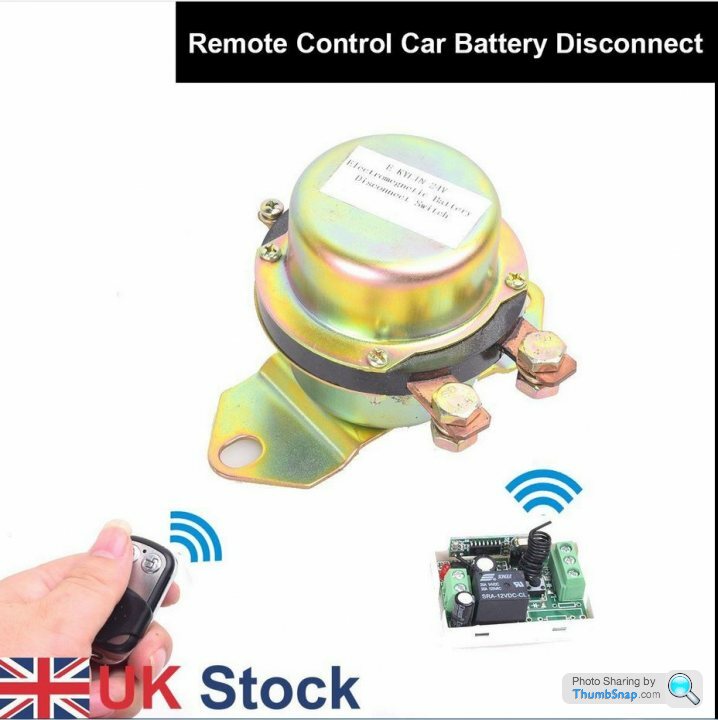
https://www.ebay.co.uk/itm/Car-Auto-Remote-Control...
Edited - Although a master switch is a very good tool, you should take note of what others have posted here regarding finding the problem current draws
Apart from the above - Yes you can master Switch the thinner supplies and leave the starter motor and alternator connected
Below is an image and link to what will do the job, this master switch will carry 100 Amps all day long, if 100 Amps is not a high enough rating you can buy higher rated systems
https://www.ebay.co.uk/itm/Car-Auto-Remote-Control...
Edited - Although a master switch is a very good tool, you should take note of what others have posted here regarding finding the problem current draws
Edited by Penelope Stoppedit on Saturday 9th December 15:57
Hello.Most battery drains can be found easily,some not so easy.On our cars[Chims & Griffs]there isn't that many ecu's present.Was told once not to leave the magazine in the autochanger as this causes a drain.A lot of owners modify the wiring to the radio so it works without ignition on.This may cause a large drain due to the amp having a battery feed instead of ignition feed.Also on mine found an intermittent door switch.A simple test is to disconnect the negative from the battery and place a simple test lamp between the negative and battery post.If your test lamp illuminates there is a drain present,then its just a case of removing fuses one at a time until the bulb goes out,then see what that fuse supplys.The cars I build are usually around 20 to 30 mA.Would expect our cars to be much less.As a reference an interior light staying on would be around 250mA.Hope this info is useful.Regards,Dave.
Most battery drains I have seen are related to the big yellow door courtesy light relay being energised ALL THE TIME, caused by improperly closing doors leaving the door pins always grounded and keeping the relay alive, which causes a 200+ma drain. They can also fail as well causing the same problem.
Check the door pin switches are being pressed correctly, and my further suggestion is to remove the relay entirely and bridge the switched earth from the door pin switch directly to earth in the relay holder. Just means that the courtesy lights don't stay on when you close the door! But will eliminate the problem forever.
You can get most TVRs (not cerbs) down to about 10-20ma quiescent current draw, any more than this I consider high and worth investigating. even 100ma draw, you should get at least 2 weeks before there's a flat problem.
Fix the problem, don't mask it with a battery disconnect!
Check the door pin switches are being pressed correctly, and my further suggestion is to remove the relay entirely and bridge the switched earth from the door pin switch directly to earth in the relay holder. Just means that the courtesy lights don't stay on when you close the door! But will eliminate the problem forever.
You can get most TVRs (not cerbs) down to about 10-20ma quiescent current draw, any more than this I consider high and worth investigating. even 100ma draw, you should get at least 2 weeks before there's a flat problem.
Fix the problem, don't mask it with a battery disconnect!
Edited by tofts on Saturday 9th December 14:50
These cars are really not that complicated find the drain  rather than messing around with circuit breakers etc a healthy battery on one of these cars should be able to maintain clock,ICE back-up,alarms etc for weeks and still spin the motor over after that duration IMO
rather than messing around with circuit breakers etc a healthy battery on one of these cars should be able to maintain clock,ICE back-up,alarms etc for weeks and still spin the motor over after that duration IMO Edited by Sardonicus on Saturday 9th December 16:43
This is what you need to pinpoint parasitic drain https://www.maplin.co.uk/p/400mm-automotive-curren...
+1 on Battery Brain works really well when parking up for more than a few weeks and great for ECU resets or isolating the battery for works on the car.
What I would like though is some way to provide constant power to my stereo as each time I shut the battery off, I have to punch in all settings again as the memory is wiped. I thought of a small rechargeable battery on the battery line to the head unit, but will that work?
What I would like though is some way to provide constant power to my stereo as each time I shut the battery off, I have to punch in all settings again as the memory is wiped. I thought of a small rechargeable battery on the battery line to the head unit, but will that work?

jazzdude said:
+1 on Battery Brain works really well when parking up for more than a few weeks and great for ECU resets or isolating the battery for works on the car.
What I would like though is some way to provide constant power to my stereo as each time I shut the battery off, I have to punch in all settings again as the memory is wiped. I thought of a small rechargeable battery on the battery line to the head unit, but will that work?
Steve, there are two permanent live male spade terminals already provided on the Battery Brain for that very purpose.What I would like though is some way to provide constant power to my stereo as each time I shut the battery off, I have to punch in all settings again as the memory is wiped. I thought of a small rechargeable battery on the battery line to the head unit, but will that work?
Just wire the stereo to one of these terminals and you won't lose your radio presets, use the other for your clock.

https://static.summitracing.com/global/images/inst...
I take on board the comments about finding the parasitic drain rather than masking it with a battery disconnect device, I eventually traced mine to a dodgy door solenoid, saying that a Battery Brain is a brilliant bit of kit for a lot more reasons than masking parasitic drains.
If you get the Battery Brain 'Gold' model with it's remote fobs, you can easily disconnect and reconnect the battery standing 10 feet from the car which is handy given where the Chimaera battery resides, it also means you can disconnect the battery after you've locked the car. This makes it a rather effective second security device, and as most car fires are electrical in origin, it's always a good idea for safety to disconnect the battery if a car is to be left for any length of time.
Even with my parasitic drain now eliminated, I continue with my policy of disconnecting my battery after locking my TVR when it's left for any length of time. I've been using the Battery Brain since March 2012 when I fitted my amazing Odyssey 25-PC1500 battery, that's just three months short of six years ago and the battery is as strong as the day I fitted it.
Thanks to the Battery Brain my Odyssey 25-PC150 has never ever been anywhere near a full discharge situation, which is what kills lead acid batteries in short order, to be honest I fully expect to get at least 15 years out of my full sized Odyssey

https://www.pistonheads.com/gassing/topic.asp?t=11...
There's a lot more to the Battery Brain than you think.
Dave.
jazzdude said:
Thanks Dave, should have spent the extra minute and read the Battery Brain manual before I fitted it. Now you have brought my attention to the tabs, the BB is now an even better piece of kit.

The Battery Brain is indeed a great bit of kit, but it isn't perfect..... be warned, the remotes do not tolerate being dropped!
If you do drop one it will fail for sure, I know this because it's happened to me twice now in the six years I've been using the Battery Brain device, unfortunately the remotes are matched to Battery Brain and because they use a rolling code you will not get a replacement, even if you give the number on the remote to the guy who sells the Battery Brain in the UK.
If you push him and you're lucky (as I was) he'll replace the whole Battery Brain, obviously this will come with a new matched pair of remotes, but recently I dropped a remote again so I'm now back in the same situation leaving me living on the spare remote and borrowed time, when this one fails I'm in for a new Battery Brain for sure.
Obviously you get two remotes with a new Battery Brain, so if one fails you're not completely screwed, but as I say you are living on borrowed time, in addition to the delicate remotes I know of two TVR friends who've suffered failures of the Battery Brain device itself, while it's a brilliant idea sadly the Battery Brain is very cheaply made, this is a real shame, if someone could come up with a more robust version or the Battery Brain importer would change his Chinese manufacturer it would be a real improvement.
When I spoke with the UK importer some three years ago when I had my first remote failure he admitted the quality was poor, he also said at the time he was changing his Chinese manufacturer, I asked him if he expected the quality to be improved, amazingly he said... "I doubt it!" I noticed from the images on the Battery Brain website about two years ago the remotes changed from the square cornered oblong version I've had twice now, to a newer rounded cornered lozenge version, but after the comments from the UK importer himself I'm yet to be convinced they're any more robust.
The moral of the story is... Do not drop your Battery Brain remote!
Many thanks for all the constructive and helpful replies.
I have been persuaded that I need to investigate further, and try to find the source and scale of the leakage current(s). Might have to be when the garage warms up a little. But will report anything significant found, which might be of value to other Chimera owners (it does seem to be a regularly recurring problem).
I have been persuaded that I need to investigate further, and try to find the source and scale of the leakage current(s). Might have to be when the garage warms up a little. But will report anything significant found, which might be of value to other Chimera owners (it does seem to be a regularly recurring problem).
450Nick said:
Pull out the interior light relay and fit a battery brain. Problem solved 
That's exactly what I did years ago Nick, disconnecting the battery worked for sure, but it's not always the final solution. For example, I've only just found what I believe was the main issue all along, a failing door solenoid. So you can't just assume it's that courtesy light delay relay, although admittedly it can be an issue..... but is certainly not the definitive source of every parasitic drain on this car.The door switches are often sighted as the issue but as everything on the Meta system is integrated, the reality is you can't just blame those door switches and or the buttons that act on them any more than you can blame the delay relay. Because everything is connected, everything must work perfectly, or you'll have issues.
Keep in mind the alarm system also serves as the central locking control unit, and in turn the alarm system is connected to and paired with the immobiliser unit, what I discovered was Meta system not only needs the door open and closed signals, but seems to need the solenoids working correctly and extending through their full stroke too. The doors may lock and unlock fine as mine did, but that doesn't mean the Meta system is seeing the doors as fully locked or unlocked. If the solenoids aren't extending through their full stroke and Meta system isn't seeing the doors as fully locked or unlocked the internal relays buried inside the Meta unit may remain energised which seems likely to have been the source of my parasitic drain.
Even with everything working correctly, the Meta system still uses a very old school microwave sensor, these sensors are so much much less current hungry these days, modern microwave sensors make the 90's tech Meta one used on the Chimaera look like a joke. So to answer the OP's question about finding a solution to the TVR battery drain, the answer must start with having David at HF solutions or Carl Baker of TVR alarms go through your car and replace the security system with one of the far superior functioning and less current hungry modern Meta systems they offer.
Gassing Station | Chimaera | Top of Page | What's New | My Stuff