
engine cooling/radiator questions
Discussion


Evening gents,
On the ariel atom there is a single front mounted radiator as per this pic:

From a bit of googling it would seem that "generally" a fan that pulls air (as opposed to blows air) is normally more efficient e.g. this link on the SPAL fans website
I would imagine that apart from anything else, having the fan on the front "blocks" some of the air from passing through the radiator. Is it likely to have a significant effect on managing coolant temps if I were to replace the fan for a high power "puller" fan located behind the radiator? I know this is probably very difficult to say without testing etc, but any opinions/help would be appreciated.
I ask this for two reasons. Firstly I want to improve cooling efficiency, and secondly I plan on fitting a chargecooler system and the obvious place for the chargecooler radiator would be at the front of the car in front of the engine cooling radiator. With the current fan in the way it takes up valuable space making that not possible.
Also, the factory offer a "hot country radiator" as an option. Its another radiator plumbed in in series that lays horizontal:
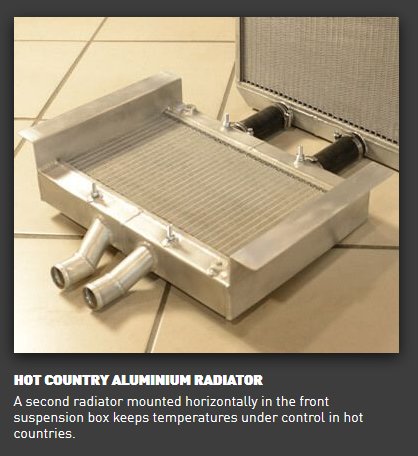
How efficient is this likely to be? I don't see how it will get any airflow? Would it be that the top mounted fan (you can see the four mounting lugs in the pic) is the sole source of driving airflow through the radiator? Would it be more likely to push or pull air? I wouldn't have thought the hot air coming off of the tarmac on a summers track day would be great for cooling, but then again if the fan was pushing air it would likely have already passed through the first (original) radiator and be hot already?
I'm considering getting a horizontal radiator fabricated similar to the one in the pic above, but just unsure as to how effective it will be on hard track use.
I would appreciate any help or advice etc.
Cheers
On the ariel atom there is a single front mounted radiator as per this pic:
From a bit of googling it would seem that "generally" a fan that pulls air (as opposed to blows air) is normally more efficient e.g. this link on the SPAL fans website
I would imagine that apart from anything else, having the fan on the front "blocks" some of the air from passing through the radiator. Is it likely to have a significant effect on managing coolant temps if I were to replace the fan for a high power "puller" fan located behind the radiator? I know this is probably very difficult to say without testing etc, but any opinions/help would be appreciated.
I ask this for two reasons. Firstly I want to improve cooling efficiency, and secondly I plan on fitting a chargecooler system and the obvious place for the chargecooler radiator would be at the front of the car in front of the engine cooling radiator. With the current fan in the way it takes up valuable space making that not possible.
Also, the factory offer a "hot country radiator" as an option. Its another radiator plumbed in in series that lays horizontal:
How efficient is this likely to be? I don't see how it will get any airflow? Would it be that the top mounted fan (you can see the four mounting lugs in the pic) is the sole source of driving airflow through the radiator? Would it be more likely to push or pull air? I wouldn't have thought the hot air coming off of the tarmac on a summers track day would be great for cooling, but then again if the fan was pushing air it would likely have already passed through the first (original) radiator and be hot already?
I'm considering getting a horizontal radiator fabricated similar to the one in the pic above, but just unsure as to how effective it will be on hard track use.
I would appreciate any help or advice etc.
Cheers
Whether there is any path for hot air from the back of the rad to nip back round to the front is the most important thing. There's no paneling shown so impossible to guess whether you have any problem there.
I'm having trouble making sense of the second radiator installation - in particular, what path the coolant will take through the two rads. More area is potentially going to give more heat dissipation, and having ram and on one side and the other side exposed to low underbody pressure seems like a good idea from the cooling point of view as long as you are not trying to do anything clever in terms of downforce..
I'm having trouble making sense of the second radiator installation - in particular, what path the coolant will take through the two rads. More area is potentially going to give more heat dissipation, and having ram and on one side and the other side exposed to low underbody pressure seems like a good idea from the cooling point of view as long as you are not trying to do anything clever in terms of downforce..
GreenV8S said:
Whether there is any path for hot air from the back of the rad to nip back round to the front is the most important thing. There's no paneling shown so impossible to guess whether you have any problem there.
I'm having trouble making sense of the second radiator installation - in particular, what path the coolant will take through the two rads. More area is potentially going to give more heat dissipation, and having ram and on one side and the other side exposed to low underbody pressure seems like a good idea from the cooling point of view as long as you are not trying to do anything clever in terms of downforce..
Hi again GreenV8S I'm having trouble making sense of the second radiator installation - in particular, what path the coolant will take through the two rads. More area is potentially going to give more heat dissipation, and having ram and on one side and the other side exposed to low underbody pressure seems like a good idea from the cooling point of view as long as you are not trying to do anything clever in terms of downforce..

The standard front mount radiator looks like this (aftermarket but same design):

There are two hard pipes (aluminium?) that run underneath the car from the engine to the radiator, joined with radiator hose onto the radiator and engine. So coolant comes out the engine down one pipe and into one port on the radiator. It flows up one side of the radiator to the top, then comes back down the other side of the radiator and exits through the other pipe and back to the engine. I think it's called a "twin pass" radiator?
The second horizontal radiator gets plumbed in series. It must be "split in half" so coolant runs through one half and into the front rad, then back out the other side of the front rad and back through the other half of the horizontal rad and back to the engine. I guess that would be twin pass as well? Unless it snakes through even more?
I hope that makes sense?
Excuse the crappy drawing but it flows like this (unless it makes multiple passes on its way through):

Here's a pic I found of an install, although both of these radiators appear to be aftermarket and not "genuine" factory items (not that it should matter):
 screengrab
I'm not quite sure what you mean by "paneling"? Something to direct the air? In terms of downforce, the atom doesn't have any

Cheers
Measure -> Analyse -> Modify -> Remeasure
Simples. Rather than ask "what effect will XXX have" why not actually measure how the existing system performs rather than just guessing?
(time after time, hobbists and tuners seem to be willing to spend £££'s on mods but not a single penny on getting any data to actually define those mods.....)
With four thermocouples and a thermocouple reader available cheaply on ebay, you can record how you existing radiator performs. Do a testlap as standard, then say take off the fan from the front of the rad, repeat the lap, and see if/how the performance improves etc
Simples. Rather than ask "what effect will XXX have" why not actually measure how the existing system performs rather than just guessing?
(time after time, hobbists and tuners seem to be willing to spend £££'s on mods but not a single penny on getting any data to actually define those mods.....)
With four thermocouples and a thermocouple reader available cheaply on ebay, you can record how you existing radiator performs. Do a testlap as standard, then say take off the fan from the front of the rad, repeat the lap, and see if/how the performance improves etc
Max_Torque said:
Measure -> Analyse -> Modify -> Remeasure
Simples. Rather than ask "what effect will XXX have" why not actually measure how the existing system performs rather than just guessing?
^^ That's good advice.Simples. Rather than ask "what effect will XXX have" why not actually measure how the existing system performs rather than just guessing?
If you need to change the fan location to enable you to package an intercooler, that seems like a perfectly reasonable thing to do.
That second radiator looks very strange and seems likely to have relatively little airflow - and what it has might well be drawing hot air from behind the original rad which will make it rather ineffective. I recommend you take Max_Torque's advice and see whether you have a cooling problem before you decide how to fix it. I have a bunch of remote sensing wired thermometers which I attach to various places around the engine by to measure air and coolant temps on and off the rad, positioned where I can see the displays. It's not as quite as good as a full data logging solution but a fraction of the cost and really all you need.
Than you both for the replies
My car has been running "hot" on track days lately which in fairness is 99.9% more likey down to the heatwave we are experiencing. I am also going to be upping the power considerably over winter (switching from the Jackson Racing supercharger to a more efficient/cooler running twin screw type supercharger plus the addition of a chargecooler, and upping boost from approx 7psi to approx 11psi) so want to plan ahead. I would sooner invest in "too much" cooling (as long as it's thermostatically controlled so that it doesn't end up running too cold!) rather than not have enough cooling just for safety and reliability wise. I would feel happier knowing the cooling is more than adequate!
As the factory offer the horizontal supplementary radiator I was hoping it would work, but know there are a lot of very knowledgeable people on here and value the input.
Thermocouples are a good suggestion and will help confirm whether the existing fan blocks airflow, but I'm not sure how they can help regarding switching to a "pull" fan on the back of the front radiator to allow front chargecooler radiator fitment, or to determine whether a horizontal radiator works (without first buying a pull fan and horizontal radiator by which time it will be too late as I would have spent the money already )
)
Based on your experience, would you expect a horizontal radiator in this application to have a push or pull fan?
Again, many thanks for the help, genuinely appreciated
My car has been running "hot" on track days lately which in fairness is 99.9% more likey down to the heatwave we are experiencing. I am also going to be upping the power considerably over winter (switching from the Jackson Racing supercharger to a more efficient/cooler running twin screw type supercharger plus the addition of a chargecooler, and upping boost from approx 7psi to approx 11psi) so want to plan ahead. I would sooner invest in "too much" cooling (as long as it's thermostatically controlled so that it doesn't end up running too cold!) rather than not have enough cooling just for safety and reliability wise. I would feel happier knowing the cooling is more than adequate!
As the factory offer the horizontal supplementary radiator I was hoping it would work, but know there are a lot of very knowledgeable people on here and value the input.
Thermocouples are a good suggestion and will help confirm whether the existing fan blocks airflow, but I'm not sure how they can help regarding switching to a "pull" fan on the back of the front radiator to allow front chargecooler radiator fitment, or to determine whether a horizontal radiator works (without first buying a pull fan and horizontal radiator by which time it will be too late as I would have spent the money already
)Based on your experience, would you expect a horizontal radiator in this application to have a push or pull fan?
Again, many thanks for the help, genuinely appreciated
The horizontal radiator looks very odd and I'm not sure how it's supposed to work. I can't guess which way the air is intended to flow through it. The bottom would be at underbody pressure, which would typically be quite low for a conventional car - but I don't know whether the Atom is similar. The top is downstream of the vertical rad which would typically also be a low pressure zone for a conventional car - but I have no idea whether that holds true here either. This suggests it isn't likely to have much ram air flow. Unless it is ducted to the main rad, in which case it will be eating hot air and doing very little to help.
The pics show it has a fan fitted. This would give some cooling boost at low speeds but without an ram air flow I suspect it will be relatively ineffective at high speeds. The fact the fan doesn't seem to be ducted suggests that it will only be affecting a small part of the core, and the position makes me suspect that it would be compromised by hot air recirculation at low speeds. If there is even a small amount of ram pressure across it at speed you would need to make sure the fans were blowing in the same direction or they will defeat their purpose.
The other curious feature is that the water flow is split so that one side sees hot coolant flow and the other sees colder coolant. This might be nice to package but isn't very efficient use of the air flow. If the horizontal rad is drawing air from the back of the vertical rad this will suffer a more extreme case of the same problem.
The point that you need to know what the problem is still holds true.
For the sake of argument I'm going to assume that you have an overheating problem at high speed and that you have ample coolant flow. You shouldn't be assuming any of this, though, or you could well end up not solving the real problem. If I had that problem and decided I needed to make better use of the available air flow, I'd try to get a second rad in series with the first but run the hot coolant through the 'downstream' rad first then through the 'upstream' rad. That doesn't work with the split rad design, though, so it would involve replacing both rads.
Is there any way to get ram air to the horizontal rad - for example by adding secondary scoops outside the nose cone that are ducted to it? That might be enough to get it working.
The pics show it has a fan fitted. This would give some cooling boost at low speeds but without an ram air flow I suspect it will be relatively ineffective at high speeds. The fact the fan doesn't seem to be ducted suggests that it will only be affecting a small part of the core, and the position makes me suspect that it would be compromised by hot air recirculation at low speeds. If there is even a small amount of ram pressure across it at speed you would need to make sure the fans were blowing in the same direction or they will defeat their purpose.
The other curious feature is that the water flow is split so that one side sees hot coolant flow and the other sees colder coolant. This might be nice to package but isn't very efficient use of the air flow. If the horizontal rad is drawing air from the back of the vertical rad this will suffer a more extreme case of the same problem.
The point that you need to know what the problem is still holds true.
For the sake of argument I'm going to assume that you have an overheating problem at high speed and that you have ample coolant flow. You shouldn't be assuming any of this, though, or you could well end up not solving the real problem. If I had that problem and decided I needed to make better use of the available air flow, I'd try to get a second rad in series with the first but run the hot coolant through the 'downstream' rad first then through the 'upstream' rad. That doesn't work with the split rad design, though, so it would involve replacing both rads.
Is there any way to get ram air to the horizontal rad - for example by adding secondary scoops outside the nose cone that are ducted to it? That might be enough to get it working.
Many thanks for the reply.
), I mentioned that the temp reading was jumping around and had hit 104 deg C+. I'm not sure that this is a "true" reading. If for now I assume that it is, it is still likely that this water temp was primarily down to the ambient temp being very hot at around 30 deg C. Normally on track days I do not experience any temperature issues, the only variable that changed was the recent heatwave.
However, if I increase power by approx 25%, I am concious that this will obviously put extra stress on the cooling system, even though the new supercharger will run a lot cooler, and that I am also going to be adding a chargecooler for additional cooling, and an engine oil cooler. I am not sure if these steps will sufficiently counteract any additional loading placed on the coolant system.
I am basically looking at the "best" options for improving cooling capacity. As the chargecooler radiator would be best placed in front of the existing radiator, this obviously gives further justification for swapping to a "pull" fan and moving it behind the existing rad to free up space. I suppose another option would be to see if I can fit a bigger custom front rad and upgrade to that.
I'm not sure about adding scoops etc to create ram air for a horizontal radiator, there isn't much room to play with.
Once again many thanks
GreenV8S said:
The point that you need to know what the problem is still holds true.
Can I just confirm that i'm not necessarily saying that there is a "problem" with the cooling system at present. All that's happened is that during the recent very hot weather, on track days during hard use the water temps have gone higher than I feel comfortable with. In my other thread about water temp guages etc (that you also kindly posted in to help me ), I mentioned that the temp reading was jumping around and had hit 104 deg C+. I'm not sure that this is a "true" reading. If for now I assume that it is, it is still likely that this water temp was primarily down to the ambient temp being very hot at around 30 deg C. Normally on track days I do not experience any temperature issues, the only variable that changed was the recent heatwave.However, if I increase power by approx 25%, I am concious that this will obviously put extra stress on the cooling system, even though the new supercharger will run a lot cooler, and that I am also going to be adding a chargecooler for additional cooling, and an engine oil cooler. I am not sure if these steps will sufficiently counteract any additional loading placed on the coolant system.
I am basically looking at the "best" options for improving cooling capacity. As the chargecooler radiator would be best placed in front of the existing radiator, this obviously gives further justification for swapping to a "pull" fan and moving it behind the existing rad to free up space. I suppose another option would be to see if I can fit a bigger custom front rad and upgrade to that.
I'm not sure about adding scoops etc to create ram air for a horizontal radiator, there isn't much room to play with.
Once again many thanks
Given that an Atom is about as aerodynamic as a block of flats, i wouldn't bother with any attempt at front mounting any additional cooling, i'd just stick a decent size air to air intercooler at the back (or in a side pod) and duct a decent stream of air into it. As you can only be on boost when moving, that'll work fine, be lighter, simpler, more efficient and the extra drag will be negligible!
(BTW, 104 degC top hose, whilst probably costing a couple of horses is no issue. OEMs consider >120 degC to be "Hot")
(BTW, 104 degC top hose, whilst probably costing a couple of horses is no issue. OEMs consider >120 degC to be "Hot")
Max_Torque said:
Given that an Atom is about as aerodynamic as a block of flats,
Too be honest I think a block of flats would be better 
Max_Torque said:
(BTW, 104 degC top hose, whilst probably costing a couple of horses is no issue. OEMs consider >120 degC to be "Hot")
I didn't know that. Because the temp guage starts flashing around 104 I thought it was getting "dangerous." I have seen it spike higher, over 110 deg C, but the temp readout fluctuates and jumps about wildly when the car is hot on track days (as per my other thread) so it's hard to know if it's an accurate reading.What would you say is a ball park max temp to constantly sit at on track? I thought the engine would go "bang" way before hitting 120 deg C. I think my ignorance about "safe" temps may be leading me to worry unnecessarily.
Many thanks!
PeterBurgess said:
Hiya, what coolant are you running?
Peter
Hi Peter,Peter
I'm using Halfords OAT coolant
Cheers
Toilet Duck said:
PeterBurgess said:
Hiya, what coolant are you running?
Peter
Hi Peter,Peter
I'm using Halfords OAT coolant
Cheers
cars also have the issue of longer pipework and more volume of coolant [or air!]
Finally have a look at link below. There are, I believe, other brands to consider.
http://www.evanscoolants.co.uk/
cheers [and please keep us updated.]
At 60/40 water/OAT, with a 1.2bar cap, you'd expect around 120 to 125 degC before the system boiled catastrophically and bled past the cap. (note, local nucleat boiling is actually a good thing and isn't an issue)
If you are chasing absolutely maximum power, then to avoid upheat, you want a max top hose temp of as little as 70degC, but generally that will required modified piston/bore clearances (hot pistons, cold bores = nipping = not good!).
Most engine will loose perhaps 1.5bhp per degC above around 90 degC, but that is highly dependent on the particular spark sensitivity (forced induction engines are worse than N/A ones because they will be running closer to the knock limit).
On track days, where you are not racing, anything below 110degC to 112 degC would be ok imo, but it shouldn't really be that unstable, i'd expect top hose to vary by not more than a few deg over the course of a lap. The longer "Loop" from rear engine to front rad can lead to more fluctuations, as at high speed the water in the rad and pipework cools down, whilst the water in the engine heats (under load) and leads to greater variations in temperature. Most mid engined cars run a dual thermostat system to avoid that causing excessive thermocycling (classic case is the old MGF, where the original single stat version blew head gaskets at the drop of a hat!)
If you are chasing absolutely maximum power, then to avoid upheat, you want a max top hose temp of as little as 70degC, but generally that will required modified piston/bore clearances (hot pistons, cold bores = nipping = not good!).
Most engine will loose perhaps 1.5bhp per degC above around 90 degC, but that is highly dependent on the particular spark sensitivity (forced induction engines are worse than N/A ones because they will be running closer to the knock limit).
On track days, where you are not racing, anything below 110degC to 112 degC would be ok imo, but it shouldn't really be that unstable, i'd expect top hose to vary by not more than a few deg over the course of a lap. The longer "Loop" from rear engine to front rad can lead to more fluctuations, as at high speed the water in the rad and pipework cools down, whilst the water in the engine heats (under load) and leads to greater variations in temperature. Most mid engined cars run a dual thermostat system to avoid that causing excessive thermocycling (classic case is the old MGF, where the original single stat version blew head gaskets at the drop of a hat!)
Edited by anonymous-user on Wednesday 8th August 23:07
If you are running hot on the track may I suggest water plus a minimum amount of corrosion inhibitor. As water has the best heat transfer abilities why use anything else?
As Dave would say, beware the snake oil salesmen!
We found engines tend to run up to +12 degrees C with Evans on the road let alone on the track. We lost a race B engine to Evans. It also takes 4 bhp to pump it round a B engine! We have a growing number of folk with problems with Evans. MGAs are marginal for cooling. Two folk have sorted it by getting rid of Evans. MGA engine died twice with Evans, I know the company that built the engine and know even if one engine had a problem the second would not have! A Jag engine we know of have died. One TR4 got so hot it nipped the valves in the head ( this is a 10 year old engine which had been changed to Evans the week before it hit the problem!).
We will not offer any warranty on heads/engines or tuning if Evans is used.
Peter
As Dave would say, beware the snake oil salesmen!
We found engines tend to run up to +12 degrees C with Evans on the road let alone on the track. We lost a race B engine to Evans. It also takes 4 bhp to pump it round a B engine! We have a growing number of folk with problems with Evans. MGAs are marginal for cooling. Two folk have sorted it by getting rid of Evans. MGA engine died twice with Evans, I know the company that built the engine and know even if one engine had a problem the second would not have! A Jag engine we know of have died. One TR4 got so hot it nipped the valves in the head ( this is a 10 year old engine which had been changed to Evans the week before it hit the problem!).
We will not offer any warranty on heads/engines or tuning if Evans is used.
Peter
Gassing Station | Engines & Drivetrain | Top of Page | What's New | My Stuff