
My version of the "hot start" fix.
Discussion


Absolutely loads of info on here regarding the hot-start problem (95 Chim serp), along with many post of varying detail on the causes and contributing factors.
Battery fine, starter fine so I wanted to focus on the solenoid wiring.
I appreciate that the immobiliser is only good for 10A and that it degrades over time, but my view was that it should virtually always be able to supply the few 100mA to energize a relay coil.
So next stop was the, almost ubiquitous, Hot start kit in the footwell. A good bit of kit fitted in 100s of Chim/Grifs no doubt...BUT
...I didn;t fancy the £40+ price tag. Then I started looking at how the hot-start kit is wired in; the grounding wire solution, the main feed solution, the fact than bit of solenoid wire is still running past the manifolds, cutiing the immobiliser loops. Surely this can be done cheaper, neater and better.
So here is my solution.
You will need: Wire that will take 20A, fused relay, crimp terminals or soldering kit. Crimp terminals are so cheap and a ratchet set of crimps so useful I think it's worth the investment. Probably works out cheaper than buying the hotstart kit.
Disconnect solenoid wire and feed up the back of the block in to the valley (realy coil +ve)
Remove coil bracket, remove back of alternator. Fit a blue ring terminal to the main alternator output, this will be you main feed. Run wire back to the valley.
Drill hole in coil bracket to allow fixation of relay and to act as the ground for the relay coil.
Run some 20A wire from relay main output down the front of the block, with the oil pump wire, then once below the engine take it across to the starter and fit to starter solenoid input.
Not a great write-up I agree but it tells you enough to do the job; if it doesn't make sense then use the hot-start kit or get a pro to do it. ;-)

Black wire at back of relay is old solenoid wire, black with red trace is the ground for the relay coil. The realy is mounted such that 20A integral fuse is under the coil bracket out of view. If mounted the other way the relay will probably foul the bonnet. Chunky red wires are feed from alt, and new solenoid wire.

Shows chunky red wire going to back of alt, and the solenoid wire running down the front of the engine.
Hope this proves useful to someone.
Battery fine, starter fine so I wanted to focus on the solenoid wiring.
I appreciate that the immobiliser is only good for 10A and that it degrades over time, but my view was that it should virtually always be able to supply the few 100mA to energize a relay coil.
So next stop was the, almost ubiquitous, Hot start kit in the footwell. A good bit of kit fitted in 100s of Chim/Grifs no doubt...BUT
...I didn;t fancy the £40+ price tag. Then I started looking at how the hot-start kit is wired in; the grounding wire solution, the main feed solution, the fact than bit of solenoid wire is still running past the manifolds, cutiing the immobiliser loops. Surely this can be done cheaper, neater and better.
So here is my solution.
You will need: Wire that will take 20A, fused relay, crimp terminals or soldering kit. Crimp terminals are so cheap and a ratchet set of crimps so useful I think it's worth the investment. Probably works out cheaper than buying the hotstart kit.
Disconnect solenoid wire and feed up the back of the block in to the valley (realy coil +ve)
Remove coil bracket, remove back of alternator. Fit a blue ring terminal to the main alternator output, this will be you main feed. Run wire back to the valley.
Drill hole in coil bracket to allow fixation of relay and to act as the ground for the relay coil.
Run some 20A wire from relay main output down the front of the block, with the oil pump wire, then once below the engine take it across to the starter and fit to starter solenoid input.
Not a great write-up I agree but it tells you enough to do the job; if it doesn't make sense then use the hot-start kit or get a pro to do it. ;-)
Black wire at back of relay is old solenoid wire, black with red trace is the ground for the relay coil. The realy is mounted such that 20A integral fuse is under the coil bracket out of view. If mounted the other way the relay will probably foul the bonnet. Chunky red wires are feed from alt, and new solenoid wire.
Shows chunky red wire going to back of alt, and the solenoid wire running down the front of the engine.
Hope this proves useful to someone.
Pretty much a standard 'Hot Start' mod.
But...as with any hot start mod the damage is already done to the immobiliser. You may get away with it working but the immobiliser relay contacts will be burnt and as a result may have issues trying to pass a low current through dirty/burnt contacts.
I hope it works for you.
Steve
But...as with any hot start mod the damage is already done to the immobiliser. You may get away with it working but the immobiliser relay contacts will be burnt and as a result may have issues trying to pass a low current through dirty/burnt contacts.
I hope it works for you.
Steve
Steve_D said:
Pretty much a standard 'Hot Start' mod.
Yep......................phillpot years ago said:
Trick is to fit a relay with a good supply from the big main feed to the starter then other side of relay back to solenoid operating connection. Use the existing solenoiod wiring to operate the relay coil.
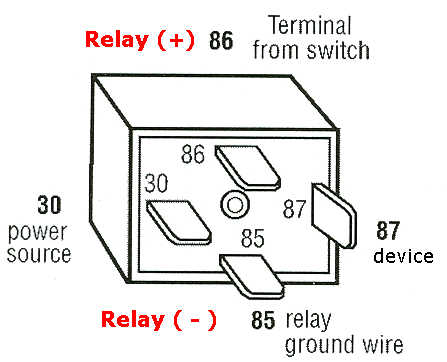
Existing cable that currently (get it) goes to spade terminal on solenoid now goes to 86
Make new cable (thin) from 85 to good earth
Make new cable (thick) from big (live) terminal on starter solenoid to 30
Make new cable (thick) from 87 to spade terminal on starter solenoid
Job done

Steve_D said:
Pretty much a standard 'Hot Start' mod.
But...as with any hot start mod the damage is already done to the immobiliser. You may get away with it working but the immobiliser relay contacts will be burnt and as a result may have issues trying to pass a low current through dirty/burnt contacts.
I hope it works for you.
Steve
Does this comment apply if the original Meta system has been replaced with an alternative alarm/immobiliser system eg Cobra?But...as with any hot start mod the damage is already done to the immobiliser. You may get away with it working but the immobiliser relay contacts will be burnt and as a result may have issues trying to pass a low current through dirty/burnt contacts.
I hope it works for you.
Steve
OldGermanHeaps said:
Is the wire at the alt fused at source or is your car going up in flames when the rough unprotected wiring to the relay chafes?
No it's not going up in flames, thanks for your input.Edited after Phillpot's helpful suggestion.
Yeah it is a standard hotstart fix, or a standard "putting a relay in the starter solenoid circuit" job.
The principles are obvious, but things such as the mounting and take-offs for the feeds haven't been mentioned before, so the write up does have value.
I think the wiring solutions are better than those utilsed by the footwell kits to be fair.
Edited by jimbo1593 on Monday 20th August 20:17
Edited by jimbo1593 on Monday 20th August 20:30
Edited by jimbo1593 on Monday 20th August 20:31
phillpot said:
Some may be concerned that the new live wire from the alternator is not fused until it gets to the relay  .
.
Should it chaff through the fuse won't help a lot!
This stuff is cheap and handy ..... clicky ...
Fair point, it is a very short run though so I'm not overly concerned. I am sure there are far more chafe prone bit of wiring in the car from the factory, and from aftermarket kits, that are equally unprotected. The aim of my sample fitting was to present a simple solution, with short runs, properly fixed and accessible..Should it chaff through the fuse won't help a lot!
This stuff is cheap and handy ..... clicky ...
jimbo1593 said:
No it's not going up in flames, thanks for your input.
Edited after Phillpot's helpful suggestion.
Yeah it is a standard hotstart fix, or a standard "putting a relay in the starter solenoid circuit" job.
The principles are obvious, but things such as the mounting and take-offs for the feeds haven't been mentioned before, so the write up does have value.
I think the wiring solutions are better than those utilsed by the footwell kits to be fair.
It is going up in flames when that wire shorts, trust me.Edited after Phillpot's helpful suggestion.
Yeah it is a standard hotstart fix, or a standard "putting a relay in the starter solenoid circuit" job.
The principles are obvious, but things such as the mounting and take-offs for the feeds haven't been mentioned before, so the write up does have value.
I think the wiring solutions are better than those utilsed by the footwell kits to be fair.
Edited by jimbo1593 on Monday 20th August 20:17
Edited by jimbo1593 on Monday 20th August 20:30
Edited by jimbo1593 on Monday 20th August 20:31
By all means do what you like but dont parade it to others as a solution, as it is a dangerous bodge, which with just a few pence worth of fuse holder and conduit added would be a safe viable solution to the problem, but as it sits, hell no.
Only last weekend I ripped yet another one of those nasty Modwise hot start kits out of another Chimaera that was presenting the classic starting issues these cars are so famous for, the hot start kit didn't help that car start more reliably any more than it serves to properly solve the problem on any other Chimaera. This is because I fear it's creator never really grasped the most common underlying reason for the fault, more worryingly people are still buying this kit thinking it's the be all and end all answer to all their starting woes when they really should be encouraged to take a proper holistic approach to understanding the true cause of their issue.
The correct approach to automotive diagnostics is no different to medical diagnosis, first you need to fully understand how a system works then and only through a series of logical tests can the true cause of the problem be identified, confirmed and so addressed correctly. One should never make assumptions, just as you wouldn't want your doctor assuming you had lung cancer and sending you for treatment simply because you are complaining of a persistent cough, you shouldn't assume your starting issue is down to a poor current supply to the starter solenoid simply because TVR never fitted a dedicated relay in that circuit. There are many components in the starting circuit so all must be tested, and you need to accept it may not be just one element causing the issue either, indeed it's very common to find a number issues that need addressing.
To the best of my knowledge at no point when you purchase this rather poorly constructed loom of wires that incorporates an odd little micro relay are you encouraged to make some proper basic tests on the complete starter circuit and it's components first, the kit is simply sold as some sort of magic cure all which it most certainly isn't. Another thing people should think about before they fit the Modwise hot start kit as it inevitably adds another point of failure, the quality of the wiring is poor and the micro relay used isn't something you will find in a motor factors or in the back of an RAC van, if it fails you're effectively screwed so best to rip it out.
The Chimaera I looked at recently actually had two faults each contributing to it's long standing starting issues, I was able to prove this before setting about fixing the car. I was also able to prove the hot start kit was doing absolutely nothing to help so it was removed and immediately went in my museum of horrors. The first issue was our old friend the immobiliser or more accurately the way TVR wired it, I didn't assume it was the immobiliser I tested it with my multimeter to prove the point, temporarily bypassing it on the starter circuit gave me a very definite click from the starter solenoid that was conspicuous by it's absence with hot start kit fitted and the circuit still running through the immobiliser.
The new strong click from the solenoid was clearly a significant step forward but reliable starting was still elusive, so the starter motor was tested, removed and inspected, my point is each of the two faults needed addressing to effect a full and permanent fix. The starter in question was clearly the original Bosch unit with a cheap aftermarket solenoid added to it, why people try to save money like this when a brand new starter motor complete with solenoid can be purchased for just £65 is beyond me?
So with the immobiliser bypassed on the starter circuit and a new £65 starter motor fitted the car was finally starting reliably, the bypass alone helped as proven by the new strong click from the starter solenoid but it needed a new starter motor too, the one thing that didn't help a jot was the hot start kit that ironically is being sold as the very solution to such problems. I did all this with my own Chimaera some five years ago with the addition of a new heavier gauge starter cable and a direct heavy gauge earth from the battery to the engine block, suffice to say I have never had a single starting issue since.
What I didn't do all those years ago was fit a hot start kit or even a regular relay, indeed the car still doesn't have a relay to this day and quite clearly doesn't need one either. At this point it's important to understand while it is automotive wiring best practice to fit a relay in the starter circuit nearly every car from the 50's and 60's never had such a relay, but by the 70's the use of a relay in the starter circuit had become common place. This use of a relay actually has nothing to do with supplying more amps to the starter solenoid, it's there to protect the contacts in your ignition switch and so to extend it's working life.
TVR never fitted a relay, either because they were saving money or they were simply stuck in a 1960's way of thinking, as it turns out the whole 'no relay' thing is a bit of a red herring anyway because the the contacts in the Vauxhall Cavalier ignition switch used by TVR seem to survive very well with without one. Like most Chimaeras out there my ignition switch is the original, it's given 22 years of service and is showing no signs of giving up anytime soon. With the Meta immobiliser bypassed on the starter circuit my starter motor solenoid is now getting all the amps it could ever need so I see absolutely no need to add another potential point of failure in the form of a relay as quite simply I've completely proved it's just not needed.
The correct approach to automotive diagnostics is no different to medical diagnosis, first you need to fully understand how a system works then and only through a series of logical tests can the true cause of the problem be identified, confirmed and so addressed correctly. One should never make assumptions, just as you wouldn't want your doctor assuming you had lung cancer and sending you for treatment simply because you are complaining of a persistent cough, you shouldn't assume your starting issue is down to a poor current supply to the starter solenoid simply because TVR never fitted a dedicated relay in that circuit. There are many components in the starting circuit so all must be tested, and you need to accept it may not be just one element causing the issue either, indeed it's very common to find a number issues that need addressing.
To the best of my knowledge at no point when you purchase this rather poorly constructed loom of wires that incorporates an odd little micro relay are you encouraged to make some proper basic tests on the complete starter circuit and it's components first, the kit is simply sold as some sort of magic cure all which it most certainly isn't. Another thing people should think about before they fit the Modwise hot start kit as it inevitably adds another point of failure, the quality of the wiring is poor and the micro relay used isn't something you will find in a motor factors or in the back of an RAC van, if it fails you're effectively screwed so best to rip it out.
The Chimaera I looked at recently actually had two faults each contributing to it's long standing starting issues, I was able to prove this before setting about fixing the car. I was also able to prove the hot start kit was doing absolutely nothing to help so it was removed and immediately went in my museum of horrors. The first issue was our old friend the immobiliser or more accurately the way TVR wired it, I didn't assume it was the immobiliser I tested it with my multimeter to prove the point, temporarily bypassing it on the starter circuit gave me a very definite click from the starter solenoid that was conspicuous by it's absence with hot start kit fitted and the circuit still running through the immobiliser.
The new strong click from the solenoid was clearly a significant step forward but reliable starting was still elusive, so the starter motor was tested, removed and inspected, my point is each of the two faults needed addressing to effect a full and permanent fix. The starter in question was clearly the original Bosch unit with a cheap aftermarket solenoid added to it, why people try to save money like this when a brand new starter motor complete with solenoid can be purchased for just £65 is beyond me?
So with the immobiliser bypassed on the starter circuit and a new £65 starter motor fitted the car was finally starting reliably, the bypass alone helped as proven by the new strong click from the starter solenoid but it needed a new starter motor too, the one thing that didn't help a jot was the hot start kit that ironically is being sold as the very solution to such problems. I did all this with my own Chimaera some five years ago with the addition of a new heavier gauge starter cable and a direct heavy gauge earth from the battery to the engine block, suffice to say I have never had a single starting issue since.
What I didn't do all those years ago was fit a hot start kit or even a regular relay, indeed the car still doesn't have a relay to this day and quite clearly doesn't need one either. At this point it's important to understand while it is automotive wiring best practice to fit a relay in the starter circuit nearly every car from the 50's and 60's never had such a relay, but by the 70's the use of a relay in the starter circuit had become common place. This use of a relay actually has nothing to do with supplying more amps to the starter solenoid, it's there to protect the contacts in your ignition switch and so to extend it's working life.
TVR never fitted a relay, either because they were saving money or they were simply stuck in a 1960's way of thinking, as it turns out the whole 'no relay' thing is a bit of a red herring anyway because the the contacts in the Vauxhall Cavalier ignition switch used by TVR seem to survive very well with without one. Like most Chimaeras out there my ignition switch is the original, it's given 22 years of service and is showing no signs of giving up anytime soon. With the Meta immobiliser bypassed on the starter circuit my starter motor solenoid is now getting all the amps it could ever need so I see absolutely no need to add another potential point of failure in the form of a relay as quite simply I've completely proved it's just not needed.
That’s good then as I effectively have a similar set up as in beefier cables to the starter and immobiliser has been put out of the equation.
I’ve often wondered if I should add a relay to save the ignition switch so now that's another little question mark I can tick off.
The added benefit is it turns the starter hot or cold at good speed, engine fires rapidly so saving my battery a lot of work.
It used to turn slower when it was hot after a long run then parked for a short time so the thicker cable is well worth adding.
It’s worked for me.
I’ve often wondered if I should add a relay to save the ignition switch so now that's another little question mark I can tick off.
The added benefit is it turns the starter hot or cold at good speed, engine fires rapidly so saving my battery a lot of work.
It used to turn slower when it was hot after a long run then parked for a short time so the thicker cable is well worth adding.
It’s worked for me.

It's like this:
1. The starter solenoid and ECU circuits both pass through the immobiliser which is nothing more complex than a switch you turn on & off with the IR fob. Potted deep inside the Meta system there are two little switching relays, one higher amp relay Meta intended for the higher amp starter solenoid circuit, and one lower amp relay intended for the lower amp ECU circuit. Basically TVR wired these two circuits back to front running the low amp ECU circuit through the higher amp Meta relay and the higher amp starter solenoid circuit through the lower amp Meta relay which consequently has a hard life leading to intermittent failure of the relay and so unreliable starting. As we know resistance in any electrical circuit increases with heat, so it should surprise no one the problem usually first starts to raise it's ugly head when the car is hot, hot restarts after stopping at a petrol station to fill with fuel are when it usually strikes.
Ideally you'd get inside the Meta system and replace the problematic relay then correct TVR's wiring mistake by switching the circuits to run through their respective and correctly rated relay, the problem with this is the little switching relays are potted deep inside the Meta system so replacement of one or both of these relays is not really practical. The option for owners suffering the Meta system internal relay failure problem is either to replace the entire system which is expensive but by far the best approach, or to bypass the system on the problematic starter solenoid circuit which is a free solution that completely solves the problem and as the ECU is still being switched by the Meta system still leaves the car secure.
If anyone wants to complete the bypass themselves I have developed a set of easy to follow step by step instructions with supporting photos to help, anyone who needs these instructions should PM me and I will send them by return. On occasion where owners are local to me and not confident to complete the bypass themselves I will complete it for them for a small fee, typically when I do so I will uncover earlier attempts by the owner, previous owner, or so called TVR specialist to fix the problem. Very often I am presented with a car with the starting problem that has already received the Modwise hot start kit, often the owner is confused why his starting problems returned after fitting this kit, hopefully the above clearly explains why. Unfortunately fitting a Modwise hot start kit can never undo existing damage to the little overloaded relay potted deep inside the Meta system which was originally caused by TVR's inability to wire the system correctly in the first place.
IMPORTANT - AT THIS POINT PEOPLE SHOULD NEVER ASSUME THEIR STARTING ISSUE IS JUST THIS COMMON META RELAY FAULT - IT MAY OR MAY NOT BE THE PROBLEM - OFTEN THE STARTING FAULT IS CAUSED BY A COMBINATION OF ISSUES ALL OF WHICH NEED ADDRESSING AS A PACKAGE OF FIXES TO FINALLY DELIVER A RELIABLE STARTING CAR
2. The starter motor has a very hard life in a Chimaera/Griffith due to being subjected to excessive heat from the exhaust manifolds, the starter motor needs testing and replacing if the tests show its not operating to full efficiency. This needn't be expensive, the last starter motor I fitted cost the owner £65 and it worked perfectly.
3. The starter cable that runs from the passenger footwell to the starter motor on the driver's side of the engine block demands a rather long run, as we know resistance increases in a cable the longer it is and and as already covered that resistance increases even more when that cable gets hot. TVR draped the cable over the bell housing where it sits trapped between the back of the engine and the insulated bulkhead where there's little or no airflow, TVR also cut costs by using a poor quality cable of an insufficient gauge. Over the years this string thin cable suffers literally thousands of hot/cold heat cycles which promotes internal corrosion and so ever greater resistance, replacing this cable is therefore a very good idea as it was only just adequate when new and given the age of the cars most are some 20 years old now.
4. Any electrical circuit is a flow of electrons that must flow from the power source (the battery) and back to it to create the completed circuit, clearly therefore there's little point in improving the live supply part of this circuit if you're not going to address the earth return too. Adding an additional earth from a stout bolt on the engine block using the same heavy gauge cable used for the starter cable and taking it directly back to the battery negative terminal completes the circuit and dramatically reduces resistance in the whole circuit. By far the highest amp draw on the car is the starter motor so getting that engine block end of this additional earth cable as close the starter motor makes good sense, therefore the best stout bold on the engine block to attach your additional earth cable to is the lower starter motor mounting bolt.
Now we understand the real reasons for the so called hot start fault we can follow the above four points and implement the improvements/solutions covered. The key point I cant stress strongly enough is each element should be tested to conclusively prove where the fault or faults lie, people also need to accept it's very common to find more than one issue so a proper fix often actually involves a package of solutions not just one.
You may have noticed at no point have I discussed the mythical need for splicing in another relay (the hot start kit) or the OP's solution covered in this post, this is because quite simply the car does not need another relay. Indeed adding one can in some cases temporarily take a little load off the failing Meta internal relay which tends to lull people into thinking they have fixed the issue, which they most certainly have not. The Modwise hot start kit is not only poorly constructed but it is also unnecessary and can give the TVR owner fitting one a feeling they have fixed something when they most definitely haven't. This is why so many of the TVRs I am presented with that have starting issues also have had the nasty Modwise hot start kit fitted at some point previously, if it worked these cars would be starting perfectly not being presented to me with continual starting issues.
If people have the hot start kit fitted on their car I would encourage the owner to study the four points in the above post to understand the true common faults these cars exhibit, I would encourage them to complete some basic tests with their multimeter to identify where their starting issue really resides. I would then encourage the owner to address the real fault or faults as described and to remove the nasty Modwise hot start kit with its hard to source micro relay as I can assure you it is not helping anything and only represents more wiring mess hanging precariously in the passenger footwell and is nothing more than adding another point of potential failure.
1. The starter solenoid and ECU circuits both pass through the immobiliser which is nothing more complex than a switch you turn on & off with the IR fob. Potted deep inside the Meta system there are two little switching relays, one higher amp relay Meta intended for the higher amp starter solenoid circuit, and one lower amp relay intended for the lower amp ECU circuit. Basically TVR wired these two circuits back to front running the low amp ECU circuit through the higher amp Meta relay and the higher amp starter solenoid circuit through the lower amp Meta relay which consequently has a hard life leading to intermittent failure of the relay and so unreliable starting. As we know resistance in any electrical circuit increases with heat, so it should surprise no one the problem usually first starts to raise it's ugly head when the car is hot, hot restarts after stopping at a petrol station to fill with fuel are when it usually strikes.
Ideally you'd get inside the Meta system and replace the problematic relay then correct TVR's wiring mistake by switching the circuits to run through their respective and correctly rated relay, the problem with this is the little switching relays are potted deep inside the Meta system so replacement of one or both of these relays is not really practical. The option for owners suffering the Meta system internal relay failure problem is either to replace the entire system which is expensive but by far the best approach, or to bypass the system on the problematic starter solenoid circuit which is a free solution that completely solves the problem and as the ECU is still being switched by the Meta system still leaves the car secure.
If anyone wants to complete the bypass themselves I have developed a set of easy to follow step by step instructions with supporting photos to help, anyone who needs these instructions should PM me and I will send them by return. On occasion where owners are local to me and not confident to complete the bypass themselves I will complete it for them for a small fee, typically when I do so I will uncover earlier attempts by the owner, previous owner, or so called TVR specialist to fix the problem. Very often I am presented with a car with the starting problem that has already received the Modwise hot start kit, often the owner is confused why his starting problems returned after fitting this kit, hopefully the above clearly explains why. Unfortunately fitting a Modwise hot start kit can never undo existing damage to the little overloaded relay potted deep inside the Meta system which was originally caused by TVR's inability to wire the system correctly in the first place.
IMPORTANT - AT THIS POINT PEOPLE SHOULD NEVER ASSUME THEIR STARTING ISSUE IS JUST THIS COMMON META RELAY FAULT - IT MAY OR MAY NOT BE THE PROBLEM - OFTEN THE STARTING FAULT IS CAUSED BY A COMBINATION OF ISSUES ALL OF WHICH NEED ADDRESSING AS A PACKAGE OF FIXES TO FINALLY DELIVER A RELIABLE STARTING CAR
2. The starter motor has a very hard life in a Chimaera/Griffith due to being subjected to excessive heat from the exhaust manifolds, the starter motor needs testing and replacing if the tests show its not operating to full efficiency. This needn't be expensive, the last starter motor I fitted cost the owner £65 and it worked perfectly.
3. The starter cable that runs from the passenger footwell to the starter motor on the driver's side of the engine block demands a rather long run, as we know resistance increases in a cable the longer it is and and as already covered that resistance increases even more when that cable gets hot. TVR draped the cable over the bell housing where it sits trapped between the back of the engine and the insulated bulkhead where there's little or no airflow, TVR also cut costs by using a poor quality cable of an insufficient gauge. Over the years this string thin cable suffers literally thousands of hot/cold heat cycles which promotes internal corrosion and so ever greater resistance, replacing this cable is therefore a very good idea as it was only just adequate when new and given the age of the cars most are some 20 years old now.
4. Any electrical circuit is a flow of electrons that must flow from the power source (the battery) and back to it to create the completed circuit, clearly therefore there's little point in improving the live supply part of this circuit if you're not going to address the earth return too. Adding an additional earth from a stout bolt on the engine block using the same heavy gauge cable used for the starter cable and taking it directly back to the battery negative terminal completes the circuit and dramatically reduces resistance in the whole circuit. By far the highest amp draw on the car is the starter motor so getting that engine block end of this additional earth cable as close the starter motor makes good sense, therefore the best stout bold on the engine block to attach your additional earth cable to is the lower starter motor mounting bolt.
Now we understand the real reasons for the so called hot start fault we can follow the above four points and implement the improvements/solutions covered. The key point I cant stress strongly enough is each element should be tested to conclusively prove where the fault or faults lie, people also need to accept it's very common to find more than one issue so a proper fix often actually involves a package of solutions not just one.
You may have noticed at no point have I discussed the mythical need for splicing in another relay (the hot start kit) or the OP's solution covered in this post, this is because quite simply the car does not need another relay. Indeed adding one can in some cases temporarily take a little load off the failing Meta internal relay which tends to lull people into thinking they have fixed the issue, which they most certainly have not. The Modwise hot start kit is not only poorly constructed but it is also unnecessary and can give the TVR owner fitting one a feeling they have fixed something when they most definitely haven't. This is why so many of the TVRs I am presented with that have starting issues also have had the nasty Modwise hot start kit fitted at some point previously, if it worked these cars would be starting perfectly not being presented to me with continual starting issues.
If people have the hot start kit fitted on their car I would encourage the owner to study the four points in the above post to understand the true common faults these cars exhibit, I would encourage them to complete some basic tests with their multimeter to identify where their starting issue really resides. I would then encourage the owner to address the real fault or faults as described and to remove the nasty Modwise hot start kit with its hard to source micro relay as I can assure you it is not helping anything and only represents more wiring mess hanging precariously in the passenger footwell and is nothing more than adding another point of potential failure.
- Complete your tests with your multimeter
- Locate and identify the real source, or more likely sources of the problem
- Based on the results of your tests effect a proper repair, or more likely repairs as outlined above
- Rip out that nasty and unnecessary Modwise hot start kit
Gassing Station | Chimaera | Top of Page | What's New | My Stuff