
Brake Hard Line Replacement - Alternate Routing on E46
Discussion


Greetings from across the pond! Forum searches suggest that you blokes have much more experience with this problem than we do in the States.
I have a corroded stuck rear brake pipe nut, where the hard line connects to the rubber (flexi) hose, on the driver's (left) side of a 2000 323iT (M52TU USA). The pipe has some surface corrosion but nothing scary. The right-side nut did come off after a couple hours of penetrating oil. Its threads had light corrosion reaching a centimeter down the nut.
Given the age of the car and intention to use for many more years, I am planning to either A) replace the whole line(s) with the BMW OE part, or B) or use cupro-nickel line to replace the whole lines or segments.
Numerous posts in this forum mention an alternate routing of the pipes that avoid going over the gas tank. Could anyone provide more detail on this routing and if new bracket/mounts must be added on?
Suggestions of good flaring tool that works well where the pipe is still on the car would also be appreciated.
Cheers!
If you use copper pipe you can route the pipe over the tank. Run the new pipe from the back all the way to the master cylinder/abs unit.
No need to remove the tank, just lower it down to rest on the prop. You don’t even have to remove the pipe brackets. Also remove the rear seat base and fuel level sender access panel to route the new brake line/s.
I use one of these:
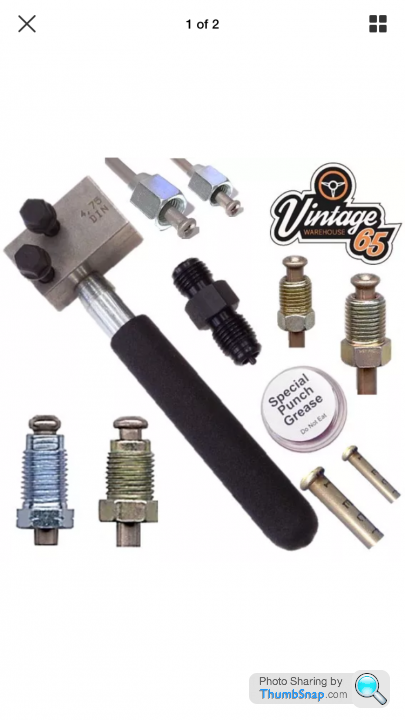
I haven’t tried it for flaring flaring steel pipe. Works a treat on copper pipe:

No need to remove the tank, just lower it down to rest on the prop. You don’t even have to remove the pipe brackets. Also remove the rear seat base and fuel level sender access panel to route the new brake line/s.
I use one of these:
I haven’t tried it for flaring flaring steel pipe. Works a treat on copper pipe:
Quite possible to run a new hard line without dropping the tank entirely as Helix has said.
I actually replaced the hard line with copper lines from the pump to before the tank and ran full braided lines up and over the tank and to each rear caliper using the existing brackets.
I prefer the flexibility of the braided lines as I was quite sick of corroding union joints.
I actually replaced the hard line with copper lines from the pump to before the tank and ran full braided lines up and over the tank and to each rear caliper using the existing brackets.
I prefer the flexibility of the braided lines as I was quite sick of corroding union joints.
I had my rear brake pipes replaced with copper last year on my Z4, which has pretty similar architecture to an E46.
The guy who did the job said the reason dealers (and anyone who uses the standard pipes) needs to drop the fuel tank is because the OEM ones are pre-formed so you can't thread the Offside Rear one through the clips between the tank and the rear bulkhead unless you drop the tank.
But with copper you can thread it through the clips then flare the end afterwards. It only cost me £100 - very happy with that!
No advisories on the MOT test this year (MOT is a compulsory annual roadworthiness examination in the UK).
You just need to find someone competent to do it.
Kupro also known as Kunnifer copper nickle pipe is superior to plain copper. It will not fatigue as copper can and is more corrosion resistant. It is also only marginally more expensive than copper as well.
As for flaring, the tool pictured above is very good, known as a powerhand here in the UK.
As for flaring, the tool pictured above is very good, known as a powerhand here in the UK.
Very good of you all to respond so quickly and on a Friday night! And thanks for the clarifying and encouraging details. I am trying to map this work out well so as to reduce time spent in discovery during the repair. I will followup in turn with a summary work plan, and eventually, hopefully, a review of the completed work. I'll be inspecting the car this weekend to specifically assess the condition of things (including the fuel lines) and the accessibility. (That routing from the ABS down looks challenging). Mike
colin_p said:
Kupro also known as Kunnifer copper nickle pipe is superior to plain copper. It will not fatigue as copper can and is more corrosion resistant. It is also only marginally more expensive than copper as well.
As for flaring, the tool pictured above is very good, known as a powerhand here in the UK.
agree...i dont know why folk still buy copper its no saving at all reallyAs for flaring, the tool pictured above is very good, known as a powerhand here in the UK.
Apologies for the delayed response, the forum has not been accepting posts from new members intermittently, due to abuse.
I got to spend some some quality time under the car this week-end (a 2000 323i M52tu USA). The corrosion is rear of the tank, as typical.
The right-side pipe (OSR) crossing over the subframe and its intermediate joint there is the worst. I was able to free the nut at the hose though to replace that hose.
It is the frozen left-side (NSR) pipe-to-hose joint that prompted this project.
Following the advice here and other PistonHead threads, I will replace the NSR OE steel pipe using copper-nickel alloy. Steps are:
PREP
- Practice flaring brake pipe using one-handed tool (Powerhand type) for on-car work,
- Prepare cupro pipe with one (1) flared end with nut in place, correctly oriented (!),
- Raise the car up on jack stands,
- Spray penetrating oil on the join nuts and line-clips,
- Depress brake pedal to engagement point to reduce fluid loss,
- Lower the almost-empty fuel tank to rest on the prop shaft (3 bolts),
- Open the fuel sender access panel of the interior seat base (NS),
REMOVE
- Hacksaw OE pipe at hose-joint and after fuel-tank before bends,
- Catch fluid drips, plug pipe, and use brake-cleaner to prevent contamination,
- Undo the accessible pipe-clips on under-body run,
- Unscrew the OE-pipe from the "front-joint" (behind the engine),
- Plug the retained upper OE-pipe (leading to the ABS),
- Catch fluid draining from the front pipe end, then plug
- Drain remaining fluid from both pipe ends,
- Plug by inserted foam-ear-plug won't be caught up when pulling through the pipe-clips,
- Pull old-pipe forward, working through fuel-sender portal to pull up over tank,
REPLACE
- Snake unflared rear end of pipe up by fuel tank,
- Threading pipe through existing clips working through fuel-sender access,
- Place front section of pipe loosely in clips under body,
- Join flared end at the front-joint,
- Bend pipe to fit by hand or mini-tool and secure clips,
- Bend pipe around tank and to hose-bracket,
- Flare pipe end with nut in place correctly oriented (!),
- Screw new hose to caliper,
- Screw pipe to hose,
- Reinstall fuel tank and access panel,
BLEED
- Disengage brake,
- Fill, flush and bleed system with pressurized tool (eg. Motive Powerbleeder),
- Inspect for leaks,
- Test drive and activate ABS by braking on slippery surface,
- Bleed again,
- Optional final bleed by pumping brake pedal, but careful not to depress fully!
NOTES & QUESTIONS
I'm aiming for that front-joint rather than all the way to the ABS because the route from the ABS (on right OS) crossing left behind the engine to above the fuel filter, looks a pain to get through. No?
That front-joint (intermediate piece) is above the left (NS) FCAB, behind the motor mount, slightly off of the body, before the fuel filter. Should have to tried to see if I could get two hands and wrenches up to it! (And some penetrating oil).
Those nuts (L&R) have light surface corrosion, but not expecting thread corrosion. (?)
I considered making a join with the OE pipe under the body (as others have done) but am wondering if cutting and flaring the OE steel pipe might be a challenge in-situ if I cannot obtain a good flaring tool?
A tech here warned of brake fluid mess when working with (cutting and flaring) the existing pipe.
My schedule is tight, so the plan is to limit the work for now to just replacing the left-rear NSR pipe+hose. There are also fresh calipers (remfr) to install.
Would be ideal to replace that rear-right (OSR) pipe also. Using single piece from the front-joint to the hose-joint, eliminating the intermediate joint by the subframe. But getting the pipe through the (2) brackets in the tight space above the subframe looks like a pain and time cost. No?
Mr Tidy says to "thread" the unflared pipe end through the clips. Which I take to mean that the clips don't have to be undone (like in the tight space around the tank and above the subframe). Yes?
Sim89's use of a long braided line from the caliper and over the tank is clever. I've found specialists online that make custom hoses. But I haven't priced them. This would require cutting and flaring the OE steel line.
Seems like most of the bending will be done in-place then by hand? (Helix402's install looks very smooth).
I saw an (untested) suggestion to protect the clean joins with body wax.
Useful clarification regarding copper vs Kupro/Kunnifer. I had assumed that the references to "copper" actually meant copper alloy, but see that copper is actually also still used.
Thanks again for your comments. I will eventually add some pictures to this post (if allowed ;-).
Mike
A few tips;
1, Run the whole pipe run.
2, Flare and fix the most difficult end first, normally at ABS pump or master cylinder.
3, Then concentrate making the bends and accurately forming the route.
4, Flare and fix the remaining end
Also take into consideration;
You do not have to form very tight bends and exactly follow factory lines.
It is also best to have a large gentle curve as you approach the final flare point, reason being, if you make a mistake, you have enough pipe to have another try.
Saying that, I've used one of those power hand tools many times and have always got perfect flares.
Oh, and don't forget, as you have already mentioned to thread the nut over the pipe in the correct orientation before you flare the end!
So, the routing from the ABS down behind the engine (and the clips back there) is not a problem? I do note that the typical advice is to start there. And Helix's pic shows it nicely done.
Guess I need to remove the cabin-airfilter out of the way to have a better look down the firewall.
And perhaps I'm overthinking the difficulty of routing the OSR crossover pipe over the subframe, as I've seen no posts warning off on that either.
Guess I need to remove the cabin-airfilter out of the way to have a better look down the firewall.
And perhaps I'm overthinking the difficulty of routing the OSR crossover pipe over the subframe, as I've seen no posts warning off on that either.
Edited by Corvis on Tuesday 28th August 18:12
Gassing Station | BMW General | Top of Page | What's New | My Stuff