
George V damaged own decks during firing on Bismark?
Discussion


Hi,
I was reading an obituary of a naval officer who had served on George V during the battle to sink the Bismark. The article suggested that George V had retired for repairs to the decks caused by firing own her own guns. I was intrigued by this, given how think deck armor was at the time, but some googling and wiki reading hasn't given me anymore detail. I realise that naval guns of this time were very big and fired huge shells with a lot of force, and that George V fired over 300 in the battle, but I can't find anything about deck damage as a result of the firing. Anyone know anything about this? The wiki articles seem to suggest that a number of George V's guns were failing and that this was the reason to withdraw, with the battle effectively already won.
I was reading an obituary of a naval officer who had served on George V during the battle to sink the Bismark. The article suggested that George V had retired for repairs to the decks caused by firing own her own guns. I was intrigued by this, given how think deck armor was at the time, but some googling and wiki reading hasn't given me anymore detail. I realise that naval guns of this time were very big and fired huge shells with a lot of force, and that George V fired over 300 in the battle, but I can't find anything about deck damage as a result of the firing. Anyone know anything about this? The wiki articles seem to suggest that a number of George V's guns were failing and that this was the reason to withdraw, with the battle effectively already won.
wolfracesonic said:
I doubt if the armoured deck would have been damaged but I don't think it was unknown for the wooden deck planking to damaged on capital ships when they fired their main armament.
They would run hoses over the decks, I believe to stop splintering of the wood while firing. No idea of how this works. Dog Star said:
wolfracesonic said:
I doubt if the armoured deck would have been damaged but I don't think it was unknown for the wooden deck planking to damaged on capital ships when they fired their main armament.
They would run hoses over the decks, I believe to stop splintering of the wood while firing. No idea of how this works. 

V8 Fettler said:
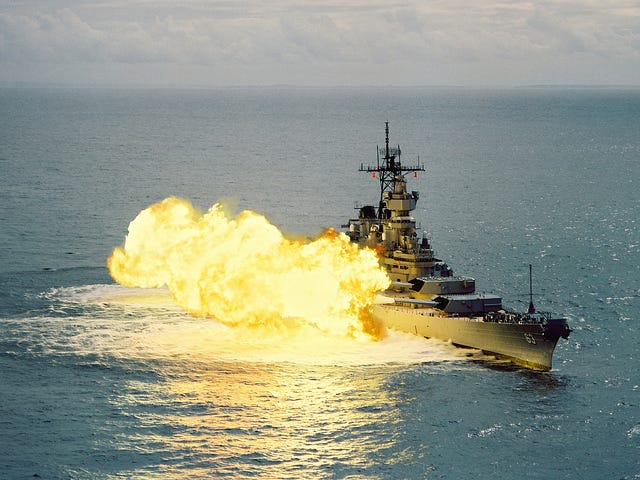
Most UK battleships of WW2 suffered self-inflicted damage when firing full broadsides, none more so than Nelson and Rodney. KGV salvos were lighter
From HMS Rodney: The Famous Ships of the Royal Navy Series. By Ian Ballantyne

Very interesting. Is there more of the article to publish ? From HMS Rodney: The Famous Ships of the Royal Navy Series. By Ian Ballantyne
In a full naval engagement with these big ships did each turret fire at will or was it co-ordinated ? I can’t imagine the stresses on the hull on a four turret simultaneous broadside !
Makes you appreciate the bravery of the crew in these large capital ships. Not only was there incoming HE shells of a similar size and velocity but your own guns where ripping your own ship to bits.
I think there is a bit of artistic licence there... most of Rodneys issues were age related, the additional stress of the battle didn't help.
Battleships/Dreadnoughts were designed to be all Big Gun platforms - whilst the paintwork would suffer the only other areas of issue would probably be the rifles and the loading mechanisms. (Some of the really big rifles only had a service life of c200 rounds...a few really big ones were c75!)
Battleships/Dreadnoughts were designed to be all Big Gun platforms - whilst the paintwork would suffer the only other areas of issue would probably be the rifles and the loading mechanisms. (Some of the really big rifles only had a service life of c200 rounds...a few really big ones were c75!)
BrettMRC said:
I think there is a bit of artistic licence there... most of Rodneys issues were age related, the additional stress of the battle didn't help.
Battleships/Dreadnoughts were designed to be all Big Gun platforms - whilst the paintwork would suffer the only other areas of issue would probably be the rifles and the loading mechanisms. (Some of the really big rifles only had a service life of c200 rounds...a few really big ones were c75!)
The latter probably isn't entirely true.Battleships/Dreadnoughts were designed to be all Big Gun platforms - whilst the paintwork would suffer the only other areas of issue would probably be the rifles and the loading mechanisms. (Some of the really big rifles only had a service life of c200 rounds...a few really big ones were c75!)
Nearly all gun systems will be life limited by Effective Full Charges (EFC). Usually your worst case round is '1'. But lesser rounds might be 0.5 or even .33.
So depending on the projectiles and charges you were firing would depend on how fast you would life the system. Could be 75 rds, could be several times that.
HMS Rodney's ability to damage HMS Rodney was identified during early trials (Ballantyne, again), full broadsides were only unleashed on special occasions e.g. when wrecking the Bismarck.
British Battleships 1919-1945, R A Burt, also refers to Rodney beating herself up when destroying the Bismarck,
Samples of Ballantyne's and Burt's books are available on the internet, better to buy at a reasonable price if available.
British Battleships 1919-1945, R A Burt, also refers to Rodney beating herself up when destroying the Bismarck,
Burt said:
During the action Rodney sustained very little damage from return fire ........ Much more damage was caused by the firing of her own 16" guns and was as follows ...
Burt said:
HACS roll corrector glass fractured. The angle support on 16in guns around inside of armoured ring bulkhead for supporting leather apron was damaged. Brass bolts within the turret broke loose leaving some hanging out of place.Periscopes in A Turret were pulled from securing bolts by blast from B Turret. Various periscopes in both 16in & 6in turrets had hoods so distorted that they were rendered practically useless. The superstructure stood up quite well to the blast of the 16in guns but the upper deck and fittings proved to be a problem and there was a need for extra support and additional stiffening which was carried out during refit as opportunity arose.
Also reference to upper deck being distorted ("depressed") in the wake of the turrets, wood decking lifted, split and blown out of place. Stowage huts, mushroom heads, skylights, breakwater and berthing stanchions broken and distorted. Watertight hatches to the sickbay flat blown open. Deck pillars distorted, girders fractured in several places, bulkheads split and distorted, ventilation trunking split and blown out of place.Samples of Ballantyne's and Burt's books are available on the internet, better to buy at a reasonable price if available.
V41LEY said:
Very interesting. Is there more of the article to publish ?
In a full naval engagement with these big ships did each turret fire at will or was it co-ordinated ? I can’t imagine the stresses on the hull on a four turret simultaneous broadside !
In principle they will fire together under the common fire director system - a simultaneous broadside is vastly more effective than individual turrets/guns firing independently. Obviously this is only possible when all guns can bear on the target.In a full naval engagement with these big ships did each turret fire at will or was it co-ordinated ? I can’t imagine the stresses on the hull on a four turret simultaneous broadside !
You will frequently read about capital ships moving sideways in the water when firing broadsides.
aeropilot said:
tertius said:
You will frequently read about capital ships moving sideways in the water when firing broadsides.
Old technology at its very best.....
Mark 7 16" gun, fires an 850kg shell down a 20m long barrel, and that shell leaves the barrel at 820m/s.
If we assume the recoil only occurs whilst the shell is in the barrel (not true, but most of it does) and that the shell accelerates linearly down the barrel (again, not true, but ok for the purposes of this calc) then the recoil force on the barrel averages 14,288 kN over the 4.8ms it takes for the shell to leave.
USS Iowa has 9 mark7 guns fitted, so total recoil force is 128 MN. The Iowa has a mass of roughly 55,000 tones, so during the firing event, assuming no energy is lost (ie by recoil arresters etc) and the ship doesn't roll (which it will because the guns fire from above the CofG) then the ship will accelerate away from the broadside at 2.25 m/s/s, and reach a speed of 0.11 m/s.
Given a hull form is pretty draggy going sideways, and allowing for the other loss factors mentioned, then i'd be surprised if the ship was more than 1m away from where it started 10 sec after firing the broadside! I suspect the real world effect is actually due to roll, and when firing with the ship under way, that roll results in the hull turning away from the blast......
Edited by anonymous-user on Tuesday 1st January 13:36
Max_Torque said:
Ok, if my maths is correct (all data from wikipedia):
Mark 7 16" gun, fires an 850kg shell down a 20m long barrel, and that shell leaves the barrel at 820m/s.
If we assume the recoil only occurs whilst the shell is in the barrel (not true, but most of it does) and that the shell accelerates linearly down the barrel (again, not true, but ok for the purposes of this calc) then the recoil force on the barrel averages 14,288 kN over the 4.8ms it takes for the shell to leave.
USS Iowa has 9 mark7 guns fitted, so total recoil force is 128 MN. The Iowa has a mass of roughly 55,000 tones, so during the firing event, assuming no energy is lost (ie by recoil arresters etc) and the ship doesn't roll (which it will because the guns fire from above the CofG) then the ship will accelerate away from the broadside at 2.25 m/s/s, and reach a speed of 0.11 m/s.
Given a hull form is pretty draggy going sideways, and allowing for the other loss factors mentioned, then i'd be surprised if the ship was more than 1m away from where it started 10 sec after firing the broadside! I suspect the real world effect is actually due to roll, and when firing with the ship under way, that roll results in the hull turning away from the blast......
I’d guess that your final comment is probably true but do remember: a) I was referring to what has been written and reported and b) by “capital ships” I meant everything from Nelsonian wooden line of battle ships up to more modern US battleships - so an 18th century 74 would have only displaced 2-3,000 tons (though with much smaller guns of course) but a more likely example might be a WW1 QE class dreadnought - c. 30,000 tons and eight 15 in guns.Mark 7 16" gun, fires an 850kg shell down a 20m long barrel, and that shell leaves the barrel at 820m/s.
If we assume the recoil only occurs whilst the shell is in the barrel (not true, but most of it does) and that the shell accelerates linearly down the barrel (again, not true, but ok for the purposes of this calc) then the recoil force on the barrel averages 14,288 kN over the 4.8ms it takes for the shell to leave.
USS Iowa has 9 mark7 guns fitted, so total recoil force is 128 MN. The Iowa has a mass of roughly 55,000 tones, so during the firing event, assuming no energy is lost (ie by recoil arresters etc) and the ship doesn't roll (which it will because the guns fire from above the CofG) then the ship will accelerate away from the broadside at 2.25 m/s/s, and reach a speed of 0.11 m/s.
Given a hull form is pretty draggy going sideways, and allowing for the other loss factors mentioned, then i'd be surprised if the ship was more than 1m away from where it started 10 sec after firing the broadside! I suspect the real world effect is actually due to roll, and when firing with the ship under way, that roll results in the hull turning away from the blast......
Edited by Max_Torque on Tuesday 1st January 13:36
Gassing Station | Boats, Planes & Trains | Top of Page | What's New | My Stuff