
Torque Multiplier Sanity Check
Discussion


I have just purchased a Torque Multiplier from Sealy tools and this is my first attempt at using it. Could some good soul please confirm my methodology.
Nut tightness required = 362 Ib/ft
Multipier torque ratio 1:3.3
Torque wrench setting therefore 110 Ib/ft
Giving output torque of 363 Ib/ft (close enough for me)
Picture shows Multipier, prevented from rotating by Axle Stand, Torque Wrench and Breaker, to prevent Hub turning.
Wheel spacer is in place to protect wheel studs and is sacrificial.
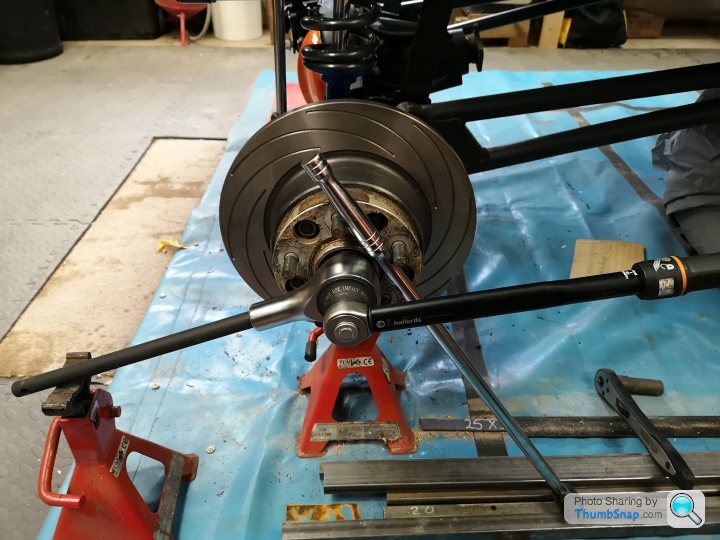
Cheers
Nut tightness required = 362 Ib/ft
Multipier torque ratio 1:3.3
Torque wrench setting therefore 110 Ib/ft
Giving output torque of 363 Ib/ft (close enough for me)
Picture shows Multipier, prevented from rotating by Axle Stand, Torque Wrench and Breaker, to prevent Hub turning.
Wheel spacer is in place to protect wheel studs and is sacrificial.
Cheers
Your maths seems fine. With that sort of torque I really wouldn't use a breaker bar directly against the screw threads of the wheel studs. It'll crunch them up. Wind a couple of wheel nuts on first and brace against those. I would also have thought the multiplier needs to be braced in the same direction as the torque wrench is pushing.
Edited by Mignon on Monday 11th February 15:51
Mignon said:
Your maths seems fine. With that sort of torque I really wouldn't use a breaker bar directly against the screw threads of the wheel studs. It'll crunch them up. I would also have thought the multiplier needs to be braced in the same direction as the torque wrench is pushing.
The multiplier always wants to turn in the opposite direction to the torque wrench. There'll be quite a lot of force lifting the hub up so be prepared for that.The studs are a good point though, it might be better to get an assistant to push the brake pedal down firmly rather than risk wrecking a wheel spacer though?
Thanks for the tips. The Spacer was in place as a sacrificial part to protect the wheel studs, as mentioned in my OP and indeed the studs on the Spacer were damaged. I couldn't use the brakes as a 'brake' as no callipers, lines or master cylinder are fitted.
All-in-all the Multiplier worked well and a lot cheaper than a BIG BUGGER torque wrench.
All-in-all the Multiplier worked well and a lot cheaper than a BIG BUGGER torque wrench.
Paul.B said:
Thanks for the tips. The Spacer was in place as a sacrificial part to protect the wheel studs, as mentioned in my OP and indeed the studs on the Spacer were damaged. I couldn't use the brakes as a 'brake' as no callipers, lines or master cylinder are fitted.
All-in-all the Multiplier worked well and a lot cheaper than a BIG BUGGER torque wrench.
Duh, of course you couldn't, I didn't pay enough attention to the picture obviously All-in-all the Multiplier worked well and a lot cheaper than a BIG BUGGER torque wrench.

Gassing Station | Home Mechanics | Top of Page | What's New | My Stuff