
Chim won't prime :(
Discussion


I know there's lots of topics about this already and I've tried every solution I've read and can think of but with no success!
I drove out of the garage on Saturday night all fine. Went to start it up 2 hours later and no priming (or starting obviously).
Nothing yesterday and nothing today, however, here's my results from today:
The witchcraft continues. Here's my updated situation after today's shenanigans:
-fuel pump works with a direct feed from a spare battery and via the cigarette lighter socket, so pump works 👍🏻
-voltage across the pump wires is just short of 12v (11.87) when I hit the immobiliser fob AND when cranking, so relays, fuses and wire continuity are good 👍🏻
-Relays have both been tested and read 1 Ohm when deactivated and 0 when activated 👍🏻
-I've had the engine running with the 12v direct feed from the lighter socket to the pump 👍🏻
When I connect the apparently working wires to the apparently working pump - nothing!!!!!
What on earth is going on?
Thanks in advance for any help!
I drove out of the garage on Saturday night all fine. Went to start it up 2 hours later and no priming (or starting obviously).
Nothing yesterday and nothing today, however, here's my results from today:
The witchcraft continues. Here's my updated situation after today's shenanigans:
-fuel pump works with a direct feed from a spare battery and via the cigarette lighter socket, so pump works 👍🏻
-voltage across the pump wires is just short of 12v (11.87) when I hit the immobiliser fob AND when cranking, so relays, fuses and wire continuity are good 👍🏻
-Relays have both been tested and read 1 Ohm when deactivated and 0 when activated 👍🏻
-I've had the engine running with the 12v direct feed from the lighter socket to the pump 👍🏻
When I connect the apparently working wires to the apparently working pump - nothing!!!!!
What on earth is going on?
Thanks in advance for any help!
Sounds like your pump isn't getting enough current from the existing circuitry.
Put an ammeter in the circuit to check what the pump is getting.
If you then put the ammeter in your new direct feed circuit, which you have proven does work, it will tell you the current actually being drawn by the pump, which is what it requires. IIRC it's about probably about 7.5A
Put an ammeter in the circuit to check what the pump is getting.
If you then put the ammeter in your new direct feed circuit, which you have proven does work, it will tell you the current actually being drawn by the pump, which is what it requires. IIRC it's about probably about 7.5A
Edited by sparkythecat on Monday 5th August 20:34
Thanks Sparky.
I'll give that a whirl tomorrow night. If I disconnect the wires from the pump and turn the ignition on, I measure 12v.
If I attach the earth and measure the live I get 12v.
If I connect the live to the pump and measure across the terminals I get 0.5v.
For the sake of a few squid, shall I just put a new pump in?
I'll give that a whirl tomorrow night. If I disconnect the wires from the pump and turn the ignition on, I measure 12v.
If I attach the earth and measure the live I get 12v.
If I connect the live to the pump and measure across the terminals I get 0.5v.
For the sake of a few squid, shall I just put a new pump in?
Thanks Sparky.
I'll give that a whirl tomorrow night. If I disconnect the wires from the pump and turn the ignition on, I measure 12v.
If I attach the earth and measure the live I get 12v.
If I connect the live to the pump and measure across the terminals I get 0.5v.
For the sake of a few squid, shall I just put a new pump in?
I'll give that a whirl tomorrow night. If I disconnect the wires from the pump and turn the ignition on, I measure 12v.
If I attach the earth and measure the live I get 12v.
If I connect the live to the pump and measure across the terminals I get 0.5v.
For the sake of a few squid, shall I just put a new pump in?
From your description and the fact that the pump runs OK from the 12v socket, the pump is working so no need to replace.
The problem as Sparky points out is that while your meter may well read 12volts if the circuit before the pump is high resistance then when a load is connected ( i.e. your pump) the high resistance will prevent enough volts reaching the pump.
This may help:
http://www.bertram-hill.com/fuel-pump-schematic.ht...
As you can see there are several items in the circuit to the pump that could be causing a high resistance, a favourite is the connector behind the passenger seat B post. I would as a first step pull out the plug and give the contacts a good clean.
The problem as Sparky points out is that while your meter may well read 12volts if the circuit before the pump is high resistance then when a load is connected ( i.e. your pump) the high resistance will prevent enough volts reaching the pump.
This may help:
http://www.bertram-hill.com/fuel-pump-schematic.ht...
As you can see there are several items in the circuit to the pump that could be causing a high resistance, a favourite is the connector behind the passenger seat B post. I would as a first step pull out the plug and give the contacts a good clean.
Thanks Belle, I'm on it later. I'm hoping that the fact the voltage jumps up to 12v when I press the fob means that the immobiliser side of things is ok.
Other than a connection problem, is there anything else that could be causing too high a resistance?
The resistance across the pump terminals is 0 when there's no power to it.
Other than a connection problem, is there anything else that could be causing too high a resistance?
The resistance across the pump terminals is 0 when there's no power to it.
phazed said:
I had that a couple of weeks ago.
It transpires that it was the immobiliser. This was a temporary thing and it restarted after about half an hour.
I had the immobiliser renewed and haven’t had a problem since .
This is a classic but immobiliser issues normally first manifest themselves as a 'No Cranking' condition rather than the 'No Fuel Pump' issue the OP describes, fault finding automotive electrics is all about understanding how the system actually works then systematically testing everything until you find the fault.It transpires that it was the immobiliser. This was a temporary thing and it restarted after about half an hour.
I had the immobiliser renewed and haven’t had a problem since .
The Immobiliser & How it Works
Potted deep within the Meta immobiliser there are two switching relays, these are shown at the bottom of this table.
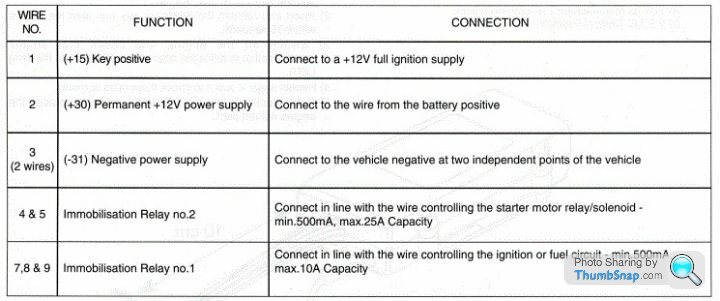
- Relay 1 is rated at 10a and was intended by Meta to switch the low amp immobilised circuit, ie the ECU
- Relay 2 is rated at 25a and was intended by Meta for to switch the high amp immobilised circuit, ie the Starter Motor Solenoid
This can best be demonstrated by following the numbers in the diagram below:

Poor connector blocks, an accidentally tripped inertia switch and a bad connection at the fuel pump ecte ect ect aside, the real reason TVR Chimaeras and Griffits have so many starting issues is that TVR wired the Meta security system incorrectly.
TVR wired the high amp starter solenoid through the low amp 10a relay 1, they then wired the low amp ECU through the higher 25a relay 2. This one simple error was the key reason our cars suffer so many starting issues, and do not get sucked in by the so called 'Hot Start Kit', it's creator did not fully grasp the whole story and the true reason for the fault
What happens over time is the contacts become pitted and burnt inside the 10a relay because these contacts are being forced to switch and carry a higher electrical load than the Meta designers ever intended. These issues often (but not always) first reveal themselves when the car and so it's wiring is hot, because as we all know resistance in a circuit increases with heat.
Over the years both relays will have gone through thousands of switching cycles which Meta designed them to do reliably, however the 10a relay being forced to work outside of its design perimeters is the one that'll give issues first and being just an interrupter switch in the starter motor solenoid circuit the result is the engine fails to crank.
There are many reasons why the starter motor may fail to crank the engine but if you find the problem happens when the car is hot and mysteriously disappears after you've let the car cool you can be fairly certain the issue resides within the immobiliser due to incorrect way TVR wired it.
The way TVR wired the immobiliser means the 25a relay 2 is actually doing a job it is way over specified for, to be clear this relay is an interrupter switch in the ECU circuit not the fuel pump circuit. The ECU is responsible for switching the fuel pump not the immobiliser, the ECU controls the live feed to the fuel pump via the fuel pump relay hanging in the passenger footwell (blue relay socket) and the inertia switch which is also an interrupter switch in the fuel pump circuit.
People get confused because when they disarm the immobiliser they hear the fuel pump, they then understandably assume the immobiliser is controlling the fuel pump. This is not the case, what happens when you disarm the immobiliser is the ECU is enabled and it's the now live ECU that runs the fuel pump for two seconds before witching it off again.
How The ECU Controls The Fuel Pump - And The Importance of a Cranking/Engine Running Signal
This two second run of the fuel pump is to prime the fuel rail in preparation for the start, the reason the ECU switches the fuel pump off again is because you wouldn't want the fuel pump running continuously with the key on as it would drain the cars battery and would not be safe either.
With the ignition still on but the ECU having switched the fuel pump off the ECU will only switch the fuel pump back on when it sees an engine speed signal from the coil, this tells the ECU the engine is cranking/running. So if we study the OP's issue and his confusing tests, and now we know it's unlikely to be an immobiliser issue he should turn his attention to establishing if his ECU is seeing this vital cranking/engine running signal.
At pin 39 on the Lucas 14CUX ECU connector you should find either a white/black or white/blue wire, this is your engine speed signal wire that also includes an inline 6.8KΩ resistor. However before getting involved there you actually just need to establish if the ECU is switching the fuel pump under cranking so just hook your meter up to terminal 86 on the fuel pump relay (blue relay connector) and a known good ground.
Turn the ignition on and your meter should show 12.5v for 2 seconds accompanied by a buzz from the fuel pump, now proceed to cranking the engine and within a second you should again see 12.5v on your meter and the engine should run with the meter holding the 12.5v permanently . You can't really rely on the sound of the fuel pump to run this test, you need a test meter, this is because as soon as the engine is cranking and especially when its running there's so much noise you could never hope to hear the fuel pump.
If you discover the fuel pump becomes live for the first two seconds but not under cranking you should suspect and test the engine speed signal from the coil to pin 39 at the 14CUX ECU connector, if there is nothing at the fuel pump even for the first two seconds you should suspect the ECU is not being switch on in the first place in which case you should suspect and test the immobiliser circuit that passes through Meta relay no 2.
After that if you still can't locate the fault you are just left to test the circuit between the fuel pump relay and the pump itself, this includes the fuel pump fuse, the relay itself, the inertia switch hidden above the elasticated glove pouch, the connector in the loom hidden behind a piece of carpet behind the passenger seat and of course the connectors at fuel pump itself.
Good luck with your fault finding and I hope the above helps?

boylers11 said:
I know there's lots of topics about this already and I've tried every solution I've read and can think of but with no success!
I drove out of the garage on Saturday night all fine. Went to start it up 2 hours later and no priming (or starting obviously).
Nothing yesterday and nothing today, however, here's my results from today:
The witchcraft continues. Here's my updated situation after today's shenanigans:
-fuel pump works with a direct feed from a spare battery and via the cigarette lighter socket, so pump works ????
-voltage across the pump wires is just short of 12v (11.87) when I hit the immobiliser fob AND when cranking, so relays, fuses and wire continuity are good ????
-Relays have both been tested and read 1 Ohm when deactivated and 0 when activated ????
-I've had the engine running with the 12v direct feed from the lighter socket to the pump ????
When I connect the apparently working wires to the apparently working pump - nothing!!!!!
What on earth is going on?
Thanks in advance for any help!
Load the circuit using an indicator bulb or something that draws current multi-meters are a great tool but can be misleading like this just because your test lamp or mutli-meter is seeing 12v dont mean the higher amp drawing pump will, in fact if you have high resistance in the circuit the pump will just pull that voltage down to single figures I drove out of the garage on Saturday night all fine. Went to start it up 2 hours later and no priming (or starting obviously).
Nothing yesterday and nothing today, however, here's my results from today:
The witchcraft continues. Here's my updated situation after today's shenanigans:
-fuel pump works with a direct feed from a spare battery and via the cigarette lighter socket, so pump works ????
-voltage across the pump wires is just short of 12v (11.87) when I hit the immobiliser fob AND when cranking, so relays, fuses and wire continuity are good ????
-Relays have both been tested and read 1 Ohm when deactivated and 0 when activated ????
-I've had the engine running with the 12v direct feed from the lighter socket to the pump ????
When I connect the apparently working wires to the apparently working pump - nothing!!!!!
What on earth is going on?
Thanks in advance for any help!
 and that just wont do , check the terminal blocks in the nearside B pillar behind passenger seat to check integrity of said multi-plugs
 Sardonicus said:
Load the circuit using an indicator bulb or something that draws current multi-meters are a great tool but can be misleading like this just because your test lamp or mutli-meter is seeing 12v dont mean the higher amp drawing pump will, in fact if you have high resistance in the circuit the pump will just pull that voltage down to single figures and that just wont do , check the terminal blocks in the nearside B pillar behind passenger seat to check integrity of said multi-plugs
Good point, a simple test bulb rig is often preferable to a multimeter for the reasons Simon outlines. and that just wont do , check the terminal blocks in the nearside B pillar behind passenger seat to check integrity of said multi-plugs I always carry a bulb holder with bulb and tail loom for this reason, it's the most basic piece of diagnostic equipment I carry but quite possibly the very most useful and effective too. A bulb rig is also extremely helpful when tracing intermittent faults such as the common Chimaera 'Momentary Engine Cut-out' as you drive, wire your bulb rig in a circuit you are suspicious of and go for a drive.
If your bulb blinks in synch with the momentary split second engine cut-outs, you have found your problem circuit, and a blinking bulb that's been taped to the dash right in front of the drivers line of sight is impossible to miss!
Hello all,
I'm new to the forum, despite having owned my 400SE since '93 when I bought it with 400 miles on the clock! It's now approaching 40k miles and I'm experiencing a similar no start problem. Prepped it to return home from France after a prolonged stay, running perfectly on Friday, cranking but wouldn't start the following morning. I've ordered a new fuel pump, fuel filter and relay to take back to France in a couple of weeks but not sure what the issue is. Could be earthing, the aftermarket Scorpion immobiliser, nibbled cables - who knows? I'm assuming the fuel relay is in the passenger side footwell but any advice/help would be much appreciated.
I'm new to the forum, despite having owned my 400SE since '93 when I bought it with 400 miles on the clock! It's now approaching 40k miles and I'm experiencing a similar no start problem. Prepped it to return home from France after a prolonged stay, running perfectly on Friday, cranking but wouldn't start the following morning. I've ordered a new fuel pump, fuel filter and relay to take back to France in a couple of weeks but not sure what the issue is. Could be earthing, the aftermarket Scorpion immobiliser, nibbled cables - who knows? I'm assuming the fuel relay is in the passenger side footwell but any advice/help would be much appreciated.
boylers11 said:
That's awesome, so a lot!
I'll report back later this evening
My best advice is to take some time to first learn exactly how the system you are diagnosing works, you cannot start the process of fault finding unless you are 100% confident in how something is designed to work in the first place. This is true of any fault finding diagnostic work but becomes even more critical with electrics because quite simply you won't ever be able to follow the circuit systematically or be able sense check your diagnostic work as you go if you're never quite sure how it should be behaving.I'll report back later this evening
Never make assumptions, forums are great for throwing possible causes at you which can be good starting points to test, but it's only your logical and systematic diagnostic tests on your car that will pin down your specific fault. The immobiliser fault is a good example, its all too easy to blame it but the truth is it's just one of many elements you need to test, don't jump to conclusions as proper fault finding is all about understanding how the system should work then conducting a series of logical and systematic tests to pin point the true point of failure in that system.
If you do find after testing your immobiliser its proven to be the issue (and I have my suspicions it isn't) I can help, send me a PM and by return I will send you my immobiliser bypass instructions that have now been shared with literally hundreds of frustrated TVR owners who are at their whits end trying to solve the so called 'Hot Start' issue dispite having fitted David Beer's Heath Robinson Hot Start Kit which is just a relay after all.
I would now like to demystify the immobiliser!
The immobiliser is just a switch, an interrupter switch on two circuits (ECU & Starter Solenoid) you activate with your key fob, but make no mistake it's very much just a switch. If you bypass any switch that's contacts are giving trouble you cannot fail but solve the problem and you'll be solving it for peanuts too. You can then simply replace the immobiliser with manual latching switch, or even a latching relay triggered by the central locking relay if you think you might forget to press your hidden immobiliser switch.
Of course replacing the entire security system is the best option, but if you just have the classic immobiliser failure issue and money is tight a bypass & manual latching switch is going to be just as effective, and if you want make the whole thing automatic just use a latching relay triggered by the central locking relay and it'll function off the key fob to mimic the original set up.
Anyway a little too much from me about the immobiliser, the OP just needs to add it to his list of circuits to check including the entire fuel pump circuit. I was always taught if you learn and fully understand any circuit first, then follow that circuit in a logical order testing at each way point from end to end the outcome can only be that you'll bump right into the issue as it'll be sure to jump up and slap you right in the face.

Throw the guesswork parts darts method in the bin where it belongs, then let knowledge and patient systematic testing be your guides

Gassing Station | Chimaera | Top of Page | What's New | My Stuff