
Environment Agency - UK flooding
Discussion


There seems to be a developing narrative, listening to people local to rivers which have recently flooded either for the first time, or more severely than previously. The Environment Agency (EA), in and amongst the various other dogmas propagated through its parent organisation DEFRA, seems to be intent on reducing dredging and maintenance of watercourses.
https://www.bbc.co.uk/news/uk-england-50372839
After Storm Desmond, in 2015, the EA were saying dredging was not the answer, but many local farmers, who in times before permits were required, were in the habit of DIY maintenance feel the policy made the eventual flooind worse for the area and also more destructive and disruptive to the stream and rivers too.
https://www.bbc.co.uk/news/uk-england-cumbria-3599...
https://www.telegraph.co.uk/news/weather/12036138/...
It seems to be one of those government departments where it is almost impossible to be 'wrong' and where people have almost no means of influencing the policies which have significant impact on their environment and livelihood.
https://www.bbc.co.uk/news/uk-england-50372839
After Storm Desmond, in 2015, the EA were saying dredging was not the answer, but many local farmers, who in times before permits were required, were in the habit of DIY maintenance feel the policy made the eventual flooind worse for the area and also more destructive and disruptive to the stream and rivers too.
https://www.bbc.co.uk/news/uk-england-cumbria-3599...
https://www.telegraph.co.uk/news/weather/12036138/...
It seems to be one of those government departments where it is almost impossible to be 'wrong' and where people have almost no means of influencing the policies which have significant impact on their environment and livelihood.
Our local rivers used to be dredged routinely when I was younger. I've not seen it for the last 20 years or so though.
I've talked to people who farm in Cumbria and they have had real problems because they can't now keep streams and rivers clear, but when the inevitable happens, not only is there huge destruction to the stream/river beds (which is the ostensible objection the EA have to maintenance) but also the adjacent fields get filled with stones and silt, making them completely unsuitable for grazing until they have been cleaned up. These are people who have, incidentally, farmed the same land for generations, but apparently some flex-time, seat-shiner in the EA knows best.
I've talked to people who farm in Cumbria and they have had real problems because they can't now keep streams and rivers clear, but when the inevitable happens, not only is there huge destruction to the stream/river beds (which is the ostensible objection the EA have to maintenance) but also the adjacent fields get filled with stones and silt, making them completely unsuitable for grazing until they have been cleaned up. These are people who have, incidentally, farmed the same land for generations, but apparently some flex-time, seat-shiner in the EA knows best.
I recall years ago a report warning that paving off gardens and building near rivers would lead to floods in future.
However if you plug a leak in a river surely it will flood somewhere else. If you build flood defenses you need to have somewhere for the water to go, so you need to create floodplains, water storage and/or increase the rate the water can flow at.
However if you plug a leak in a river surely it will flood somewhere else. If you build flood defenses you need to have somewhere for the water to go, so you need to create floodplains, water storage and/or increase the rate the water can flow at.
It’s only a guess but I would say budget has a role to play in this approach. The EA has responsibility for all flood protection and defence and only so much money to do so. I’m not sure what it’s budget is now but when I worked there, up to 2003, I think it’s annual budget was c800M for its entire remit of work, which is reasonably broad.
Otherwise my view was that there were many pragmatic people in charge, certainly better than many other gov organisations I’ve worked for.
Otherwise my view was that there were many pragmatic people in charge, certainly better than many other gov organisations I’ve worked for.
Its a change in approach. Flooding, really bad flooding is going to be a frequent issue due a combination of climate change, ill conceived development plans, (building on flood plains) and a wrong headed approach to water management, moving water quickly away, rather than let it sit on the land and drain away gradually.
In the past people would accept that rivers burst their banks, that's what water meadows and flood plains are there for. This seems to be the approach the government agencies have now adopted (not that they really have any choice).
A common feature of modern drainage plans for developments is to prevent surface water going into the system too quickly and preventing storm surges, that is what is really dangerous.
In the past people would accept that rivers burst their banks, that's what water meadows and flood plains are there for. This seems to be the approach the government agencies have now adopted (not that they really have any choice).
A common feature of modern drainage plans for developments is to prevent surface water going into the system too quickly and preventing storm surges, that is what is really dangerous.
Not going to comment on dredging etc as that will just end up in a spat with the resident 'expert.'
Just to put this in some context, have posted this on the wet and windy thread too, mea culpa, but amazing stats coming out of the Met Office. In the 47days up to November 7th, HALF A YEAR'S WORTH of rain fell in parts of South Yorkshire.
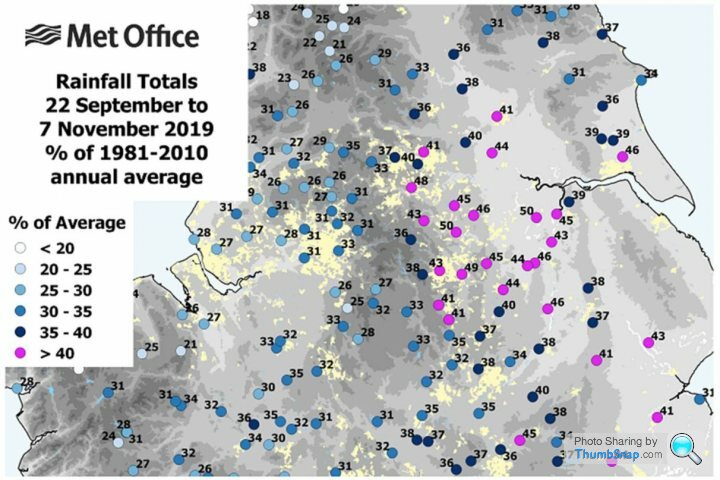
[/quote]
Also flood defences in Sheffield held, at least to some extent, compared to 2007, despite much much heavier rainfall. Which shifts the problem downstream, which arguably either now can't cope, couldn't have coped, allegedly in a worse position to cope.
Agree with OP does seem to be a narrative developing though.
Just to put this in some context, have posted this on the wet and windy thread too, mea culpa, but amazing stats coming out of the Met Office. In the 47days up to November 7th, HALF A YEAR'S WORTH of rain fell in parts of South Yorkshire.
[/quote]
Also flood defences in Sheffield held, at least to some extent, compared to 2007, despite much much heavier rainfall. Which shifts the problem downstream, which arguably either now can't cope, couldn't have coped, allegedly in a worse position to cope.
Agree with OP does seem to be a narrative developing though.
Regardless of how the EA dress it up as protecting the river bed environment ,dredging the lower reaches of the the river don should be mandatory given the fact the recent defensive approach higher up its route. stopping flood spill in sheffield and pushing it downstream requires a deeper faster exit route otherwise over topping occurs towards its estuary. My dutch friend who is a land drainage expert of 40 years experience believes the ea are failing in its responsibility, not dredging allows the cash to be spent creating wetlands and eco nature friendly schemes which do little good,but give a politically eco friendly image,just ask the local farmers ,the fishlake area has not flooded in 100+ years ,now the EA are clearly failing in providing a habitable environment implementing this no dredge policy ,what the hell are those fools who create these policies in their ivory towers thinking ? The damage bill far exceeds any dredging costs per annum,yet alone the distress and disruption.
Holland sits below sea level in many areas ,yet little flooding as we know it occurs ,they dredge and control efficiently .a lesson needs learning here .
Holland sits below sea level in many areas ,yet little flooding as we know it occurs ,they dredge and control efficiently .a lesson needs learning here .
FiF said:
Just to put this in some context, have posted this on the wet and windy thread too, mea culpa, but amazing stats coming out of the Met Office. In the 47days up to November 7th, HALF A YEAR'S WORTH of rain fell in parts of South Yorkshire.
Yes, TBF, the conditions have been testing. Some places got a month's worth of rain in a day. I think the issue is, that local knowledge - anecdotals do count in this regard - sees a reduction in maintenance and activity. Given that we all know the climate is changing, not even maintaining the work of previous decades is madness.oilrag1 said:
Regardless of how the EA dress it up as protecting the river bed environment ,dredging the lower reaches of the the river don should be mandatory given the fact the recent defensive approach higher up its route. stopping flood spill in sheffield and pushing it downstream requires a deeper faster exit route otherwise over topping occurs towards its estuary. My dutch friend who is a land drainage expert of 40 years experience believes the ea are failing in its responsibility, not dredging allows the cash to be spent creating wetlands and eco nature friendly schemes which do little good,but give a politically eco friendly image,just ask the local farmers ,the fishlake area has not flooded in 100+ years ,now the EA are clearly failing in providing a habitable environment implementing this no dredge policy ,what the hell are those fools who create these policies in their ivory towers thinking ? The damage bill far exceeds any dredging costs per annum,yet alone the distress and disruption.
Holland sits below sea level in many areas ,yet little flooding as we know it occurs ,they dredge and control efficiently .a lesson needs learning here .
Excellent post.Holland sits below sea level in many areas ,yet little flooding as we know it occurs ,they dredge and control efficiently .a lesson needs learning here .
Although in some instances building and development don’t have an impact on flooding it doesn’t help when council ask for an EA opinion on flood risk when deciding on planning etc and then just go on to ignore the advice given by the EA that they shouldn’t build.
When you have lack of investment along with little power to stop councils developing regardless then this can cause issues.
They should be dredging every water course that needs it and the Gov should be providing them with powers to stop development where it will cause issues.
When you have lack of investment along with little power to stop councils developing regardless then this can cause issues.
They should be dredging every water course that needs it and the Gov should be providing them with powers to stop development where it will cause issues.
oilrag1 said:
Regardless of how the EA dress it up as protecting the river bed environment ,dredging the lower reaches of the the river don should be mandatory given the fact the recent defensive approach higher up its route. stopping flood spill in sheffield and pushing it downstream requires a deeper faster exit route otherwise over topping occurs towards its estuary. My dutch friend who is a land drainage expert of 40 years experience believes the ea are failing in its responsibility, not dredging allows the cash to be spent creating wetlands and eco nature friendly schemes which do little good,but give a politically eco friendly image,just ask the local farmers ,the fishlake area has not flooded in 100+ years ,now the EA are clearly failing in providing a habitable environment implementing this no dredge policy ,what the hell are those fools who create these policies in their ivory towers thinking ? The damage bill far exceeds any dredging costs per annum,yet alone the distress and disruption.
Holland sits below sea level in many areas ,yet little flooding as we know it occurs ,they dredge and control efficiently .a lesson needs learning here .
Lessons that had been learnt for centuries by our forebears. It's this generation of beaurocrats that has thrown all of that knowledge in the bin for their own foolish aims. The EA simply isn't fit for purpose. Everyone knows what needs doing, sadly everyone but those in charge. Blaming climate change is such an easy cop out for them. Obv climate change doesn't happen in Holland.Holland sits below sea level in many areas ,yet little flooding as we know it occurs ,they dredge and control efficiently .a lesson needs learning here .
The closest we’ve come to a flood near us was when a local farmer was prevented from clearing a ditch (part of which was a brook). He’s cleared that ditch every year for decades, and his dad did if before him. Some twerp from the EA decided that it shouldn’t be done anymore because some of it was “natural watercourse”. I believe plod phoned the EA and got permission while the farmer waited with his digger....
rxe said:
The closest we’ve come to a flood near us was when a local farmer was prevented from clearing a ditch (part of which was a brook). He’s cleared that ditch every year for decades, and his dad did if before him. Some twerp from the EA decided that it shouldn’t be done anymore because some of it was “natural watercourse”. I believe plod phoned the EA and got permission while the farmer waited with his digger....
There was a very serious flood up in a part of the Lakes which was attributable to the prevention of maintenance. Washed out a footbridge and flooded a farm to about 2ft deep.The problem is, when the rivers and streams are not maintained, they loose their capacity and depth, and we all know shallower watercourses will run faster when flooded.
Fatball said:
Although in some instances building and development don’t have an impact on flooding it doesn’t help when council ask for an EA opinion on flood risk when deciding on planning etc and then just go on to ignore the advice given by the EA that they shouldn’t build.
When you have lack of investment along with little power to stop councils developing regardless then this can cause issues.
They should be dredging every water course that needs it and the Gov should be providing them with powers to stop development where it will cause issues.
As you’ve mentioned Council involvement........When you have lack of investment along with little power to stop councils developing regardless then this can cause issues.
They should be dredging every water course that needs it and the Gov should be providing them with powers to stop development where it will cause issues.
It used to be that a lot of sand and gravel dredged from rivers and watercourses was used in the construction industry.
These days far more apparently comes from gravel pits, often created from scratch even on agricultural land.
My point? It’s far less expensive, less dangerous and much easier to dig out sand and gravel from a land site than it is to get it from rivers. Just environmentally worse, in many ways.
Landowners find it much more lucrative than farming and councils seem easily ‘persuaded’ (?) to allow it to happen.
I wonder if all of the building work is adding to this mess? It seems that estates and houses are being built on land that was previously left alone.
I doubt anything would be said about this though because it would contradict the notion that we need to keep building.
Field behind our house is now an estate. People who live there are currently complaining about flooded gardens every time it rains.
I doubt anything would be said about this though because it would contradict the notion that we need to keep building.
Field behind our house is now an estate. People who live there are currently complaining about flooded gardens every time it rains.
Blib said:
Digga said:
Places where there are established drainage boards - e.g. Humber and Somerset - there seems to be the funding and resources to both battle the EA and get work done.
I assume they received funding only after the catastrophic Somerset Levels floods of five or six years ago?Building flood defences are a "whack a mole approach" IMHO, build them in one place and the flood breaks through somewhere else.
River dredging might not be the whole answer but it sure as hell would help. I remember the old days of the water board who used to have a regular maintenance program delivered by locals who knew that they were doing not some theorist sitting in an office miles who's knowledge of the area was a precisely zero.
Don't get me started on some of the local problems we have experienced that were down to the authorities doing zero in preventative maintenance.
River dredging might not be the whole answer but it sure as hell would help. I remember the old days of the water board who used to have a regular maintenance program delivered by locals who knew that they were doing not some theorist sitting in an office miles who's knowledge of the area was a precisely zero.
Don't get me started on some of the local problems we have experienced that were down to the authorities doing zero in preventative maintenance.
Gassing Station | News, Politics & Economics | Top of Page | What's New | My Stuff