
Weber Rotisserie Tips and Recipes
Discussion


Firstly get a decent amount of charcoal well lit and spread out, then close the bottom vents almost all the way. Put the lid on, and close the top vents most of the way. The ring for the rotisserie lets in more air than if you just have the lid on. The whole point of using the rotisserie is for the juices / fats from the food to drip on the coals, so you definitely want to be using direct heat. Once you've finished cooking, take off the ring, put the lid back, close all the vents and you should save most of the unused charcoal for next time.
For me it's then either whole chickens or a bone in, skin on loin of pork. Both of these are so much nicer cooked on the rotisserie than any other method. The crackling on the loin of pork comes out perfect, every single time (apart from one disaster - see below).
The only disaster I've had was cooking a very fatty pork loin (at least 2" of fat). It was doing fine, with the closed vents keeping flare-ups totally under control, but then I took the lid off to check progress, turned my back for about a minute and the entire joint was engulfed in flame. The meat was fine, but the crackling was beyond saving.
The rotisserie attachment is the one thing that's stopped me replacing my Weber kettle with a Big Green Egg.
For me it's then either whole chickens or a bone in, skin on loin of pork. Both of these are so much nicer cooked on the rotisserie than any other method. The crackling on the loin of pork comes out perfect, every single time (apart from one disaster - see below).
The only disaster I've had was cooking a very fatty pork loin (at least 2" of fat). It was doing fine, with the closed vents keeping flare-ups totally under control, but then I took the lid off to check progress, turned my back for about a minute and the entire joint was engulfed in flame. The meat was fine, but the crackling was beyond saving.
The rotisserie attachment is the one thing that's stopped me replacing my Weber kettle with a Big Green Egg.
I tend to use lumpwood unless I'm smoking, so I don't use a chimney.
I use lots of charcoal, then use the vents to keep the temp down. I don't actually measure the temperature and just use the outside appearance of the meat to judge when it's done. Remember, there's a big thick metal skewer going right through the middle of the meat.
If you're doing two chickens at the same time, don't ram them together.
As with everything you cook, better ingredients = better results.
I use lots of charcoal, then use the vents to keep the temp down. I don't actually measure the temperature and just use the outside appearance of the meat to judge when it's done. Remember, there's a big thick metal skewer going right through the middle of the meat.
If you're doing two chickens at the same time, don't ram them together.
As with everything you cook, better ingredients = better results.
Best to set up for indirect:
https://www.weber.com/US/en/blog/tips-techniques/h...
https://www.worldofpower.co.uk/blog/how-to-use-a-w...
https://www.weber.com/US/en/blog/tips-techniques/h...
https://www.worldofpower.co.uk/blog/how-to-use-a-w...
omniflow said:
The whole point of using the rotisserie is for the juices / fats from the food to drip on the coals, so you definitely want to be using direct heat.
Interesting, this looks to be the opposite of what I (and seemingly most others) thought was best practice. I use indirect heat with a drip tray between 2 halves of charcoal directly under the meat, I have never got round to putting spuds or similar under the meat to catch the fat. I can see the benefit of using indirect heat, what advantage of using direct? Doesn't it make it harder to control flare ups when the fat hits the heat?
Tony Angelino said:
Interesting, this looks to be the opposite of what I (and seemingly most others) thought was best practice. I use indirect heat with a drip tray between 2 halves of charcoal directly under the meat, I have never got round to putting spuds or similar under the meat to catch the fat.
I can see the benefit of using indirect heat, what advantage of using direct? Doesn't it make it harder to control flare ups when the fat hits the heat?
Well, it would appear that my approach is not aligned with "best practice", however I stand by what I've said. If you're doing it with indirect heat, then what's the difference between using a BBQ and an Oven?I can see the benefit of using indirect heat, what advantage of using direct? Doesn't it make it harder to control flare ups when the fat hits the heat?
Having the vents mostly closed controls the flare ups just fine.
I'm doing a whole chicken on mine this evening, and I'll bet it will taste far better than one cooked over indirect heat. Not sulking - honest. I would urge anyone to try it and report back.
omniflow said:
Tony Angelino said:
Interesting, this looks to be the opposite of what I (and seemingly most others) thought was best practice. I use indirect heat with a drip tray between 2 halves of charcoal directly under the meat, I have never got round to putting spuds or similar under the meat to catch the fat.
I can see the benefit of using indirect heat, what advantage of using direct? Doesn't it make it harder to control flare ups when the fat hits the heat?
Well, it would appear that my approach is not aligned with "best practice", however I stand by what I've said. If you're doing it with indirect heat, then what's the difference between using a BBQ and an Oven?I can see the benefit of using indirect heat, what advantage of using direct? Doesn't it make it harder to control flare ups when the fat hits the heat?
Having the vents mostly closed controls the flare ups just fine.
I'm doing a whole chicken on mine this evening, and I'll bet it will taste far better than one cooked over indirect heat. Not sulking - honest. I would urge anyone to try it and report back.
theboss said:
I use indirect heat - coal baskets either side with a drip tray underneath. Vents wide open. Two chickens take a little more than an hour and come out perfect. There isn’t much of a knack to it - it’s fool proof.
This was my Christmas turkey last week...
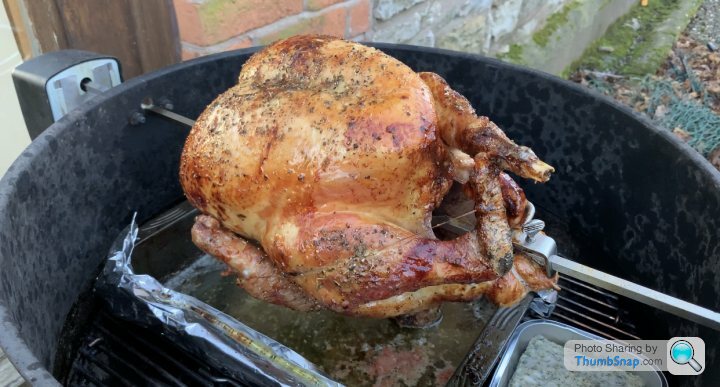
How often does charcoal need topping up?This was my Christmas turkey last week...
I find that if you've got the time, brining the chickens overnight, then dry rub for at least 4 hours before starting.
Indirect method, mixture of lumpwood and hardwood for me. One caveat, if you are doing a really large joint of meat, adding some briquets at the base of the indirect baskets helps maintain an even temperature, should you need to add more lumpwood during the cook.
Indirect method, mixture of lumpwood and hardwood for me. One caveat, if you are doing a really large joint of meat, adding some briquets at the base of the indirect baskets helps maintain an even temperature, should you need to add more lumpwood during the cook.
hyphen said:
How often does charcoal need topping up?
It didn’t. I used Weber briquettes which burn at a stable temperature for 3-4 hours. The turkey was cooked in 2:45 and could have done with 10-15 mins less. The first time I shoved a thermometer in, it was done!To the comment above about oven cooking - I don’t possess an oven other than a small microwave with convection. Any roast therefore needs to be done on a bbq. Rotisserie itself is vastly different to roasting regardless of whether the heat is direct or indirect. The perfectly even heat and self-basting effect of rotation means that the cook is much faster than roasting (label for that particular bird said 3:50) and much more moist.
I also usually want a drip tray for gravy/stock which necessitates indirect.
That said I will have to give a direct cook a go some time and compare!
Gassing Station | Food, Drink & Restaurants | Top of Page | What's New | My Stuff