
“Trade tensions rise as US threatens car tariffs”
Discussion


https://www.bbc.com/news/business-51206425
What’s the game plan here? Boris and Sajid are clearly not stupid, US trade deal is being negotiated, is this a ruse?
Have they agreed this as part of the game plan for the UK / EU deal with Trump?
Interested to hear peoples thoughts of the chess moves in play.
What’s the game plan here? Boris and Sajid are clearly not stupid, US trade deal is being negotiated, is this a ruse?
Have they agreed this as part of the game plan for the UK / EU deal with Trump?
Interested to hear peoples thoughts of the chess moves in play.


BBC article said:
The UK government sees a new trade deal with the US as a high priority after Britain leaves the European Union at the end of this month.
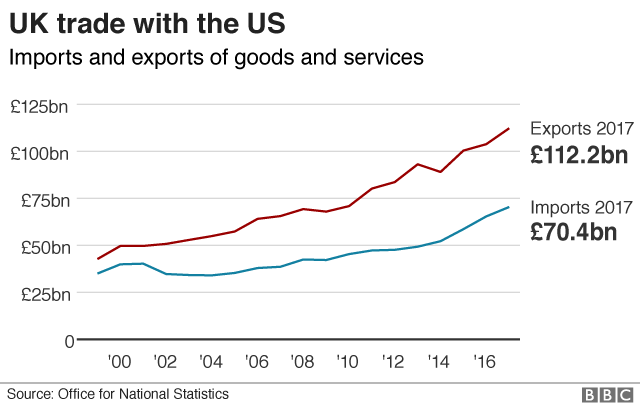
Can somebody explain what more there is to be had by any new deal on trade between these two countries?US negotiators will want things that the UK cannot allow, either for reasons of monomania* (chlorinated chicken) or for reasons of priority (selling into the EU is essential, along with the maintenance of certain EU rules and standards).
Over the last year, Trump has made noises about wanting to do "great" or "big" deals. But there isn't much "great" or "big" that can be done without utterly reversing the current priority of trade from EU to US. And for various reasons, not least geography, this would be absurd.
The UK is the world's second-largest exporter of services, after the US.
The US is the largest foreign investor in the UK and vice-versa.
PS: We can all but guarantee that any "tensions" cited in this article are indeed about posturing and messaging -- part of the game that serves as backdrop to the actual conversations behind closed doors.
*Yes, I am aware that this word will not find agreement among many of you.
g4ry13 said:
Trevor555 said:
g4ry13 said:
UK car makers....do we have any these days?
Jaguar Landrover is the only maker that send a decent amount to the US?Can't think of any others.
Anyone?
Edited by garagewidow on Thursday 23 January 01:26
PSB1 said:
I do hope there’s a master strategy at play here. Far from combined though.
Leverage.The argument around the tech tax = buttons. It means nothing re revenue. £400million? The Americans will be desperate to avoid any precedent however. That’s why they peeled off France.
Huawei is interesting. The intelligence community is absolutely adamant that Huawei is contained and this isn’t an issue. Frankly it wouldn’t be a huge deal if Johnson back tracks on that but again leverage.
Personally I find the current situation good: this is what grown up independent nations have to consider and the fact that the U.K. isn’t rolling over yet is an exceptionally good sign. If they roll over I hope it will be for an adequate quid pro quo.
g4ry13 said:
They're not UK owned brands though are they? Now if Caterham want to sell in US that's a problem.
If they’re built in the UK and exported to the US, isn’t it a problem regardless of who owns the company?It would presumably mean a drop in demand, leading to production cut backs or movement of production from a UK plant to another based elsewhere, with potential knock on impacts to jobs, etc.
On a related note:
Last year, Boris Johnson made public statements about how the US is a difficult market to negotiate for trade partners, because many issues of regulation and certification (say: for financial services) are not managed nationally by Washington, DC, but at the capital of each US state.
This is not a matter of redundancy, as some states do not allow what others do. Or some states have more diverse requirements and / or more detailed protections than others.
Boris literally said something along the lines of, "Over there, you can't just have one meeting in Washington. You have to meet 50 groups of people across the whole country."
When Boris does this, he sounds like a shoeless shop owner in the hills of West Virginia. The whole point of the founding of the US is this separation and distribution of powers. The eye rolling and the laughter over here, among friends in trade and the expatriate, was palpable.
There is of course an even more egregious talker in the form of the current occupant of 1600 Pennsylvania Avenue. But being the smaller of the two partners (circa 10 percent of US GDP), the UK will do well to be a bit more polished.
The UK team needs to come across as informed and not Lilliputian.
Last year, Boris Johnson made public statements about how the US is a difficult market to negotiate for trade partners, because many issues of regulation and certification (say: for financial services) are not managed nationally by Washington, DC, but at the capital of each US state.
This is not a matter of redundancy, as some states do not allow what others do. Or some states have more diverse requirements and / or more detailed protections than others.
Boris literally said something along the lines of, "Over there, you can't just have one meeting in Washington. You have to meet 50 groups of people across the whole country."
When Boris does this, he sounds like a shoeless shop owner in the hills of West Virginia. The whole point of the founding of the US is this separation and distribution of powers. The eye rolling and the laughter over here, among friends in trade and the expatriate, was palpable.
There is of course an even more egregious talker in the form of the current occupant of 1600 Pennsylvania Avenue. But being the smaller of the two partners (circa 10 percent of US GDP), the UK will do well to be a bit more polished.
The UK team needs to come across as informed and not Lilliputian.
unsprung said:
But there isn't much "great" or "big" that can be done without utterly reversing the current priority of trade from EU to US.
How do you square this view with the fact that trade deal was negotiated between the EU and the US? You're suggesting that the two parties are so far apart that the UK has to pick one, yet we can see that that if that was the case TTIP would be impossible.paulrockliffe said:
How do you square this view with the fact that trade deal was negotiated between the EU and the US? You're suggesting that the two parties are so far apart that the UK has to pick one, yet we can see that that if that was the case TTIP would be impossible.
That's the kind of counter argument that I've asked for. We may expect something "big" if the entire EU block is part of the deal. But if the other party is "merely" the UK, will the value and volume, for the US, seem "big"?Apparently the TTIP would add $100-billion to the US economy. That figure is less than the increase the EU would receive. It is also less than what the rest-of-world, ie: non-EU and non-US, would receive if TTIP should be implemented.
As impressive as $100-billion sounds, it's more or less the annual GDP of Hawaii. This is less than one-half of one percent of total US GDP.
It's a pity that TTIP has failed to conclude its necessary agreements (mostly because of complaints and prevarication by Trump).
Without TTIP, however, the EU and US remain some distance apart and the UK has some choices to make -- whilst simultaneously acknowledging that the EU is significantly more important to UK trade, at this time, than the US.
There's some interesting info here:
https://www.bbc.com/news/business-44802666
And here:
https://en.wikipedia.org/wiki/Transatlantic_Trade_...
Gassing Station | News, Politics & Economics | Top of Page | What's New | My Stuff