
Swirl Pot Corrosion and Scaling
Discussion


Hi All,
Had a hose split the other day (top hose between swirl pot and block) which resulted in a hairy steam filled limp home. Stopped at one point to top up header tank and the water was cool which amazed me, but for reasons which will become clear.
Took off offending hose and the swirl pot outlet was full of pink crystalline scale, which had also completely corroded away the aluminium beneath, see photo below. Major restriction to flow. Turns out the other end also had scale in it, and the outlet to header was totally blocked! See photos below.
Elsewhere, inlet to block seems clean, radiator top and bottom inlets look clean. But I am a bit worried about where else the scale might be sitting. Anyone seen anything like this? Talking to someone at ACT while ordering hoses, they think the pink versions of antifreeze can be very corrosive to aluminium, and recommend the blue instead.
Any thoughts on best way to flush system just in case? Descaler might damage other aluminium parts (engine!). Vinegar?
Cheers!
Swirl outlet to block:

Swirl inlet:

Swirl outlet to header:

Had a hose split the other day (top hose between swirl pot and block) which resulted in a hairy steam filled limp home. Stopped at one point to top up header tank and the water was cool which amazed me, but for reasons which will become clear.
Took off offending hose and the swirl pot outlet was full of pink crystalline scale, which had also completely corroded away the aluminium beneath, see photo below. Major restriction to flow. Turns out the other end also had scale in it, and the outlet to header was totally blocked! See photos below.
Elsewhere, inlet to block seems clean, radiator top and bottom inlets look clean. But I am a bit worried about where else the scale might be sitting. Anyone seen anything like this? Talking to someone at ACT while ordering hoses, they think the pink versions of antifreeze can be very corrosive to aluminium, and recommend the blue instead.
Any thoughts on best way to flush system just in case? Descaler might damage other aluminium parts (engine!). Vinegar?
Cheers!
Swirl outlet to block:
Swirl inlet:
Swirl outlet to header:

 te quality coolant ,hard water, or poor cooling system maintenance (doubtful in your case methinks) or combination of all 3
  or above mentioned
That G48 does look good, will get some.
Can't remember what antifreeze I used last time, but last few times I've topped up with tap water (small amounts - it never really loses any) and it is a v hard water area.
I ordered up some white vinegar to clean the swirl/header, and I reckon I'll dilute and flush some of that through the system. Then fully displace before re-fill. I might look at distilled water too. Was pretty shocked to see all that crap in there.
Can't remember what antifreeze I used last time, but last few times I've topped up with tap water (small amounts - it never really loses any) and it is a v hard water area.
I ordered up some white vinegar to clean the swirl/header, and I reckon I'll dilute and flush some of that through the system. Then fully displace before re-fill. I might look at distilled water too. Was pretty shocked to see all that crap in there.
Definitely mixed types anti-freeze by the look of it. I just used the basic blue stuff on my last 2 Chimaera, it was fine. Unless you drive in the Arctic or regular 40C heat, it's sufficient.
May be worth taking off the radiator and flushing it out as well as a hose pipe into the block.
May be worth taking off the radiator and flushing it out as well as a hose pipe into the block.
Thanks Dunc and V8.
Tested vinegar on the 'scale' and it does not do anything, so no point messing with that.
Cracked the thermostat housing off, and pretty clean in there, felt around in the entrance to block too, seems ok.
Took header tank off (well - ripped the studs out of the wing.....), full of blue coolant, but bottom exit tube completely blocked with hard scale for the entire length, had to use drill bit to excavate, inside bottom of tank pretty corroded too. All other hoses and inlets/outlets ok (swan neck quite corroded inside but not the same scale stuff as swirl/header).
Radiator seems to flow through well.
So it seems like the weird scale stuff is associated with presence of aluminium, some sort of reaction there. Fortunately direction of flow is from block to swirl and not the other way round, so I don't think I would have got any chunks of scale migrating into block.
Header tank pipe:

Tested vinegar on the 'scale' and it does not do anything, so no point messing with that.
Cracked the thermostat housing off, and pretty clean in there, felt around in the entrance to block too, seems ok.
Took header tank off (well - ripped the studs out of the wing.....), full of blue coolant, but bottom exit tube completely blocked with hard scale for the entire length, had to use drill bit to excavate, inside bottom of tank pretty corroded too. All other hoses and inlets/outlets ok (swan neck quite corroded inside but not the same scale stuff as swirl/header).
Radiator seems to flow through well.
So it seems like the weird scale stuff is associated with presence of aluminium, some sort of reaction there. Fortunately direction of flow is from block to swirl and not the other way round, so I don't think I would have got any chunks of scale migrating into block.
Header tank pipe:
Hamish,
I had an almost identical problem about 8 years ago, see here:
http://www.bertram-hill.com/griffith-cooling-syste...
I had an almost identical problem about 8 years ago, see here:
http://www.bertram-hill.com/griffith-cooling-syste...
When the inhibitors fail to function or wear out then aluminium is corroded with great vigor , just for example a water pump thats bearings had stared to fail at 150k miles on a 2000 year Toyota Yaris that I have maintained since four years old this is a 19 year old water-pump I changed last year the rad is also original showing no internal furring or scaling up  I use the same coolant in the RV8 cooling systems ask for little and are simple to maintain IME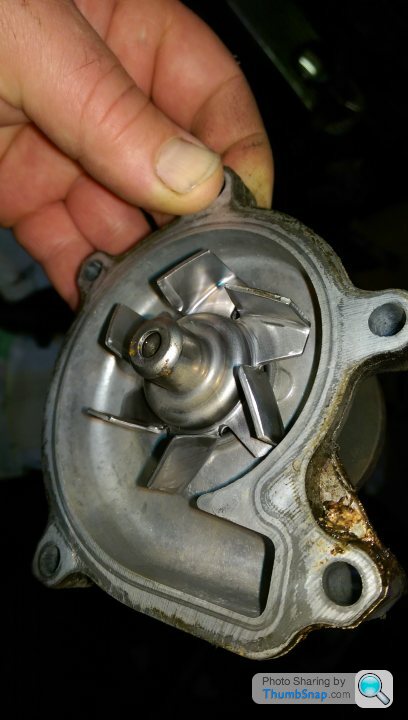
I use the same coolant in the RV8 cooling systems ask for little and are simple to maintain IME Zener said:
when the inhibitors fail you have steel copper and aluminium dissimilar metals that would rather be apart combined with water you have enough elements to make a battery  far from ideal
^^This^^ far from ideal An aluminium swirl pot can be described as the anode, the sludge and scale deposits are the cathode. The swirl pot becomes the sacrificial anode and is where pitting corrosion occurs due to localised galvanic reaction and the alloy/aluminium is depleted causing pinholes.
What you need is the corrosion inhibition effect of sodium diphosphate on the aluminum, suspended in water-ethylene glycol solution sodium diphosphate will form a stable passive film on the surface of aluminium.
I remember Toyota used to sell an antifreeze with a high concentration of sodium diphosphate in it, this was in the 1980s/90s and if I rember correctly the stuff was called Forlife. Toyota developed it because all their engines were aluminium and the other antifreeze solutions available at the time were that effective or long lasting in aluminium engines.
Toyota named their antifreeze ForLife because it was intended to be effective for the life of the engine, it was red in colour and back in the day was the best you could get for any aluminium engine, I have no idea if it still exists as I've always used Blucol in my RV8 and I change it every 18 months.
Not sure if this is the same stuff but I used it in a TR3A for 10 years without any problems:
https://4lifecoolant.co.uk/technical
https://4lifecoolant.co.uk/technical
Lou - wow, almost identical issue as you say! I've got 5 L of the G48 now, hope that works better.
Chimp/Zener - don't think the G48 has diphosphate, claims to have 'silicate' based inhibitors. I guess I won't know if it works for while....
Cleaned up the swirl inlet/outlet, serious erosion of the tube walls, just where the majority of the 'scale' was, which makes me think the deposits are some sort of aluminium compound, potentially related to cathodic reactions as suggested. Funny how it is right at entry and exit points and not in tank itself.
I've got some aluminium brazing rods, will try to repair, will not be pretty but will post results...
Radiator end :

Block end :

Chimp/Zener - don't think the G48 has diphosphate, claims to have 'silicate' based inhibitors. I guess I won't know if it works for while....
Cleaned up the swirl inlet/outlet, serious erosion of the tube walls, just where the majority of the 'scale' was, which makes me think the deposits are some sort of aluminium compound, potentially related to cathodic reactions as suggested. Funny how it is right at entry and exit points and not in tank itself.
I've got some aluminium brazing rods, will try to repair, will not be pretty but will post results...
Radiator end :
Block end :
Gassing Station | Chimaera | Top of Page | What's New | My Stuff