
Train drivers - how do you know when to slow down?
Discussion


I amused myself for an hour or so watching an in-cab film on YouTube of the journey from Edinburgh to Carlisle on a Cass 350. At 22m 42s the train arrives at a 30 sign and enters a tight right bend. The driver has already slowed the train from the previous line speed of 95 mph. At no point on the journey do I see one of the triangular yellow "warning" boards that tell the driver to start slowing down for a lower speed limit, so how do they know? I know the drivers have intimate knowledge of the routes that they are cleared to operate on, but do they rely entirely on this or is there something else that isn't apparent in the film? Link here, for any one who wants to watch it.
Route knowledge and these days some automatic trains.
The lines all have distance markers (normally distance from London) and the drivers all know at what distance marker the speed limits are.
Passenger trains stop pretty well although that can take well over a mile, it is nothing to a laden freight train where it takes some time, and distance, just for the brakes to apply, never mind stop the train.
The lines all have distance markers (normally distance from London) and the drivers all know at what distance marker the speed limits are.
Passenger trains stop pretty well although that can take well over a mile, it is nothing to a laden freight train where it takes some time, and distance, just for the brakes to apply, never mind stop the train.
MitchT said:
If it's entirely down to route knowledge then it bids the question, how do they spot the relevant visual ques when it's dark?
Even in the dark or in a tunnel you’re still acutely aware of exactly where you are and you also notice other cues as well such as the different noises you hear when you go over points and the sequence of going around various curves and such like.A lot of training is purely on route learning both during the day and night driving. When a driver passes out, he/she will be intimately familiar with all the routes they operate on.
Purely route knowledge and there are visual cues for some speed changes in advance.
Even in the dark your headlights still illuminate the surrounding area to an extent so you can still see your braking points and although every train is slightly different after you've drove the same class day in day out you get to understand it's performance.
Even in the dark your headlights still illuminate the surrounding area to an extent so you can still see your braking points and although every train is slightly different after you've drove the same class day in day out you get to understand it's performance.
You know I had never considered driving a train to be an actual skill before. I guess I didn’t think about the man speeding it up and slowing it down, it just seemed an automatic process to pull away from one station and end up at another. Daft really that I’d never even considered it.
Douglas Quaid said:
You know I had never considered driving a train to be an actual skill before. I guess I didn’t think about the man speeding it up and slowing it down, it just seemed an automatic process to pull away from one station and end up at another. Daft really that I’d never even considered it.
I used to think that, (the lorry driver in me  )
)Then I saw a program on Discovery about how the fresh fish get moved on trains, (iirc) between Norway and Sweden. I t was a real eye opener.
I used to run into some of the Scottish lads in the mid 90's, that were getting the fresh fish from Scotland to Madrid and Barcelona. Apart from the ferry crossing of choice and fuel, they were pretty much non stop

Route knowledge is what it's all about, we have to know each route we work on intimately, in all weathers day and night. Being centrally based (at Rugby depot) my route card is quite extensive, taking in the WCML from Willesden up to Crewe via the Birmingham / Stour and Trent Valley lines, the Midland Mainline from West Hampstead up as far as Toton Yard at Sandiacre, all round the West Mids area via the Grand Junction line from Stetchford to Bescot and Bushbury and the Sutton Park avoiding line round the top of Birmingham. From Brum I also sign the route to Stourbridge, Worcester, Cheltenham and Gloucester, and down through Solihull to Leamington, Banbury, Oxford and Didcot, from Banbury I also sign the Chiltern route from Aynho Junction down to Northolt and Old Oak Common. Heading east from Brum I sign the road to Nuneaton and Leicester and from there the 'Corby loop' to Kettering via Syston, Melton Mowbray, Oakham and Corby (this includes the magnificent 82 arch Harringworth viaduct over the Welland Valley). I also sign the Bletchley to Bedford branch, the Coventry to Leamington branch and Leicester to Coalville branch. Where the main routes into London get close to each other in the Acton / Willesden / Cricklewood area I sign the freight only lines connecting them altogether, plus the two seperate routes from there down to Battersea via Clapham Junction and Kensington Olympia.
Retaining this route knowledge can be difficult at times and we're supposed to have a refresher over a route if we've not been over it for six months. The same applies to the different classes of locos I drive, if I've not been on one for a while I'd need a quick refresher, an example which has just cropped up is that last October I was passed out on Class 70s but I've never driven one in anger yet.
The route knowledge itself encompasses everything along a that route which we need to know off by heart and signing a legal document to that effect - the names and directions of running lines, loops, depots, yards and sidings, permanent speed restrictions on running lines, points and crossings, all the gradients, junctions, stations, level crossings, foot crossings, tunnels, bridges, viaducts, areas of low adhesion, the signalling (taking in the different types ie : multiple aspect colour lights, the newer LED type colour lights, manually operated semaphores, ground position lights, shunting discs, junction indicators, theatre box displays etc), where they are placed, how far apart they are, which ones apply to which line, what they mean, where they can take you (and just important, where they can't), which ones we can pass at danger, which signalbox controls them etc. It sounds like a hell of a lot of information to cram into your head but you'd be surprised how much you can accrue. On top of all that there are the rules and regs for degraded working (for example signal or level crossing failures, single line working, working by pilotman etc) emergency procedures, loco failures, dangerous goods incidents, bad weather conditions, tresspassers, fatalities etc.
My very first 'solo' turn after passing out was a bit of a baptism of fire, I was on the 22.00 spare turn and had to take a light loco down to Wembley in thick fog to rescue a mate who's loco had failed, it was a proper pea souper all the way with visibility down to about ten yards, it was a real test of my route knowledge but I knew the road so well because most of my train handling hours were done on the WCML. Seeing the glow of the signals looming up out of the fog at 75mph certainly helps the concentration...
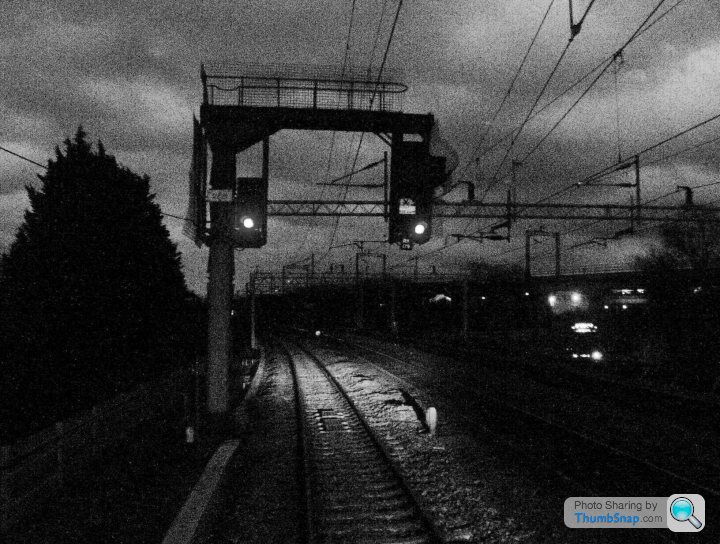
This is Rugby Trent Valley Junction about twelve years ago...
Retaining this route knowledge can be difficult at times and we're supposed to have a refresher over a route if we've not been over it for six months. The same applies to the different classes of locos I drive, if I've not been on one for a while I'd need a quick refresher, an example which has just cropped up is that last October I was passed out on Class 70s but I've never driven one in anger yet.
The route knowledge itself encompasses everything along a that route which we need to know off by heart and signing a legal document to that effect - the names and directions of running lines, loops, depots, yards and sidings, permanent speed restrictions on running lines, points and crossings, all the gradients, junctions, stations, level crossings, foot crossings, tunnels, bridges, viaducts, areas of low adhesion, the signalling (taking in the different types ie : multiple aspect colour lights, the newer LED type colour lights, manually operated semaphores, ground position lights, shunting discs, junction indicators, theatre box displays etc), where they are placed, how far apart they are, which ones apply to which line, what they mean, where they can take you (and just important, where they can't), which ones we can pass at danger, which signalbox controls them etc. It sounds like a hell of a lot of information to cram into your head but you'd be surprised how much you can accrue. On top of all that there are the rules and regs for degraded working (for example signal or level crossing failures, single line working, working by pilotman etc) emergency procedures, loco failures, dangerous goods incidents, bad weather conditions, tresspassers, fatalities etc.
My very first 'solo' turn after passing out was a bit of a baptism of fire, I was on the 22.00 spare turn and had to take a light loco down to Wembley in thick fog to rescue a mate who's loco had failed, it was a proper pea souper all the way with visibility down to about ten yards, it was a real test of my route knowledge but I knew the road so well because most of my train handling hours were done on the WCML. Seeing the glow of the signals looming up out of the fog at 75mph certainly helps the concentration...
This is Rugby Trent Valley Junction about twelve years ago...
Edited by P5BNij on Saturday 2nd May 14:06
As others, never thought it was so skilled
The question these days is why ?
You could have computer controlled routes using GPS ether directly controlling the train, or giving target speeds to the driver ?
Glad in someways it isn't like that though
Mind you, didn't we replace ATP with something ?
The question these days is why ?
You could have computer controlled routes using GPS ether directly controlling the train, or giving target speeds to the driver ?
Glad in someways it isn't like that though
Mind you, didn't we replace ATP with something ?
Gary C said:
As others, never thought it was so skilled
The question these days is why ?
You could have computer controlled routes using GPS ether directly controlling the train, or giving target speeds to the driver ?
Glad in someways it isn't like that though
Mind you, didn't we replace ATP with something ?
On various tube lines and *i think* Eurostar this already happens.(Well, not the GPS bit - that doesn’t work too well in the tunnels...). On Eurostar the trains go too fast and you risk a driver missing a signal and hey, it’s new so why not put a modern system in while you can and on the tubes, it’s all tied in to a new spangdangly, all singing and dancing signalling system that enables trains to run extremely close to one another (This is also being installed for Crossrail).The question these days is why ?
You could have computer controlled routes using GPS ether directly controlling the train, or giving target speeds to the driver ?
Glad in someways it isn't like that though
Mind you, didn't we replace ATP with something ?
National Rail are experimenting with a system called ERTMS (a digital signalling system) which is along the lines of what you’re thinking of but it’s both insanely complex and so monumentally expensive that it’ll be a number of decades before you see it in any meaningful way.
ERTMS (European Train Management System) is not far off being in use in the Heathrow tunnels, and is already fitted to the Elizabeth line units. They currently use line side signalling between Reading and Paddington. It is similar to the system on Eurostar, and the rest of Europe.
The main purpose is to increase capacity. The trains communicate with the signals so they can run closer together, at higher speeds. In simple terms the train gives a movement authority and tells the driver what speed he should be doing.
Network rail have a line (Cambrian) in Wales with it as well.
I’m sure if you google it you’ll find lots about it.
The main purpose is to increase capacity. The trains communicate with the signals so they can run closer together, at higher speeds. In simple terms the train gives a movement authority and tells the driver what speed he should be doing.
Network rail have a line (Cambrian) in Wales with it as well.
I’m sure if you google it you’ll find lots about it.
EXMX5 said:
The trains communicate with the signals so they can run closer together, at higher speeds. In simple terms the train gives a movement authority and tells the driver what speed he should be doing.
The reliance on a high and intimate level of route knowledge by drivers is very much a British railway practise (plus bits of the world where Britain either built or owned the railways). Elsewhere in the world - Europe and North America especially - they've always had 'speed-based' signalling rather than our 'path-based' signalling. Basically British signalling has only ever told the driver whether the line ahead is clear or not. Beyond the upper speed limit for the line and the equipment, it's then up to the driver to judge how fast they should be going, whether they should be under power, coasting or braking, or accelerating/deccelerating and by how much/how fast for any given postion, time and condition. This is why the drivers need the really in-depth route knowledge.
Elsewhere the signals not only provide the basic 'Danger', 'Caution' or 'Clear' aspects but also indicate what speed the driver should go at. For instance, Canadian railroad signals display 'Clear' (go at maximum permitted speed), 'Limited' (two-thirds max. speed), 'Medium' (half speed), 'Slow' (quarter line speed) and 'Restricted' (slow enough to stop in half the current visibilty/line of sight). This leads to much more complicated signalling equipment and drivers have to learn more fiendishly complicated signal aspects, but once they have they don't need quite the same level and sort of specific route knowledge as British drivers.
Europa1 said:
P5BNij][A lot of interesting stuff said:
Edited by P5BNij on Saturday 2nd May 14:06
Gassing Station | Boats, Planes & Trains | Top of Page | What's New | My Stuff