
UK Naval losses during the Falklands war - what did we learn
Discussion


I've been reading a few books on the Falklands war, about the logicstics to support the fighting so far away from the UK, and several books written by the soldiers, seamen and airmen who fought. What strikes me is that the UK's Naval losses were fairly significant, expecially considering the relatively low capability of the argentine airforce (fighting at extreme aircraft range, not correctly setting bomb fuses, poor tactics etc (although they certainly fought very courageously, despite those handicaps!)).
So my question, what did we learn as a Naval nation from those losses? It seems to me that there was nothing new compared to that learnt in WW2, ie that ships are really vunerable to aircraft. Did our "high tech" defense systems actually provide any significant margin? The Harriers on CAP certainly did, both physically and mentally, but it seems that most of the close defence systems put in place (rapier, sea slug etc) simply failed to prevent what where really basic bombing runs by pretty old aircraft, dropping dumb munitions?
Having read a few warship history books (Warspite, Rodney etc) what is evident during WW2 is that the anti-aircraft fit at the end of WW2 was very very different from at the start, with the number of guns being something like 10 times that of those fitted at the start of the war.
And what about today? Has anything really changed?
So my question, what did we learn as a Naval nation from those losses? It seems to me that there was nothing new compared to that learnt in WW2, ie that ships are really vunerable to aircraft. Did our "high tech" defense systems actually provide any significant margin? The Harriers on CAP certainly did, both physically and mentally, but it seems that most of the close defence systems put in place (rapier, sea slug etc) simply failed to prevent what where really basic bombing runs by pretty old aircraft, dropping dumb munitions?
Having read a few warship history books (Warspite, Rodney etc) what is evident during WW2 is that the anti-aircraft fit at the end of WW2 was very very different from at the start, with the number of guns being something like 10 times that of those fitted at the start of the war.
And what about today? Has anything really changed?
Max_Torque said:
...expecially considering the relatively low capability of the argentine airforce...
Some of the issues were because of their relatively low capability, or at least because they weren't the Russians.I've been down a youtube rabbit hole on this for some reason recently.
https://www.youtube.com/watch?v=yLn2TJZqR_o
https://www.youtube.com/watch?v=vh5Z6MgxTsk
https://www.youtube.com/watch?v=gt0PZHHhyHg
https://www.youtube.com/watch?v=tGaSmvSv8jI
cb31 said:
Max_Torque said:
really basic bombing runs by pretty old aircraft, dropping dumb munitions?
I'm not expert but I think exocet qualified as pretty smart and lethal munitions?As for dumb weapons. They were using French Super Etendard Aircraft and the Exocet anti ship missile. Dumb they were not. At the time they were state of the art and probably one of the best anti ship missiles about.
We were lucky that the US got involved on the quite. They secretly shipped a load of AIM 9 sidewinders to the Ascension Islands for the U.K. fleet to stop and pick up on the way down.
They US also had a quite word in the ear of the French (who had Military experts on the ground in Argentina showing them how to arm, fit and use the Exocet), explaining they might want to stop arming the Argentinians if they ever want to purchase American military hardware ever again in the future.
Fair dos to the Argentinians. They were basically left with crates of missiles stack next to aircraft and figures it out themselves.
(All the above comes from Admiral Woodward’s book: The 100 Days)
Edited by MB140 on Monday 22 June 12:00
MB140 said:
cb31 said:
Max_Torque said:
really basic bombing runs by pretty old aircraft, dropping dumb munitions?
I'm not expert but I think exocet qualified as pretty smart and lethal munitions?As for dumb weapons. They were using French Super Etendard Aircraft and the Exocet anti ship missile. Dumb they were not. At the time they were state of the art and probably one of the best anti ship missiles about.
We were lucky that the US got involved on the quite. They secretly shipped a load of AIM 9 sidewinders to the Ascension Islands for the U.K. fleet to stop and pick up on the way down.
They US also had a quite word in the ear of the French (who had Military experts on the ground in Argentina showing them how to arm, fit and use the Exocet), explaining they might want to stop arming the Argentinians if they ever want to purchase American military hardware ever again in the future.
Fair dos to the Argentinians. They were basically left with crates of missiles stack next to aircraft and figures it out themselves.
(All the above comes from Admiral Woodward’s book)
Edited by MB140 on Monday 22 June 11:55
Edited by MB140 on Monday 22 June 11:56
It's worth reading "The British Aircraft Carrier" by Paul Beaver.
The updated version I have was written not long after events, and shows how stretched we were in terms of airframes and how much they over performed.
There are negative and positive lessons from that conflict, but it's still astounding what was achieved with such a small carrier based force.
The updated version I have was written not long after events, and shows how stretched we were in terms of airframes and how much they over performed.
There are negative and positive lessons from that conflict, but it's still astounding what was achieved with such a small carrier based force.
Whilst the Exocet is remembered by most as the no1 threat to the fleet, they had limited numbers of those missiles, and limited ways of launching them at a fleet right at the end of the operational range of the launch aircraft. And yes, it's hard, even today, to stop a fast, small, low level missile before it hits your ships.
However, i'm more thinking about the dumb bombing of the landing fleet in Falkland sound and San Carlos Water, targets not really suitable for Exocet due to the confining nature of that environment. Here, some broadly pretty low performance aircraft (Pucara, Skyhawk) dropped basic iron bombs on ships that had mostly had radar warning of those incoming aircraft. The losses here were significant. This is the sort of attack more reminiscent of WW2 and was really only repulsed during WW2 (especially in the pacific theater) by massive basic anti-aircraft fire using projectiles that didn't require a direct hit (ie flak).
We got lucky at the start, thanks to the poor fuse setting debarcle, meaning lots of bombs hit their targets but didn't go bang.. Certainly i'd suggest 3 or more additional landing fleet ships all hit by non-exploding bombs would probably have all been lost if those bombs had armed and exploded. Looses of the argentinian aircraft were significant, and those wasted sorties dropping bombs that didn't go bang meant they lost aircraft for no gain.
so my question stands, did we learn from this? do our modern ships have a large enough basic anti-aircraft fit, or are we again relying on complex systems that may possibly not work when push comes to shove?
However, i'm more thinking about the dumb bombing of the landing fleet in Falkland sound and San Carlos Water, targets not really suitable for Exocet due to the confining nature of that environment. Here, some broadly pretty low performance aircraft (Pucara, Skyhawk) dropped basic iron bombs on ships that had mostly had radar warning of those incoming aircraft. The losses here were significant. This is the sort of attack more reminiscent of WW2 and was really only repulsed during WW2 (especially in the pacific theater) by massive basic anti-aircraft fire using projectiles that didn't require a direct hit (ie flak).
We got lucky at the start, thanks to the poor fuse setting debarcle, meaning lots of bombs hit their targets but didn't go bang.. Certainly i'd suggest 3 or more additional landing fleet ships all hit by non-exploding bombs would probably have all been lost if those bombs had armed and exploded. Looses of the argentinian aircraft were significant, and those wasted sorties dropping bombs that didn't go bang meant they lost aircraft for no gain.
so my question stands, did we learn from this? do our modern ships have a large enough basic anti-aircraft fit, or are we again relying on complex systems that may possibly not work when push comes to shove?
Not read a lot bu came across this a while back.
https://twitter.com/FirstFalklands
I didn't know there were lorry launched Exocets. Not sure they did anything though.
https://twitter.com/FirstFalklands
I didn't know there were lorry launched Exocets. Not sure they did anything though.
Eric Mc said:
Operating naval vessels with inadequate (i.e. none) airborne advanced early warning radar was tantamount to suicide.
That was the biggest single point I remember from my reading around this. You don't want the enemy aircraft getting close enough to drop bombs in the first place. It did seem a bit as if some of the WW2 lessons about ships being highly vulnerable to aircraft had been forgotten, or perhaps a complacency about modern weapon systems had crept in. Though that maybe unfair.
Just an FYI, something often forgotten. 14 ships in the Royal Navy fleet were armed with Exocet missile systems. 2x County class Destroyers, 2x Type 22 Frigates, 6x Type 21 Frigates (Antelope was the only one not fitted with them) and the 4x Leander Class frigates.
So we had practical knowledge of what they could do ourselves and was another reason the Argentinian navy kept it's distance.
So we had practical knowledge of what they could do ourselves and was another reason the Argentinian navy kept it's distance.
Eric Mc said:
Operating naval vessels with inadequate (i.e. none) airborne advanced early warning radar was tantamount to suicide.
Yep.The losses experienced by the RN (and Merchant Navy) would have likely been massively reduced had the RN task force still had a proper carrier force, and thus AEW.....and possibly the Argentine wouldn't have even bother risking an invasion had we still had that capability at the time.
Max_Torque said:
so my question stands, did we learn from this?
No.We don't want to spend the money to do it properly, as evidenced by the still compromised poor AEW setup for the 2 new 'carriers' because we still want to create the illusion of being at a party we don't want to pay for.
Edited by aeropilot on Monday 22 June 13:35
I wrote a day by day timeline on here a few years ago. https://www.pistonheads.com/gassing/topic.asp?h=0&...
The one lesson that we learnt at great cost - "Planes kick boat ass" and the Argentine Air Force were incredibly brave in many cases. Many ships were lost due to "dumb" iron bombs.
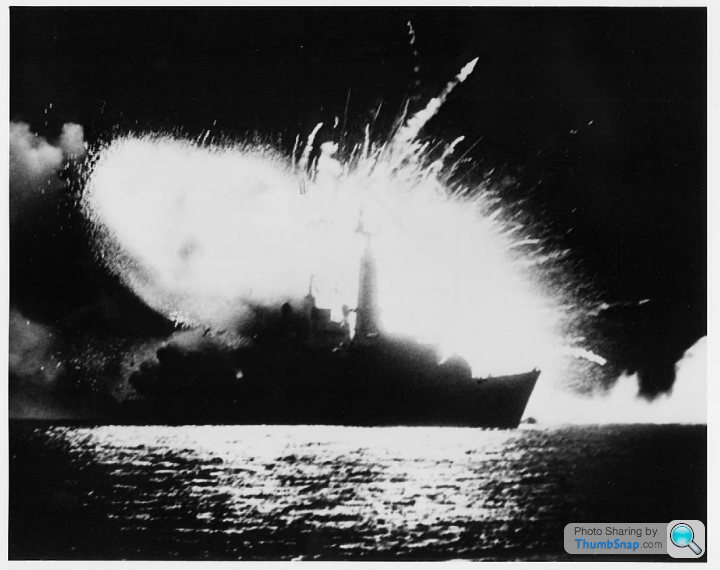
HMS Antelope's magazine explodes as fires rage uncontrolled after 1000lb bombs explode"
SD.
The one lesson that we learnt at great cost - "Planes kick boat ass" and the Argentine Air Force were incredibly brave in many cases. Many ships were lost due to "dumb" iron bombs.
HMS Antelope's magazine explodes as fires rage uncontrolled after 1000lb bombs explode"
SD.
Zirconia said:
Not read a lot bu came across this a while back.
https://twitter.com/FirstFalklands
I didn't know there were lorry launched Exocets. Not sure they did anything though.
It was a land based Exocet which hit HMS Glamorgan. The Navy was fully aware of the land based system, and told ships to stay out of range just in case. HMS Glamorgan had spent the night bombarding positions in support the Battle of Two Sisters and was late leaving the gun line. In a bid to get back out to open sea before the Argentine airforce appears, she short cut across the "no go" area. https://twitter.com/FirstFalklands
I didn't know there were lorry launched Exocets. Not sure they did anything though.
The lauch was observed by the crew and the ship turned hard away from it, but the missle hit the hanger on the rear of the ship. Had the missle hit lower, then it would have hit the Sea Slug magazine. As it was it hit the freshly fueled and armed Helicopter. Sadly 14 crew where killed.
shed driver said:
The one lesson that we learnt at great cost - "Planes kick boat ass"
Except, we really haven't learned that, even 40 years later.But then again, the Argentine Navy learned a lesson as well, "Nuc subs kick capital ship ass" if you equally don't have adequate force protection for them......so they kept their carrier tied up in port after that.
Gassing Station | Boats, Planes & Trains | Top of Page | What's New | My Stuff