
A little off the top sir ? (Denver accident)
Discussion


Key Lime Air Metrolink on a ferry flight is cleared to land on 17L.
Meantime, a cirrus private aircraft cleared to land on 17R. Overshoots both 17R and L, collides with the metrolink.
Metrolink manages to land, cirrus deploys parachute and "lands" in a field.
Oops...
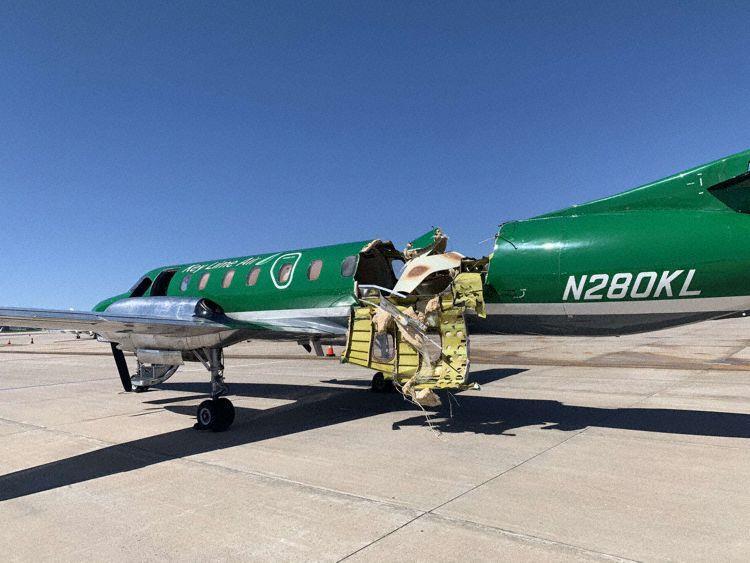

AV herald report: https://avherald.com/h?article=4e74b6e5&opt=0
Meantime, a cirrus private aircraft cleared to land on 17R. Overshoots both 17R and L, collides with the metrolink.
Metrolink manages to land, cirrus deploys parachute and "lands" in a field.
Oops...
AV herald report: https://avherald.com/h?article=4e74b6e5&opt=0
Edited by Crafty_ on Thursday 13th May 08:41

https://www.youtube.com/watch?v=f5tb2dVWJqc
Crikey, what a mess... From a noob perspective seems like a failure of ATC bringing both in with no spacing to turn for finals and land on parallel runways.
Another great example of the parachute proving its worth too!
Crikey, what a mess... From a noob perspective seems like a failure of ATC bringing both in with no spacing to turn for finals and land on parallel runways.
Another great example of the parachute proving its worth too!
Imagine if the metrolink had passengers on board.. thank goodness it did not.
Metrolink was aware of the parallel landing, seems the cirrus was not - or if it was they just wandered in to the approach path anyway. Wouldn't they be able to see the the metrolink ? maybe they were to pre-occupied with the turn to be doing observations.
must have been a hell of a bang. Right engine failure he says, yeah that was probably the fuselage wrapped round it
Metrolink was aware of the parallel landing, seems the cirrus was not - or if it was they just wandered in to the approach path anyway. Wouldn't they be able to see the the metrolink ? maybe they were to pre-occupied with the turn to be doing observations.
must have been a hell of a bang. Right engine failure he says, yeah that was probably the fuselage wrapped round it
Its amazing that there was enough strength left in what remained of the fuselage and floor to withstand the flight and landing loads from the tail, given that the tailplane imparts a downforce in flight, which presumably increases in the flare. It also sounds from the recording that the crew were unaware of the nature of the fuselage damage so wouldn't have made allowances for it.
Reminiscent of Aloha Flight 243, although that was caused by corrosion, not a collision.

Reminiscent of Aloha Flight 243, although that was caused by corrosion, not a collision.
From the clip, seems like the Cirrus overshot the extended centreline for the right hand runway. Not a massive problem if there's no traffic on the left, but there was . . . same height / position. All very lucky indeed . . . .
As for criticising ATC, I'm not so sure. All aircraft involved were positioning visually, which negates the requirement for statutory spacing for traffic flying under Instrument Flight Rules. Seems like they did everything correct in terms of ensuring each party were aware of the other traffic and ensuring which runways they were each cleared onto an approach for. . .
As for criticising ATC, I'm not so sure. All aircraft involved were positioning visually, which negates the requirement for statutory spacing for traffic flying under Instrument Flight Rules. Seems like they did everything correct in terms of ensuring each party were aware of the other traffic and ensuring which runways they were each cleared onto an approach for. . .
Edited by 5150 on Thursday 13th May 15:14
Krikkit said:
https://www.youtube.com/watch?v=f5tb2dVWJqc
Crikey, what a mess... From a noob perspective seems like a failure of ATC bringing both in with no spacing to turn for finals and land on parallel runways.
Another great example of the parachute proving its worth too!
Well, noobs can still do some basic research - there's doubtless lessons to learn for all, but I'm afraid you're very wide of the mark.Crikey, what a mess... From a noob perspective seems like a failure of ATC bringing both in with no spacing to turn for finals and land on parallel runways.
Another great example of the parachute proving its worth too!
The ‘culpability’ referred to in the clip is removed by the pilots both declaring ‘visual’. I don’t know whether the Metro was initially flying under an Instrument Flight Rules, flight plan, but if they were, then declared visual, that was their choice. By remaining under Instrument rules, ATC have an obligation to separate the traffic by protecting their approach from other aircraft. Each airfield / control zone will have their own set of rules regarding parallel approaches, and Instrument traffic mixing with traffic operating under visual rules, such as the Cirrus was. I’m not saying ATC are blameless, but in this example, it seems they’ve done everything correct, rather than negligence with vectoring / sequencing.
It’ll all come out in the wash !
It’ll all come out in the wash !
5150 said:
The ‘culpability’ referred to in the clip is removed by the pilots both declaring ‘visual’. I don’t know whether the Metro was initially flying under an Instrument Flight Rules, flight plan, but if they were, then declared visual, that was their choice. By remaining under Instrument rules, ATC have an obligation to separate the traffic by protecting their approach from other aircraft. Each airfield / control zone will have their own set of rules regarding parallel approaches, and Instrument traffic mixing with traffic operating under visual rules, such as the Cirrus was. I’m not saying ATC are blameless, but in this example, it seems they’ve done everything correct, rather than negligence with vectoring / sequencing.
It’ll all come out in the wash !
Whilst agreeing with most of your points, to clarify: responsibility for separation depends on the airspace the aircraft are within. Allowing for the USA often operating slightly different versions of the rules to the UK, Centennial seems to be class D around the airport, outside the zone, class G.It’ll all come out in the wash !
If the aircraft are within Class G, ATC has, in effect, no responsibility to provide separation; the best one can expect is assistance n avoiding collisions, that obligation met by traffic information. However, it's likely they were either entering or within class D, in which case: VFR operate see & avoid, with traffic information; IFR are given traffic information on VFR, & separation from IFR. From what I understand, they were given traffic information appropriately, although there seems to be some debate as to whether the subject aircraft were on separate frequencies, & therefore whether they were fully aware of where they were, relative to each other. If the IFR (Metroliner) has opted to fly a visual approach, then ATC are still obliged to separate from IFR, & it's good practice to update traffic if deemed necessary. By opting to continue visually, the IFR pilot is acknowledging he has sufficient visual reference to do so safely. ATC have no method to maintain IFR separation, & no requirement to do so.
I'm also slightly alarmed by his contention (in the video above) that instructing an aircraft to route to a point automatically confers a "radar heading" upon it - that's not the case in the UK, because if the aircraft is operating visually, the pilot may need to manoeuvre to maintain VMC. We can't even be sure the ATCO had a radar, anyway. The implication that the instruction automatically assumes some separation responsibility is flawed, it's more complex than that.
The individual ATCO doesn't have responsibility for designing the procedures to suit the airport layout: they work within the system they are given. Running parallel approaches so close together looks like a recipe for exactly this scenario to me, I'd be surprised if there hadn't been some close calls before; if it turns out to be a contributory factor, I'd be looking towards whoever signed off on it.
Edited by MarkwG on Saturday 15th May 12:10
MarkwG said:
Whilst agreeing with most of your points, to clarify: responsibility for separation depends on the airspace the aircraft are within. Allowing for the USA often operating slightly different versions of the rules to the UK, Centennial seems to be class D around the airport, outside the zone, class G.
If the aircraft are within Class G, ATC has, in effect, no responsibility to provide separation; the best one can expect is assistance n avoiding collisions, that obligation met by traffic information. However, it's likely they were either entering or within class D, in which case: VFR operate see & avoid, with traffic information; IFR are given traffic information on VFR, & separation from IFR. From what I understand, they were given traffic information appropriately, although there seems to be some debate as to whether the subject aircraft were on separate frequencies, & therefore whether they were fully aware of where they were, relative to each other. If the IFR (Metroliner) has opted to fly a visual approach, then ATC are still obliged to separate from IFR, & it's good practice to update traffic if deemed necessary. By opting to continue visually, the IFR pilot is acknowledging he has sufficient visual reference to do so safely. ATC have no method to maintain IFR separation, & no requirement to do so.
I'm also slightly alarmed by his contention (in the video above) that instructing an aircraft to route to a point automatically confers a "radar heading" upon it - that's not the case in the UK, because if the aircraft is operating visually, the pilot may need to manoeuvre to maintain VMC. We can't even be sure the ATCO had a radar, anyway. The implication that the instruction automatically assumes some separation responsibility is flawed, it's more complex than that.
The individual ATCO doesn't have responsibility for designing the procedures to suit the airport layout: they work within the system they are given. Running parallel approaches so close together looks like a recipe for exactly this scenario to me, I'd be surprised if there hadn't been some close calls before; if it turns out to be a contributory factor, I'd be looking towards whoever signed off on it.
If the aircraft are within Class G, ATC has, in effect, no responsibility to provide separation; the best one can expect is assistance n avoiding collisions, that obligation met by traffic information. However, it's likely they were either entering or within class D, in which case: VFR operate see & avoid, with traffic information; IFR are given traffic information on VFR, & separation from IFR. From what I understand, they were given traffic information appropriately, although there seems to be some debate as to whether the subject aircraft were on separate frequencies, & therefore whether they were fully aware of where they were, relative to each other. If the IFR (Metroliner) has opted to fly a visual approach, then ATC are still obliged to separate from IFR, & it's good practice to update traffic if deemed necessary. By opting to continue visually, the IFR pilot is acknowledging he has sufficient visual reference to do so safely. ATC have no method to maintain IFR separation, & no requirement to do so.
I'm also slightly alarmed by his contention (in the video above) that instructing an aircraft to route to a point automatically confers a "radar heading" upon it - that's not the case in the UK, because if the aircraft is operating visually, the pilot may need to manoeuvre to maintain VMC. We can't even be sure the ATCO had a radar, anyway. The implication that the instruction automatically assumes some separation responsibility is flawed, it's more complex than that.
The individual ATCO doesn't have responsibility for designing the procedures to suit the airport layout: they work within the system they are given. Running parallel approaches so close together looks like a recipe for exactly this scenario to me, I'd be surprised if there hadn't been some close calls before; if it turns out to be a contributory factor, I'd be looking towards whoever signed off on it.
Edited by MarkwG on Saturday 15th May 12:10

NTSB News Release
National Transportation Safety Board Office of Safety Recommendations and CommunicationsInvestigative Update: Wednesday's Mid-Air Collision Near Denver
5/13/2021 WASHINGTON (May 13, 2021) — National Transportation Safety Board investigators continue Thursday to gather information about Wednesday’s mid-air collision involving a Cirrus SR-22 airplane and a Swearingen Metroliner airplane near Centennial Airport, Denver.
No one was injured when the Swearingen Metroliner, operated by Key Lime Air, and a Cirrus SR-22 rented, from Independence Aviation, collided as the planes were landing at Centennial Airport.
The NTSB Investigator-in-Charge for this accident has interviewed both pilots, and an NTSB air traffic control specialist has listened to recordings from air traffic control. Interviews of the controllers working with the Cirrus and Metroliner pilots are planned.
An NTSB investigator examined the wrecked Cirrus Wednesday and will examine the Metroliner Thursday. The insurer of the Cirrus arranged for removal and transport of the plane to Centennial Airport and the Metroliner is at a Key Lime Air facility at Centennial Airport.
Both aircraft were operating under Part 91 general aviation rules. The Cirrus was on a local flight from Centennial and the Metroliner was repositioning from Salida, Colorado.
The NTSB’s investigation of the mid-air collision will, in general terms, look at the people involved in the accident, the airplanes involved in the accident and the environment in which the accident happened. There are currently four NTSB investigators working on this accident investigation.
“We are working to understand how and why these planes collided,” said John Brannen, a Senior Air Safety Investigator from the NTSB’s Central Region office and the Investigator-in-Charge for the accident investigation. “It is so fortunate that no one was injured in this collision.”
A preliminary report will publish in the next 14 days and the investigation is expected to take between 12 and 18 months to complete.
National Transportation Safety Board Office of Safety Recommendations and CommunicationsInvestigative Update: Wednesday's Mid-Air Collision Near Denver
5/13/2021 WASHINGTON (May 13, 2021) — National Transportation Safety Board investigators continue Thursday to gather information about Wednesday’s mid-air collision involving a Cirrus SR-22 airplane and a Swearingen Metroliner airplane near Centennial Airport, Denver.
No one was injured when the Swearingen Metroliner, operated by Key Lime Air, and a Cirrus SR-22 rented, from Independence Aviation, collided as the planes were landing at Centennial Airport.
The NTSB Investigator-in-Charge for this accident has interviewed both pilots, and an NTSB air traffic control specialist has listened to recordings from air traffic control. Interviews of the controllers working with the Cirrus and Metroliner pilots are planned.
An NTSB investigator examined the wrecked Cirrus Wednesday and will examine the Metroliner Thursday. The insurer of the Cirrus arranged for removal and transport of the plane to Centennial Airport and the Metroliner is at a Key Lime Air facility at Centennial Airport.
Both aircraft were operating under Part 91 general aviation rules. The Cirrus was on a local flight from Centennial and the Metroliner was repositioning from Salida, Colorado.
The NTSB’s investigation of the mid-air collision will, in general terms, look at the people involved in the accident, the airplanes involved in the accident and the environment in which the accident happened. There are currently four NTSB investigators working on this accident investigation.
“We are working to understand how and why these planes collided,” said John Brannen, a Senior Air Safety Investigator from the NTSB’s Central Region office and the Investigator-in-Charge for the accident investigation. “It is so fortunate that no one was injured in this collision.”
A preliminary report will publish in the next 14 days and the investigation is expected to take between 12 and 18 months to complete.
Gassing Station | Boats, Planes & Trains | Top of Page | What's New | My Stuff