
Flame Velocity in Petrol ICE
Discussion


Does anyone know if there is actually a way to measure the flame velocity within a combustion chamber and get comparative figures for say standard spark plug/carburettor, spark plug/direct injection and HCCI configurations etc?
Also how critical is the flame velocity to the power output of an engine?
Many thanks for any insights you may have in this area.
Also how critical is the flame velocity to the power output of an engine?
Many thanks for any insights you may have in this area.
I seem to remember Saab were doing some research in that area based around some clever electronics that used the spark plug as a pressure sensor. The idea at that time was to optimise the timing of peak pressure relative to crank angle. That all went quiet, but perhaps you could use a similar approach with a proper pressure transducer. I assume that the timing of the pressure rise after ignition is essentially what you want to measure.
Other than a high speed camera inside the chamber...you're not really going to measure exactly what you ask.
But pressure sensing within the chamber would be the closest.
https://www.plex-tuning.com/products/pca-2000-comb...
But pressure sensing within the chamber would be the closest.
https://www.plex-tuning.com/products/pca-2000-comb...
GreenV8S said:
I seem to remember Saab were doing some research in that area based around some clever electronics that used the spark plug as a pressure sensor. The idea at that time was to optimise the timing of peak pressure relative to crank angle. That all went quiet, but perhaps you could use a similar approach with a proper pressure transducer. I assume that the timing of the pressure rise after ignition is essentially what you want to measure.
Interesting idea by Saab.MikeStroud said:
Interesting idea by Saab.
Saab used ion sensing as a means of detecting detonation...not sure that's quite the same as trying to measure pressure.That said, some modern dieses have glow plugs with pressure sensors in them. Not sure how accurate or fast they actually are for any real useful information though.
Or indeed what they actually used them for.
Anyone any idea on criticality of flame velocity to power output?
There are some photos of surface discharge spark plug in the link below as used in F1, I'd imagine the benefit is smooth airflow (more efficiency) through the cylinder but the spark is to the side of the charge (less efficiency) so I'd have assumed no net benefit but there must be else they'd not be used?
There are some photos of surface discharge spark plug in the link below as used in F1, I'd imagine the benefit is smooth airflow (more efficiency) through the cylinder but the spark is to the side of the charge (less efficiency) so I'd have assumed no net benefit but there must be else they'd not be used?
MikeStroud said:
Anyone any idea on criticality of flame velocity to power output?
There are some photos of surface discharge spark plug in the link below as used in F1, I'd imagine the benefit is smooth airflow (more efficiency) through the cylinder but the spark is to the side of the charge (less efficiency) so I'd have assumed no net benefit but there must be else they'd not be used?
If you compare the available rev range for diesel versus petrol you can see that combustion speed is a limiting factor for diesel but not for petrol within the rev range that's mechanically practical. So you're chasing tiny effects relating to the shape of the pressure curve relative to mechanical leverage. There are some photos of surface discharge spark plug in the link below as used in F1, I'd imagine the benefit is smooth airflow (more efficiency) through the cylinder but the spark is to the side of the charge (less efficiency) so I'd have assumed no net benefit but there must be else they'd not be used?
Where are you going with this? Are you in the process of revolutionizing the IC industry, planning a research project for a multi-billion manufacturer or just wondering aloud over a beer?
Sad as it may seem I came across HCCI (which I don't really understand) then I Googled spark plugs for F1 cars that lead me to surface discharge plugs. I can see they offer smoother flow through the cylinder but (I assume) must mean the spark is less close to the centre of the air/fuel mass. So on the one hand they give smoother flow (an advantage) and on the other hand the spark is at the edge of the air/fuel charge (a disadvantage I assume).
The fact F1 cars use these plugs suggests to me that smooth air flow is more important than a spark closer to the middle of the air/fuel charge in the cylinder. I'm assuming the latter gives greater flame velocity?
I'm trying to understand how these things relate and what a designer prioritises. From what I've read it isn't simple and interrelated with many many things including cooling etc etc.
The fact F1 cars use these plugs suggests to me that smooth air flow is more important than a spark closer to the middle of the air/fuel charge in the cylinder. I'm assuming the latter gives greater flame velocity?
I'm trying to understand how these things relate and what a designer prioritises. From what I've read it isn't simple and interrelated with many many things including cooling etc etc.
I think I read somewhere about thirty years ago that the ideal speed for the flame front was 50fps, and detonation gives a sudden rise to 200fps.
It’s not about increasing or decreasing the speed of the flame front really, it’s more about controlling it and positioning the spark plug to give the desired start point. It’s always a juggling act between many factors, not least of which is cost.
Modern fuels, modern direct injection, combustion chamber design and metallurgy have all allowed huge improvements over recent years. Shame it’s all pretty much coming to an end
It’s not about increasing or decreasing the speed of the flame front really, it’s more about controlling it and positioning the spark plug to give the desired start point. It’s always a juggling act between many factors, not least of which is cost.
Modern fuels, modern direct injection, combustion chamber design and metallurgy have all allowed huge improvements over recent years. Shame it’s all pretty much coming to an end
MikeStroud said:
Sad as it may seem I came across HCCI (which I don't really understand) then I Googled spark plugs for F1 cars that lead me to surface discharge plugs. I can see they offer smoother flow through the cylinder but (I assume) must mean the spark is less close to the centre of the air/fuel mass. So on the one hand they give smoother flow (an advantage) and on the other hand the spark is at the edge of the air/fuel charge (a disadvantage I assume).
The fact F1 cars use these plugs suggests to me that smooth air flow is more important than a spark closer to the middle of the air/fuel charge in the cylinder. I'm assuming the latter gives greater flame velocity?
I'm trying to understand how these things relate and what a designer prioritises. From what I've read it isn't simple and interrelated with many many things including cooling etc etc.
I would imagine that F1 use surface discharge...as it means there is zero risk of the electrode falling off. I would doubt it has anything to do with flame velocity...as it would probably have no effect on it. Once the spark has ignited, swirl, chamber shape etc etc etc would all be factors in burn rates. Not how a single point of ignition has started it all.The fact F1 cars use these plugs suggests to me that smooth air flow is more important than a spark closer to the middle of the air/fuel charge in the cylinder. I'm assuming the latter gives greater flame velocity?
I'm trying to understand how these things relate and what a designer prioritises. From what I've read it isn't simple and interrelated with many many things including cooling etc etc.
Tony1963 said:
I think I read somewhere about thirty years ago that the ideal speed for the flame front was 50fps, and detonation gives a sudden rise to 200fps.
It’s not about increasing or decreasing the speed of the flame front really, it’s more about controlling it and positioning the spark plug to give the desired start point. It’s always a juggling act between many factors, not least of which is cost.
Modern fuels, modern direct injection, combustion chamber design and metallurgy have all allowed huge improvements over recent years. Shame it’s all pretty much coming to an end
Interesting thanks.It’s not about increasing or decreasing the speed of the flame front really, it’s more about controlling it and positioning the spark plug to give the desired start point. It’s always a juggling act between many factors, not least of which is cost.
Modern fuels, modern direct injection, combustion chamber design and metallurgy have all allowed huge improvements over recent years. Shame it’s all pretty much coming to an end
stevieturbo said:
I would imagine that F1 use surface discharge...as it means there is zero risk of the electrode falling off. I would doubt it has anything to do with flame velocity...as it would probably have no effect on it. Once the spark has ignited, swirl, chamber shape etc etc etc would all be factors in burn rates. Not how a single point of ignition has started it all.
I thought they used surface discharge plugs: (1) to remove the earth electrode projection from the chamber as it may cause perturbations in the flow and (2) the earth electrode can get too hot at high revs and may melt? Maybe that's what you mean by falling off.I take your point about the start point of ignition being a lesser factor provided the swirl etc are right. Good point.
It's interesting that for performance some people index spark plugs to get the gap pointing in the right direction to start ignition and that gives a performance boost... I'd never even heard of that.
MikeStroud said:
It's interesting that for performance some people index spark plugs to get the gap pointing in the right direction to start ignition and that gives a performance boost... I'd never even heard of that.
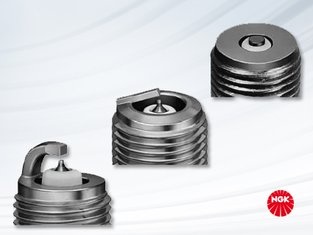
Dark ages nonsense for the most part. If anyone could measure a difference I'd be amazed.And as NGK say themselves
"Racing spark plugs must be able to resist especially hard loads because races often exceed 15,000 rpm.
Temperature, pressure, vibrations and currents in the combustion chamber are so large that a conventional ground electrode could break or burn out.
For this reason, racing spark plugs are designed, for example, with a ground electrode in ring-shaped. Instead of jumping, the spark slips from the Center electrode to the ground."
Edited by stevieturbo on Saturday 21st August 21:21
Gassing Station | Engines & Drivetrain | Top of Page | What's New | My Stuff