
Discussion


I'm trying to find some detail on X4906
I found this info, could someone de-code it for me?
Serial Pic Model Factory Notes (click note to toggle full text)
X4906 Ia EA FF 26-12-40 6MU 28-12-40 457S 24-6-41 53OTU 23-10-41 FAAC 16-5-42 attached RAE 1-6-42
Is there anywhere where I can look for some history/pictures of this particular aircraft?
I found this info, could someone de-code it for me?
Serial Pic Model Factory Notes (click note to toggle full text)
X4906 Ia EA FF 26-12-40 6MU 28-12-40 457S 24-6-41 53OTU 23-10-41 FAAC 16-5-42 attached RAE 1-6-42
Is there anywhere where I can look for some history/pictures of this particular aircraft?
Keep it stiff said:
I'm trying to find some detail on X4906
I found this info, could someone de-code it for me?
Serial Pic Model Factory Notes (click note to toggle full text)
X4906 Ia EA FF 26-12-40 6MU 28-12-40 457S 24-6-41 53OTU 23-10-41 FAAC 16-5-42 attached RAE 1-6-42
Is there anywhere where I can look for some history/pictures of this particular aircraft?
Serial Number - X4906I found this info, could someone de-code it for me?
Serial Pic Model Factory Notes (click note to toggle full text)
X4906 Ia EA FF 26-12-40 6MU 28-12-40 457S 24-6-41 53OTU 23-10-41 FAAC 16-5-42 attached RAE 1-6-42
Is there anywhere where I can look for some history/pictures of this particular aircraft?
Version - Vickers Supermarine Spitfire Mk IA
First Flight - 26 December 1940
Delivered to Number 6 Maintenance Unit (MU) 28 December 1940
Delivered to RAF 457 Squadron 24 June 1941
Delivered to RAF 53 Operational Training Unit (53 OTU) 23 October 1941
Damaged in a flying accident (Category C i.e. retired from flying) 16 May 1942
Transfered to the Royal Aircraft Establishment (RAE) on 1 June 1942
Thanks for this info.
I assume it no longer exists.
Is it possible to establish what alpha-numeric code would have been displayed on the fuselage and or any other information about it? I would love to find a picture.
The reason for my interest is that it was a presentation aircraft linked to the city of Bath and I'm trying to find some local history.
I assume it no longer exists.
Is it possible to establish what alpha-numeric code would have been displayed on the fuselage and or any other information about it? I would love to find a picture.
The reason for my interest is that it was a presentation aircraft linked to the city of Bath and I'm trying to find some local history.
Keep it stiff said:
Thanks for this info.
I assume it no longer exists.
Is it possible to establish what alpha-numeric code would have been displayed on the fuselage and or any other information about it? I would love to find a picture.
The reason for my interest is that it was a presentation aircraft linked to the city of Bath and I'm trying to find some local history.
If anyone has a picture or info, it's likely to be Mr.Spitfire himself, Peter Arnold, who was a regular contributor on the Flypast Forum before Key Publishing ruined it, and most of the old knowledgeable people like PA were driven away.I assume it no longer exists.
Is it possible to establish what alpha-numeric code would have been displayed on the fuselage and or any other information about it? I would love to find a picture.
The reason for my interest is that it was a presentation aircraft linked to the city of Bath and I'm trying to find some local history.
I have no idea what other media platforms/forums PA and others like him from those days now frequent instead.
Keep it stiff said:
Thanks for this info.
I assume it no longer exists.
Is it possible to establish what alpha-numeric code would have been displayed on the fuselage and or any other information about it? I would love to find a picture.
The reason for my interest is that it was a presentation aircraft linked to the city of Bath and I'm trying to find some local history.
The registration of the aircraft was X4906, so that is the "serial" (what you referred to as the "alpha-numeric" code) which would have been displayed on the aircraft. I assume it no longer exists.
Is it possible to establish what alpha-numeric code would have been displayed on the fuselage and or any other information about it? I would love to find a picture.
The reason for my interest is that it was a presentation aircraft linked to the city of Bath and I'm trying to find some local history.
Most RAF aircraft in World War 2 also displayed a three letter code system denoting the squadron (or other unit) and the individual aircraft. Squadrons were given a two letter code. For instance, 303 Squadron's code was "RU". So, aircraft in that squadron would have been RU-A, RU-B, RU-C etc.
457 Squadron was actually an Australian unit and the squadron codes in use at the time this Spitfire was delivered were "BP".
Here are some colour schemes worn by 457 Squadron Spitfires in 1941-42.
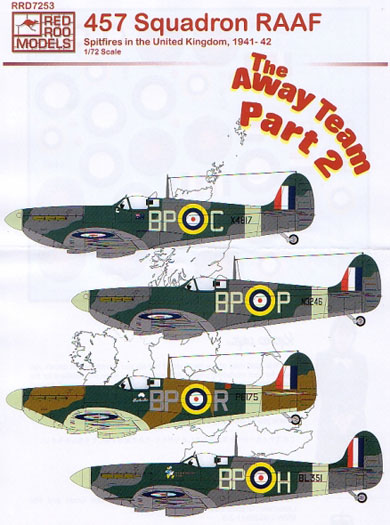
The Earth and Green scheme shown on BP-R is most likely what would have been worn by X4906, especially in its early life with the squadron.
Keep it stiff said:
Is it possible to establish what alpha-numeric code would have been displayed on the fuselage and or any other information about it? I would love to find a picture.
It would have worn the fuselage codes BP-* while with 457 Sqn, which appears to have been the only operational unit it flew with.It went to 457 on 24th June '41, so likely one of the original batch of Spit when 457 formed at RAF Bagington (now Coventry airport, but not for much longer) on 14th June '41.
457 Sqn records might get you the individual letter code it had.
I think I've found a photo of it [pic] https://m.facebook.com/photo.php?fbid=534353627506...tn=R-R[/pic]
CobolMan]I think I've found a photo of it [pic said:
PH at its best... from a generic request in less than 12 hours you get full history with pic 
Many thanks everyone, great info.
Was it usual for presentation aircraft to have markings such as City of Exeter as shown here?
https://commons.wikimedia.org/wiki/File:Supermarin...
Was it usual for presentation aircraft to have markings such as City of Exeter as shown here?
https://commons.wikimedia.org/wiki/File:Supermarin...
During the Battle of Britain, RAF fighters were camouflaged with Dark Earth and Dark Green upper surfaces with "sky" undersurfaces and (usually) black propeller spinners. It was found that, in the heat of a whirling dogfight, not enough of the colours stood out to allow RAF pilots to identify aircraft in this scheme to properly identify their own side's fighters - especially if the aircraft was in silhouette.
As a result, it was decided to change the spinner colour to Sky and to paint a Sky band around the rear fuselage.
In 1942, fighter colours changed to Ocean Grey and Dark Green upper surfaces with Medium Sea Grey undersides. But the sky band on the rear fuselage was retained. It was also decided to paint part of the wing leading edge with a yellow stripe.
Finally, in 1942 the red/white/blue proportions in the roundels and fin flashes were changed, with the white portions being made much thinner.
As a result, it was decided to change the spinner colour to Sky and to paint a Sky band around the rear fuselage.
In 1942, fighter colours changed to Ocean Grey and Dark Green upper surfaces with Medium Sea Grey undersides. But the sky band on the rear fuselage was retained. It was also decided to paint part of the wing leading edge with a yellow stripe.
Finally, in 1942 the red/white/blue proportions in the roundels and fin flashes were changed, with the white portions being made much thinner.
Eric Mc said:
During the Battle of Britain, RAF fighters were camouflaged with Dark Earth and Dark Green upper surfaces with "sky" undersurfaces and (usually) black propeller spinners. It was found that, in the heat of a whirling dogfight, not enough of the colours stood out to allow RAF pilots to identify aircraft in this scheme to properly identify their own side's fighters - especially if the aircraft was in silhouette.
Same reason the Luftwaffe favoured yellow spinners, noses, wingtips and tail surfaces for their 109s, especially to prevent misidentification as a Hurricane. When did the early war black/white underside get dropped? IIRC that lingered on until the summer of 1940 but was already being phased after experience in France showed that it made fighter formations much more visible in the air - when a flight all banked at the same time they created a very eye-catching chequerboard pattern to anyone looking from their underwing side.
There were various permutations of the "half black/half white" undersides. There was a 1938 version (around the time of the Munich Crisis where the port wing was black, the starboard wing was white and the underside of the fuselage was silver.
There has always been a conflict between the need to tone down the colours of an aircraft in order to make it harder for the enemy to see it whilst at the same time having some sort of distinguishing features which make them easier to identify to prevent friendly fire incidents.
There has always been a conflict between the need to tone down the colours of an aircraft in order to make it harder for the enemy to see it whilst at the same time having some sort of distinguishing features which make them easier to identify to prevent friendly fire incidents.
2xChevrons said:
When did the early war black/white underside get dropped? IIRC that lingered on until the summer of 1940 but was already being phased after experience in France showed that it made fighter formations much more visible in the air - when a flight all banked at the same time they created a very eye-catching chequerboard pattern to anyone looking from their underwing side.
The original black/white underside continued until June 1940, after which aircraft were no longer painted in this scheme at the factory, and the sky undersides factory scheme took over, and aircraft currently in service (that survived not getting shot down) would likely only get re-painted when having to go back to 2nd line maintenance units. With the turn-over of aircraft and attrition rates, that's why you see so few b/w undersides in the Battle of Britain period photos from July onwards.However, the scheme was re-introduced in November 1940, and used through the winter of 40/41 before being dropped again in April 1941.
Eric Mc said:
There was also a Sky/Black underside version.
It gets confusing.
Later on they switched to black/white stripes as an ID system. Although normally associated with D-Day, they were tried earlier in the war although the thickness of the stripes was different in the original versions.
Not on Spitfires. That was Typhoons, because they looked like 190s.It gets confusing.
Later on they switched to black/white stripes as an ID system. Although normally associated with D-Day, they were tried earlier in the war although the thickness of the stripes was different in the original versions.
Gassing Station | Boats, Planes & Trains | Top of Page | What's New | My Stuff