
Lotus Excel SE | The Brave Pill
No spreadsheet is necessary to calculate the appeal of this one

Many of us have used the sports car excuse over the years. This is the get out of jail free card frequently played when volunteers are being asked to step forward for transport duties for an expedition involving family or friends: "I'd love to drive, obviously - but I've only got a two seats."
Yet some more sociable types want to have both a sports car and the ability to give a lift to more than one other person at the time, which is where the sub-genre of four-seaters comes in. As a category these obviously blend with the comfier grand tourers, which, more often than not, come with the luxury of rear accommodation. But despite its extra pews the Lotus Excel definitely qualifies as being a proper sports car thanks to the combination of twin-cam power and a kerbweight lighter than a modern Mini.
While the imminent arrival of another four-seat Lotus started the thought process on this one, it didn't take long to decide on an Excel. This was based on rational criteria - the sensibleness of some shared Toyota parts and the fact that there are two in the classifieds, versus the grand total of zero Éclats. But also on the entirely emotional grounds that the Excel was one of the very first cars I experienced as a motoring journalist in the late 1990s.

I was a part-timer in those days, combining a day job selling software with a weekend gig doing small write-ups on interesting cars found in the back pages of a well-known classic car magazine. Beyond an instruction not to select anything too obvious - so none of the MGBs, Triumph TRs or Merc SLs that would inevitably be found in the features section - I had free rein as to what to choose, only needing to persuade the vendor to let me have a go. So, naturally, I immediately set about trying to fill in some of the many gaps in my automotive education.
Many of the cars I drove fell short of my fresh faced expectations, but the Excel comprehensively exceeded them. From memory it was a very similar SE to our Pill, but finished in black and being sold by a nice chap in darkest Oxfordshire who let me have a comprehensive test drive on some tight, slippery local roads. It was my first experience of a Lotus twin-cam engine - rorty, muscular - but also of the brand's chassis magic. The Excel had a plaint ride, a pointy front end and a rear axle which surrendered grip unscarily - even with the owner sitting next to me and egging me on. It went straight onto my list of personal dynamic heroes.
The Excel had been developed from the earlier Lotus Éclat, that being a stylish four-seater that - alongside the related Type 75 Elite - owed a substantial debt of inspiration to the Lamborghini Espada. Being a '70s Lotus the Éclat had also quickly developed a reputation for expensive shonkiness, especially chassis corrosion.

By the early 1980s Lotus was working closely with Toyota on what would become the A60 Supra, and so the decision was taken to use a fair amount of Toyota componentry for the new improved car. This included the rear differential, gearbox and both steering column plus the wheel itself for what was initially branded as Éclat Excel, but which was soon pruned to just become Excel. Power came from Lotus's long-serving slant four, this mounted as close to the front bulkhead as possible to help with weight distribution. The combination of a galvanised steel chassis and glassfibre bodywork - the rubbing strip hiding the gap between upper and lower mouldings - translated to an impressively svelte 1,168 kg kerbweight. So while there wasn't much mass to share between the axles its static balance was a perfect 50:50.
Despite generally positive reviews, demand was limited, and after four years of slow sales Lotus tried to increase interest with the launch of the SE version. This was a separate variant above the regular Excel, but in reality it seems to have effectively replaced the basic car in short order. The SE got a brawnier 180hp version of the 2.2-litre engine, indicated by a red cam cover, although one that still breathed through twin Dellorto carbs rather than the fuel injection most contemporary rivals had already switched to. It also got a walnut dashboard, electric windows an adjustable steering column and a chunkier front air dam. For £19,590 in 1986 it was just over £1,000 more than the regular car.
The price tag emerges from the inflation calculator at £61,000 in 2022 pounds, but it still made the SE look like strong value compared to posher rivals: the similarly powerful Porsche 944S started at £25,300. But reviewers seemed less keen on the SE than they had the original car, with criticism of the limited refinement of the slant four when worked hard. The SE only revived fading sales numbers briefly, and during ten years of production Lotus sold just 2,075 Excels of all types.

Yet despite the modest numbers out there, Excel values haven't made for the stratosphere as interest in other '80s neo-classics has risen. For £15,995 this one looks like fair value for a low-mileage car being sold by a dealer whose specialist credentials are underwritten by also having the only other Excel currently in the classifieds.
The advert claims our Pill comes with good service history, and the MOT history confirms both attentive care in its cleanliness, but also that mileage has been creeping up both slowly and constantly. So although the Excel has only covered a couple of hundred miles between its recent tests, they do pretty much run together without gaps - a sign of the sort of constant use which is much better for cars of this era than long periods off the road. The official record shows the Excel passed the 50,000 mile barrier just before its 2017 test, with that figure having only increased to 51,123 by the time the most recent ticket got digitally stamped in February.
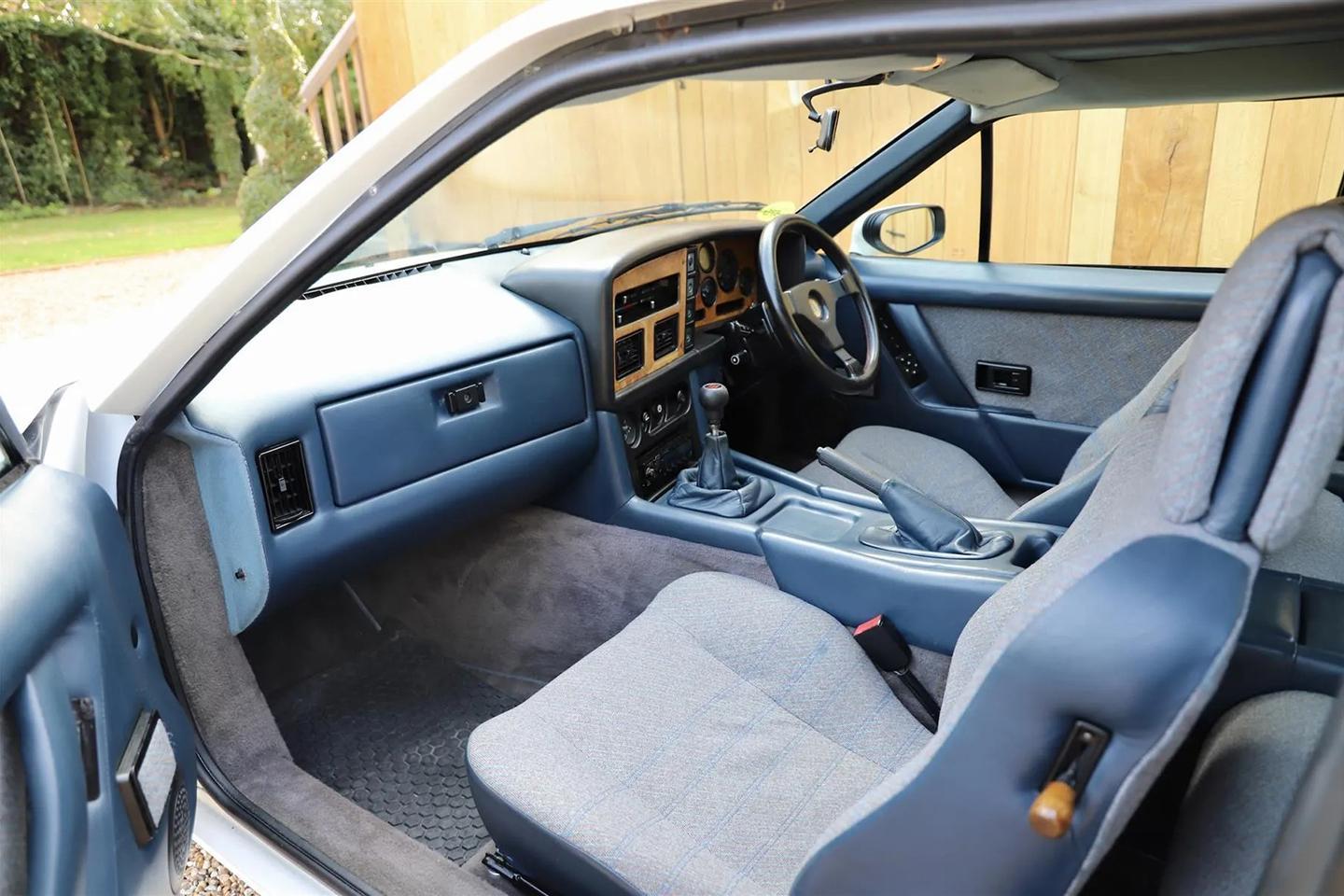
Don't worry; as you would expect for any Pill this one is spared the heresy of perfection. The original buyer opted for the standard tweed cloth trim instead of the £1,000 upgrade to full leather, and although the grey fabric still looks nice it is sagging on the passenger door card, and a patch of rear headlining also seems to have lost the fight against gravity.

Although widely spread throughout a generation of Lotus products, and widely known to specialists, the slant four engine also suffers from enough issues to be considered courageous, and while the late high-compression 912 iteration featured here is one of the tougher members of the clan, owners still report a tendency towards bearing wear on some. The Toyota bits should be tough, but, ironically, may actually be harder to replace if they do go wrong than the better supported pure Lotus componentry.
Although we don't have finalised pricing for the all-electric Eletre it seems likely that you'd be able to nab this Excel SE for well under 20 percent of the EV's price tag, and it wouldn't be surprising if the Excel also turns out to be less than half the weight, too - while able to transport an equal number of people to the next local chapter meeting of the Lotus Owners' Club. You'd almost certainly feel more welcome when you get there, too - and wouldn't need to ask permission to hook up an extension cord.


I’ve seen some interesting Excels , ranging from well priced average examples as this pill to completely lovingly rebuilt ones owned by enthusiasts. Also there seems to be plenty of auction Excels popping up (over a year not monthly)most of these seem complete yet neglected and underused.
On reflection I’d say the only Excel or any lotus of this era to buy is the one that’s been over restored and has had more money sunk into it than it will ever be worth, and in all likelihood is way better than it ever left the Lotus factory. Such cars do appear, and I doubt they’d be dearer than this example. I had no regard for the low mileage on this one and personally it wouldn’t add any value to me on such an old car.
Anyway , having looked and researched,(write ups ,contemporary test drives YouTube videos) but never driven one I have come to the conclusion that an Excel is a nearly car.
Nearly great, nearly fast , no where near torquey or not nearly powerful enough old fashioned engine to to compensate, these fundamental draw backs which come with an underfunded cheaply built plastic car.
I also came across video of a lexus V8 converted Excel , and even this seemed underwhelming.(too heavy?)
So My radical Excel idea, would be to buy a cheap but complete example and do what Colin chapman would surely do if he was around today .
So keeping to his adding lightness theory , I would change out the sixties boat anchor engine for a modern Fiesta ST triple 1.5 which would at a stroke bring circa 230 bhp, add bags of low down torque and perhaps bring the kerb weight down to close to 1000 kgs.
By my estimates a fully dressed twin cam engine weighs about 180 kg produces 217nm torque (@5000 rpm)
Fiesta triple engine mildly chiptuned 230 bhp, 390 nm torque and 122 kg fully dressed.
It’s the low down torque that would transform.
Anyway , Sunday morning musings, no hangover !!!!
2.3L Ecoboost crate engine!
I’ve seen some interesting Excels , ranging from well priced average examples as this pill to completely lovingly rebuilt ones owned by enthusiasts. Also there seems to be plenty of auction Excels popping up (over a year not monthly)most of these seem complete yet neglected and underused.
On reflection I’d say the only Excel or any lotus of this era to buy is the one that’s been over restored and has had more money sunk into it than it will ever be worth, and in all likelihood is way better than it ever left the Lotus factory. Such cars do appear, and I doubt they’d be dearer than this example. I had no regard for the low mileage on this one and personally it wouldn’t add any value to me on such an old car.
Anyway , having looked and researched,(write ups ,contemporary test drives YouTube videos) but never driven one I have come to the conclusion that an Excel is a nearly car.
Nearly great, nearly fast , no where near torquey or not nearly powerful enough old fashioned engine to to compensate, these fundamental draw backs which come with an underfunded cheaply built plastic car.
I also came across video of a lexus V8 converted Excel , and even this seemed underwhelming.(too heavy?)
So My radical Excel idea, would be to buy a cheap but complete example and do what Colin chapman would surely do if he was around today .
So keeping to his adding lightness theory , I would change out the sixties boat anchor engine for a modern Fiesta ST triple 1.5 which would at a stroke bring circa 230 bhp, add bags of low down torque and perhaps bring the kerb weight down to close to 1000 kgs.
By my estimates a fully dressed twin cam engine weighs about 180 kg produces 217nm torque (@5000 rpm)
Fiesta triple engine mildly chiptuned 230 bhp, 390 nm torque and 122 kg fully dressed.
It’s the low down torque that would transform.
Anyway , Sunday morning musings, no hangover !!!!
Peerless chassis but compromised in many other ways and lacking the iconic status of an early Esprit or Space 1999 wackiness of 70s Elite/Eclat.
1.5 Fiesta triple sounds an excellent plan. ACBC would surely approve, especially in the absence of a suitable motor from Vauxhall whence the 2.2 slant four in the Excel ultimately derived. A cooking Ford block was good enough for the Elan after all.
When does your project start?;)
 every steel component was covered in thick rust. Not just surface rust, but real heavy stuff, as if it had been stored in shallow sea water for 10 years. It was priced towards the top of the price range, so it was rather sobering. Anyway I politely declined to buy it and ended up with something else altogether.
https://www.autotrader.co.uk/car-details/202111179...
Jay was telling us to buy one 5 years ago.

My 1979 car covered 20,000 miles in 2 years of ownership back in the 90s, and was by and large a great car.
There were some design flaws, such as the foam insert between the chassis and the body which held onto moisture and caused rot, and the complex vacuum operated pop-up lights.
Both of these were remedied for the Excel which came with a galvanised back bone chassis.
That said, the car was nearly quick enough to match its exotic looks, and handled and rode beautifully.
I owned a 944 after the Eclat, which was of course a better ownership experience, but lacked the character and charm of the Lotus.
My car (all Eclats actually) developed a slight leak in a vacuum pipe which caused one of the headlights to raise a fraction when left overnight. It had the look of Roger Moore about it…
But at the time, I did not have the resources to give it the love and attention it required.
Hopped from the Excel into my E46 M3 and it made the BMW feel like a wallowy old imprecise lump (obv the M3 would likely run rings around the Lotus, but the handling and steering feel were vastly superior on the Excel)

Gassing Station | General Gassing | Top of Page | What's New | My Stuff