
Rev Range Data
Discussion


Morning fellow Porsche Owners
Iv got a 997.1 C2S - thread can be found here: https://www.pistonheads.com/gassing/topic.asp?h=0&...
Iv recently go the over revs read out as follows:
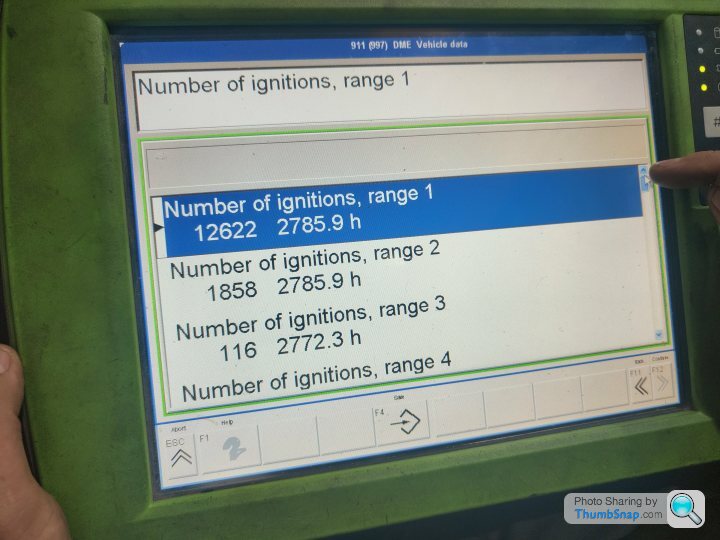
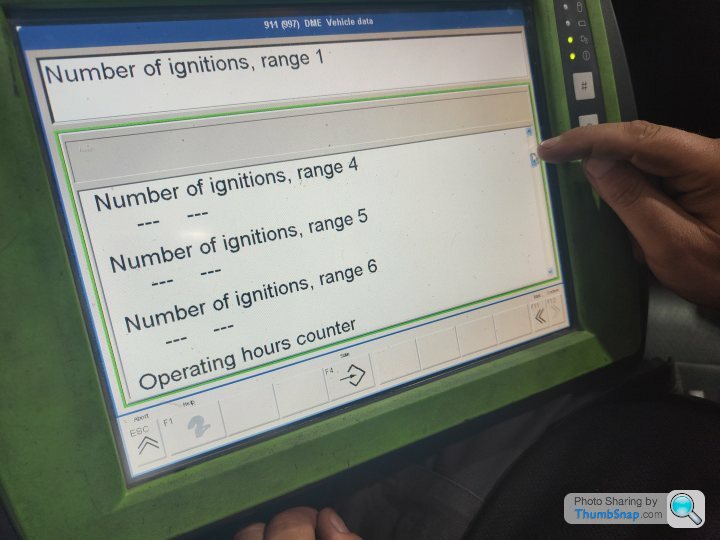
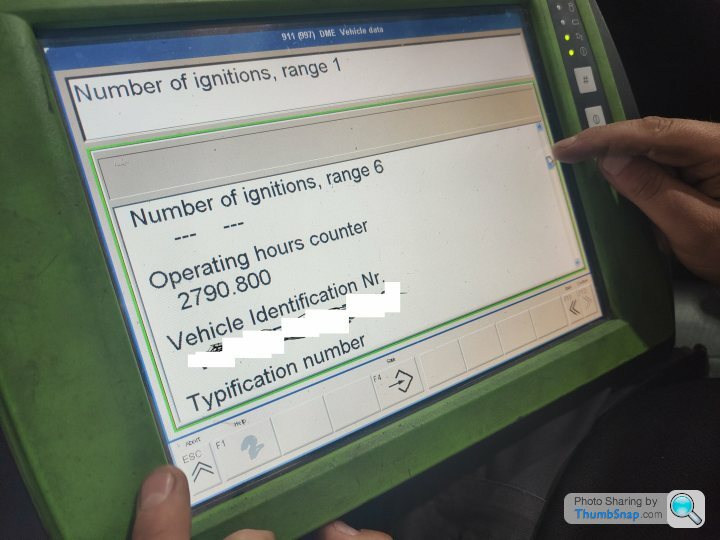
From what I understand ranges 1-3 are typical of hitting the limiter. Can anyone shed anymore light/feedback on these readouts?
Thanks in advance
Iv got a 997.1 C2S - thread can be found here: https://www.pistonheads.com/gassing/topic.asp?h=0&...
Iv recently go the over revs read out as follows:
From what I understand ranges 1-3 are typical of hitting the limiter. Can anyone shed anymore light/feedback on these readouts?
Thanks in advance
What do you want to know?
Range 1,2,3 are hitting the limiter.
The hours next to the number of ignitions are when it last hit that range.
So you hit the limiter last about 5 running hours ago based on the overall running time.
Your average MPH works out about right for 90k miles (range/number of total running hours) at about 32MPH average.
Range 1,2,3 are hitting the limiter.
The hours next to the number of ignitions are when it last hit that range.
So you hit the limiter last about 5 running hours ago based on the overall running time.
Your average MPH works out about right for 90k miles (range/number of total running hours) at about 32MPH average.
First I've heard of range 3 being accessible courtesy of merely hitting the limiter. I've always thought only range 1 and 2 can be triggered that way with anything higher some kind of mechanical over rev.
I've certainly bounced the limiter in several of my 9x7 cars without triggering range 3.
I've certainly bounced the limiter in several of my 9x7 cars without triggering range 3.
romeodelta said:
Not sure why people in the Porsche world get so hung up on this.
It's a car, that's meant to be driven.
Doesn't seem to happen with any other marque (Ferrari mileage excepted).
Presumably if it's been overrevved too many times they won't let you extend the warranty? (An option for cars up to 15 years old).It's a car, that's meant to be driven.
Doesn't seem to happen with any other marque (Ferrari mileage excepted).
john41901 said:
Presumably if it's been overrevved too many times they won't let you extend the warranty? (An option for cars up to 15 years old).
Bingo. If I recall correctly, ranges 3-4 require a compression test by the OPC and must have been XYZ hours ago and 5 onwards aren’t deemed warranty-worthy, or something to that effect. 
romeodelta said:
Not sure why people in the Porsche world get so hung up on this.
It's a car, that's meant to be driven.
Doesn't seem to happen with any other marque (Ferrari mileage excepted).
It's like a lot of things. Even if you aren't worried about the mechanical implications of a car with some rev range implications, you have to factor in the impact on resale. Similar to a Ferrari with mileage. You may not care, but the market does and so that's the reality.It's a car, that's meant to be driven.
Doesn't seem to happen with any other marque (Ferrari mileage excepted).
Moreover, having scanned a lot of these cars myself over the years, it's only a fairly smallish minority that have ignitions above range two. So, you're not narrowing your market much by excluding cars with anything above range two.
romeodelta said:
Not sure why people in the Porsche world get so hung up on this.
It's a car, that's meant to be driven.
Doesn't seem to happen with any other marque (Ferrari mileage excepted).
It’s just the way it is.It's a car, that's meant to be driven.
Doesn't seem to happen with any other marque (Ferrari mileage excepted).
Depends on the use case a bit, if your just want to buy the car, don’t care about the value of the car / never intent to sell it and can self-warranty then yes, treat as bs.
However, for some 911s, for example my .2 GT3, even a tiny amount of ignitions in range 3 will be a ball ache when trying to sell.
Just discount anything with ignitions above ranges 1 and 2.

anonymous said:
[redacted]
It's not at all complicated. Each rev range pertains to a certain rpm. The engine limiter likewise is set to a certain rpm and won't allow the engine to be revved higher. So, if the rev limiter is set below rev range 3, you will never trigger that range or any of the higher ranges by simply revving the engine into the limiter.In a manual car you can exceed the limiter by changing down to too low a gear. If you're doing near max revs in 3rd and shift to 2nd, you will exceed the limiter if you allow the clutch to fully engage. Arguably more commonly, it's a 'miss' shift that causes the problem, like shifting down to 4th from 5th, but accidentally selecting 2nd.
You can't generalise about any given mis-shift, it all depends on road speed, resulting engine speed and the specific rev ranges for the model in question, as those vary.
Personally, have not previously heard of range 3 being achievable from bumping the limiter. Which is presumably why Porsche requires a compression test to apply a warranty to any car that has ignitions range 3 and above.
The DME monitors the rev ranges on 987 + 997 as follows:
Rev range 1: 7,200 -1 ... to 7,500 -1
Maximum permitted engine speed exceeded; engine damage possible.
Rev range 2: 7,500 -1 ... to 7,700 -1
Maximum permitted engine speed exceeded; engine damage possible.
Rev range 3: 7,700 -1 ... to 7,900 -1
Maximum permitted engine speed exceeded; engine damage probable.
Rev range 4: 7,900 -1 ... to 8,400 -1
Maximum permitted engine speed clearly exceeded; engine damage very probable.
Rev range 5: 8,400 -1 … to 9,500 -1
Maximum permitted engine speed very clearly exceeded; engine damage has generally occurred.
Rev range 6: over 9,500 -1
Maximum permitted engine speed very clearly exceeded; engine damage has generally occurred.
To be plausible the counters will show a tapering score with range 1 being the highest - if you get to range four you must go through 1; 2 and 3 on the way up and then back through on the way down.
The ranges are used for diagnosis in cases of engine failure for obvious reasons - it is not the fault of the manufacturer if operator error damages the engine.....
Personally have seen range 3 on cars that have been accelerated downhill for example - where the acceleration forces push the engine faster than the limiter allows if the driver stays in the throttle and doesn't change gear.
Rev range 1: 7,200 -1 ... to 7,500 -1
Maximum permitted engine speed exceeded; engine damage possible.
Rev range 2: 7,500 -1 ... to 7,700 -1
Maximum permitted engine speed exceeded; engine damage possible.
Rev range 3: 7,700 -1 ... to 7,900 -1
Maximum permitted engine speed exceeded; engine damage probable.
Rev range 4: 7,900 -1 ... to 8,400 -1
Maximum permitted engine speed clearly exceeded; engine damage very probable.
Rev range 5: 8,400 -1 … to 9,500 -1
Maximum permitted engine speed very clearly exceeded; engine damage has generally occurred.
Rev range 6: over 9,500 -1
Maximum permitted engine speed very clearly exceeded; engine damage has generally occurred.
To be plausible the counters will show a tapering score with range 1 being the highest - if you get to range four you must go through 1; 2 and 3 on the way up and then back through on the way down.
The ranges are used for diagnosis in cases of engine failure for obvious reasons - it is not the fault of the manufacturer if operator error damages the engine.....
Personally have seen range 3 on cars that have been accelerated downhill for example - where the acceleration forces push the engine faster than the limiter allows if the driver stays in the throttle and doesn't change gear.
Pope said:
Personally have seen range 3 on cars that have been accelerated downhill for example - where the acceleration forces push the engine faster than the limiter allows if the driver stays in the throttle and doesn't change gear.
Assume that's an inference rather than an actual observation?I get the theory, but seems implausible. At very high rpm the engine will be generating a great deal of engine breaking and the point of the limiter is that while the driver may be 'staying in the throttle', the ECU is over riding that. I do not see one of these cars accelerating downhill in gear with the engine already spinning at 7,500rpm-plus and the ECU cutting power.
The question is whether the momentum (actually acceleration) of going downhill is enough to overcome the significant engine braking at very high rpm.
Take your car up to about 6,500rpm (leaving a bit of margin just in case!) pointing down a hill and then lift off (the ECU lifts off for you when you reach the limiter). You think the car is going to accelerate? I'm not convinced.
Take your car up to about 6,500rpm (leaving a bit of margin just in case!) pointing down a hill and then lift off (the ECU lifts off for you when you reach the limiter). You think the car is going to accelerate? I'm not convinced.
esotericar said:
The question is whether the momentum (actually acceleration) of going downhill is enough to overcome the significant engine braking at very high rpm.
Take your car up to about 6,500rpm (leaving a bit of margin just in case!) pointing down a hill and then lift off (the ECU lifts off for you when you reach the limiter). You think the car is going to accelerate? I'm not convinced.
Not sure about that - in most cases it cuts the fuelling or ignition; it doesn't shut the throttle. The whole situation occurs in less than a fraction of a second so the explanation has always sounded plausible to me.Take your car up to about 6,500rpm (leaving a bit of margin just in case!) pointing down a hill and then lift off (the ECU lifts off for you when you reach the limiter). You think the car is going to accelerate? I'm not convinced.
Not had any I can think of with only RR3 recorded that have suffered failure specifically. Generally it's do the checks as advised, document and carry on.
Gassing Station | Porsche General | Top of Page | What's New | My Stuff