
Parking sensor dropped into bumper
Discussion


A few weeks ago I backed my car into my partner’s car. Only doing 2-3 mph, hell of a bang, but a quick examination of both cars revealed no damage so I thought I’d got away with it.
After washing my car on Saturday I noticed a 3-4cm section of paint had come off the bumper - maybe it cracked at the time of the impact and I’ve dislodged the paint today whilst cleaning the car. Not the end of the world.
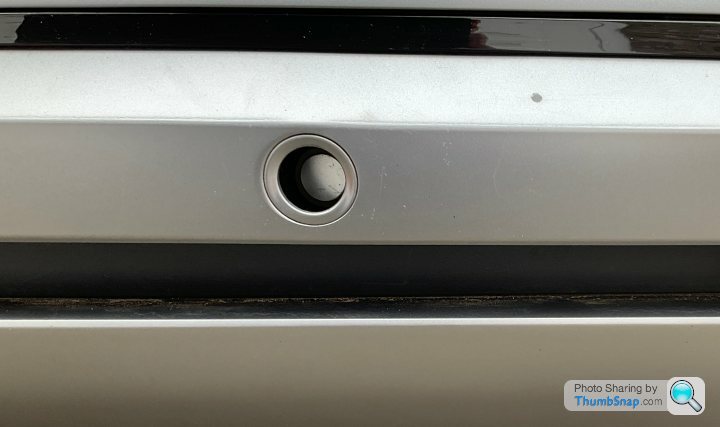
But, while backing the car off the drive, the reversing sensor was constantly sounding. A quick check and one of the sensors is now inside the bumper. Again it was probably weakened at the time and my cleaning has finally caused it to give way.
From what I can see, there’s nothing damaged or broken, I think the impact has just caused the bumper to flex and the sensor to pop out if its retaining clips. The problem I have is coaxing it back in place. I’ve managed to take a part of the underside of the bumper off this morning which gave a large enough gap for me to get my arm into. I was hoping I’d be able to feel the sensor flopping about and just push it back it, but the circular part of the sensor seems to be in a box shaped housing and it is into this housing which the sensor has fallen. That means no rear access without dropping the bumper, which I’m not very keen to take on.
So, that’s my problem - how to coax the loose part of the sensor back into its channel and flush with the bumper, with only being able to access it from the front and it ending up filling a hole exactly the same size as the sensor (so I can’t use a tool that grips the sides of the sensor to pull it with as the tool fouls the hole).
I’ve tried, and failed, to use a blob of blutak and some really sticky tape on the end of a screwdriver. Both times it stuck, but it came away as soon as the sensor got to the last few mm of the channel - the fit is tight there to hold it in place. Someone suggested glueing something to the sensor which would probably work but I suspect would ruin the sensor when I tried to remove it afterwards.
After washing my car on Saturday I noticed a 3-4cm section of paint had come off the bumper - maybe it cracked at the time of the impact and I’ve dislodged the paint today whilst cleaning the car. Not the end of the world.
But, while backing the car off the drive, the reversing sensor was constantly sounding. A quick check and one of the sensors is now inside the bumper. Again it was probably weakened at the time and my cleaning has finally caused it to give way.
From what I can see, there’s nothing damaged or broken, I think the impact has just caused the bumper to flex and the sensor to pop out if its retaining clips. The problem I have is coaxing it back in place. I’ve managed to take a part of the underside of the bumper off this morning which gave a large enough gap for me to get my arm into. I was hoping I’d be able to feel the sensor flopping about and just push it back it, but the circular part of the sensor seems to be in a box shaped housing and it is into this housing which the sensor has fallen. That means no rear access without dropping the bumper, which I’m not very keen to take on.
So, that’s my problem - how to coax the loose part of the sensor back into its channel and flush with the bumper, with only being able to access it from the front and it ending up filling a hole exactly the same size as the sensor (so I can’t use a tool that grips the sides of the sensor to pull it with as the tool fouls the hole).
I’ve tried, and failed, to use a blob of blutak and some really sticky tape on the end of a screwdriver. Both times it stuck, but it came away as soon as the sensor got to the last few mm of the channel - the fit is tight there to hold it in place. Someone suggested glueing something to the sensor which would probably work but I suspect would ruin the sensor when I tried to remove it afterwards.
Jazoli said:
Removing a rear bumper is very straightforward and shouldn't take more than 30 minutes at most, what car is it?
Hyundai Ioniq 5. I watched a YouTube video this morning of a guy removing the bumper so he could fit a tow bar. It’s just a load of screws and clips but even this guy who seemed really competent remarked that he broke a few clips along the way. He was of the opinion that the bumpers are not really designed to be removed and replaced and that you’d usually be putting a new one on after the original has been wrecked. That’s why the clips breaking wouldn’t matter.It may be removal of the bumper is the only way to do it but I thought I’d try on here first in case someone had been through this before and found a way to do it I haven’t considered.
paintman said:
Not tried it on a sensor but hot glue?
Stick something to the sensor & once you've - hopefully - pulled it back into place use a hot air gun carefully to get the glue hot enough to release.
What temperature does the glue release at and does it come off cleanly? I’m worried about destroying the sensor in the process.Stick something to the sensor & once you've - hopefully - pulled it back into place use a hot air gun carefully to get the glue hot enough to release.
Someone suggested a suction cup. This sounds like it might be an option, if I can find one small enough. The sensor is 12mm diameter, so I reckon I’d need one about 10mm to allow for it to splay out when it connects.
I'd try to hook the wire so that I can drag the sensor to somewhere accessible. Then you can either grab hold of it from the back and simply push it into place, or loop a piece of button thread or similar round the back of it and pull it into position from the outside. It would probably help to have something tacky stuck on the front so you can orient it and guide it into its hole, but I don't think you'd ever be able to use that alone to pull it into position. Just getting hands on it and pushing it into place will be the quickest approach by far if you can get your hand on it.
Just pull it out as far as you can & whilst holding it out superglue round the edges.
I've put a few back in over the years, but always managed to access from behind & they usually take a fair push to get them to seat properly.
Or, depending on the sensor, you might need to line up lugs on the sensor with the corresponding receiving holes they click into on the bumper. (Or vice versa) They can break with the impact & if they have you're snookered.
The sucker might work if you've got a handheld vacuum pump or similar to get maximum suction, I can't see a little push on one having the sticky power.
I've put a few back in over the years, but always managed to access from behind & they usually take a fair push to get them to seat properly.
Or, depending on the sensor, you might need to line up lugs on the sensor with the corresponding receiving holes they click into on the bumper. (Or vice versa) They can break with the impact & if they have you're snookered.
The sucker might work if you've got a handheld vacuum pump or similar to get maximum suction, I can't see a little push on one having the sticky power.
Edited by paintman on Monday 19th September 20:28
paintman said:
Just pull it out as far as you can & whilst holding it out superglue round the edges.
I've put a few back in over the years, but always managed to access from behind & they usually take a fair push to get them to seat properly.
Or, depending on the sensor, you might need to line up lugs on the sensor with the corresponding receiving holes they click into on the bumper. (Or vice versa) They can break with the impact & if they have you're snookered.
The sucker might work if you've got a handheld vacuum pump or similar to get maximum suction, I can't see a little push on one having the sticky power.
I had high hopes that it would be an easy fix when I managed to get my hand in there earlier, but alas not. I too think a suction cup of such a small size is going to struggle. The thread option mentioned above may be a possibility though if I can loop it round it somehow. It will depend on whether the sensor is a cylinder or shaped more like a golf tee with a “head” to loop around.I've put a few back in over the years, but always managed to access from behind & they usually take a fair push to get them to seat properly.
Or, depending on the sensor, you might need to line up lugs on the sensor with the corresponding receiving holes they click into on the bumper. (Or vice versa) They can break with the impact & if they have you're snookered.
The sucker might work if you've got a handheld vacuum pump or similar to get maximum suction, I can't see a little push on one having the sticky power.
Edited by paintman on Monday 19th September 20:28
Semmelweiss said:
Small neodymium magnet with hole in it. Dental floss through hole. Drop through hole in bumper. Fish it up.
Dental floss in loop around sensor. Hold tight and pull through hole in bumper. Cut dental floss and pull through.
Now that's an elegant solution! I've never heard of neodymium but I'm off to research it right away. Thanks very much.Dental floss in loop around sensor. Hold tight and pull through hole in bumper. Cut dental floss and pull through.
Silverage said:
Semmelweiss said:
Small neodymium magnet with hole in it. Dental floss through hole. Drop through hole in bumper. Fish it up.
Dental floss in loop around sensor. Hold tight and pull through hole in bumper. Cut dental floss and pull through.
Now that's an elegant solution! I've never heard of neodymium but I'm off to research it right away. Thanks very much.Dental floss in loop around sensor. Hold tight and pull through hole in bumper. Cut dental floss and pull through.
Silverage said:
Right, I've been and researched. So this is a two-stage operation? The magnet is used to hold the loose sensor steady while I get a loop of floss around it and then use the floss to pull the sensor properly in position and slide the magnet off? I wonder if the magnet itself would be strong enough to allow the sensor to be pulled back in place?
Yes it is.Silverage said:
I've fallen at the first hurdle. I've just been out with a regular magnet I had lying around and the sensors don't have enough metal in them for it to stick.
Neodymium are WAY stronger. If you have an old hard disk at home, take it apart and inside there will be (at least) 2 neodymiums. Touch them together and you will see what I mean.These are the ones that I have used to retrieve magnetic items from motorcycle clutches, and various items dropped into inaccessible locations.
https://www.amazon.co.uk/dp/B007UOXRY0
Semmelweiss said:
Neodymium are WAY stronger. If you have an old hard disk at home, take it apart and inside there will be (at least) 2 neodymiums. Touch them together and you will see what I mean.
These are the ones that I have used to retrieve magnetic items from motorcycle clutches, and various items dropped into inaccessible locations.
https://www.amazon.co.uk/dp/B007UOXRY0
Ah I see. These are the ones that I have used to retrieve magnetic items from motorcycle clutches, and various items dropped into inaccessible locations.
https://www.amazon.co.uk/dp/B007UOXRY0
I do have some old hard disks lying around actually so I could break one up. The magnets aren't going to be so strong that they'll wreck the sensor though are they?
I've sacrificed and old 40gb Maxtor drive and found one magnet inside it. While the magnet is quite keen on my screwdrivers and any other bits of nearby metal on my desk, it wants nothing to do with the sensors on the car, so I can only assume they either have no or only very small amounts of metal in them.
I do like the dental floss lassoo part of the plan though, so I'm going to attempt some keyhole surgery with a couple of screwdrivers.
I do like the dental floss lassoo part of the plan though, so I'm going to attempt some keyhole surgery with a couple of screwdrivers.
Gassing Station | Home Mechanics | Top of Page | What's New | My Stuff