
How long does it really take for oil to sludge up?
Discussion


I've seen a lot of "Customer states" videos showing engines (in the US) absolutely barmed up due to missed oil changes, usually stating (possibly because the customer lied) that the oil is 20k miles or less. I know in the US there is a tradition of changing engine oil every few thousand miles, hence all the quick-lube places. The expectation of such short oil intervals does make me wonder about the quality of the oil being used.
Over here, I remember one PH member posting a video showing an old runabout he bought where the oil drain involved using things like white spirit and diesel to get it moving. Clearly a neglected engine but I seem to recall the oil hadn't been changed in 10 years.
Now... I have never seen an engine go sludgy. I am pretty sure I've changed 20k mile oil before with no sludge, and I've had the rocker covers off most engines I've owned and never seen sludge.
So how long does it really take a properly working engine to go sludgy when filled with a good quality oil?
Over here, I remember one PH member posting a video showing an old runabout he bought where the oil drain involved using things like white spirit and diesel to get it moving. Clearly a neglected engine but I seem to recall the oil hadn't been changed in 10 years.
Now... I have never seen an engine go sludgy. I am pretty sure I've changed 20k mile oil before with no sludge, and I've had the rocker covers off most engines I've owned and never seen sludge.
So how long does it really take a properly working engine to go sludgy when filled with a good quality oil?
A few years back my mum handed over her Honda Jazz to my brother after about 4 years of owning it. She confessed she couldn’t remember when it was last serviced if at all. I dropped the oil and it came out like treacle and changed the filters (the air filter had a thick layer of crap on it) he ran it for 100 miles and we dropped the oil again and although a more regular viscosity it was jet black. Filter and oil changed again about 500 miles after that and it looked close to normal. Changed yearly from then on and it was fine luckily. Eventually when he was going through some receipts when he sold it we discovered it hasn’t been serviced for almost 5 years and 55,000 miles! Fortunately only a little unstressed engine but it I’m not sure how long it would have lasted had we not got to it when we did!
Best not let it get in that condition, removing the rocker cover will give a rough idea of how bad things are but then comes the question of what, short of cleaning all the crud from the entire crankcase by hand, a task likely to take several days, do you do about it.
If you use a flushing oil and it starts to breaks up and find its way into the sump the chances are of a blocked pick up pipe and engine seizure, even if you leave it in place and just change the oils normally good quality oil will start to break the filth up.
I've seen all sorts of engines thick with carbon crud, every one caused through neglect, saved a few £hundred at most on oil changes at the cost of a scrap engine or one needing fully stripping.
What doesn't help is fuel injectors, especially Diesel, being inside the engine instead of as they once were bolted or clamped from outside the head like spark plugs, if a seal fails outside you see it straight away, inside it can carbonise the oil in rapid time leading to blocked sump pick up and ruination.
Fortunately on 3.0 litre Toyota Diesels the oil pick up is directly over the sump bung so inspection of the filter is easy every time you change the oil, might be worth checking on your car with an endoscope shoved up the drain hole.
For what its worth none of my own vehicles has ever gone beyond 5000 miles between oil changes and never will.
Large truck engines are now typically on 100,000km oil change intervals, but they are generally fitted with oil spinners which remove much of the carbon and have sump capacities of 5 gallons or more plus there will be fresh oil added in those 100k, my own truck gets over 2 gallons total added in between services.
Have heard of people adding oil spinners to their car engines but never seen one so fitted personally, seldom even see an aftermarket oil pressure gauge.
I'd not buy a car that had seen 20k or so called long life oil change intervals regardless of the alleged oil quality, especially as so many owners boast of using no oil between services and the sump likely to hold no more than 5 litres in the first place, nor would i want a car without a dipstick to see feel and smell the oil for myself.
If you use a flushing oil and it starts to breaks up and find its way into the sump the chances are of a blocked pick up pipe and engine seizure, even if you leave it in place and just change the oils normally good quality oil will start to break the filth up.
I've seen all sorts of engines thick with carbon crud, every one caused through neglect, saved a few £hundred at most on oil changes at the cost of a scrap engine or one needing fully stripping.
What doesn't help is fuel injectors, especially Diesel, being inside the engine instead of as they once were bolted or clamped from outside the head like spark plugs, if a seal fails outside you see it straight away, inside it can carbonise the oil in rapid time leading to blocked sump pick up and ruination.
Fortunately on 3.0 litre Toyota Diesels the oil pick up is directly over the sump bung so inspection of the filter is easy every time you change the oil, might be worth checking on your car with an endoscope shoved up the drain hole.
For what its worth none of my own vehicles has ever gone beyond 5000 miles between oil changes and never will.
Large truck engines are now typically on 100,000km oil change intervals, but they are generally fitted with oil spinners which remove much of the carbon and have sump capacities of 5 gallons or more plus there will be fresh oil added in those 100k, my own truck gets over 2 gallons total added in between services.
Have heard of people adding oil spinners to their car engines but never seen one so fitted personally, seldom even see an aftermarket oil pressure gauge.
I'd not buy a car that had seen 20k or so called long life oil change intervals regardless of the alleged oil quality, especially as so many owners boast of using no oil between services and the sump likely to hold no more than 5 litres in the first place, nor would i want a car without a dipstick to see feel and smell the oil for myself.
Back when it was clearly heading for the big scrap heap in the sky anyway, I decided to experiment with not servicing my wife's old Fiat Panda. It lasted about 4 years and 20k miles of mostly short journeys before it suffered any obvious ill effects and which point we started to notice a drop in power, rise in fuel consumption, and erratic temperature fluctuations which got steadily worse over the next few months.
Shortly before we finally got rid of it (due to the power steering motor failing), I changed the oil, coolant and water pump and it appeared to go entirely back to how it started before the whole experiment so there was no obvious damage done to the engine. Everything I could get at to inspect certainly looked OK - compression was still good, the bores were still smooth, the crank didn't appear to have any play in it, the top-end looked OK (although it's very hard to spot cam-lobe wear by eye),...
I still change the oil regularly in anything which isn't on its last legs though. For the sake of £50 a year it just doesn't seem worth the risk of not doing so.
Shortly before we finally got rid of it (due to the power steering motor failing), I changed the oil, coolant and water pump and it appeared to go entirely back to how it started before the whole experiment so there was no obvious damage done to the engine. Everything I could get at to inspect certainly looked OK - compression was still good, the bores were still smooth, the crank didn't appear to have any play in it, the top-end looked OK (although it's very hard to spot cam-lobe wear by eye),...
I still change the oil regularly in anything which isn't on its last legs though. For the sake of £50 a year it just doesn't seem worth the risk of not doing so.
Edited by kambites on Friday 23 September 17:22
Sludge is a thing of the past.
The reality is you can probably run a modern car on synthetic to 100,000 miles with no oil changes at all - but that would depend on the use cycle. Manufacturers do these kinds of crazy things in durability testing before they come back and recommend "2 years or 20,000 miles" as a compromise to make allowance for city driving, lots of cold start running etc.
The reality is you can probably run a modern car on synthetic to 100,000 miles with no oil changes at all - but that would depend on the use cycle. Manufacturers do these kinds of crazy things in durability testing before they come back and recommend "2 years or 20,000 miles" as a compromise to make allowance for city driving, lots of cold start running etc.
Panamax said:
Sludge is a thing of the past.
The reality is you can probably run a modern car on synthetic to 100,000 miles with no oil changes at all - but that would depend on the use cycle. Manufacturers do these kinds of crazy things in durability testing before they come back and recommend "2 years or 20,000 miles" as a compromise to make allowance for city driving, lots of cold start running etc.
^^^^ Wot 'e said.The reality is you can probably run a modern car on synthetic to 100,000 miles with no oil changes at all - but that would depend on the use cycle. Manufacturers do these kinds of crazy things in durability testing before they come back and recommend "2 years or 20,000 miles" as a compromise to make allowance for city driving, lots of cold start running etc.
Haven't seen sludge in an engine in 20 years.
One of my uncles had, I think, a Passat estate which was one of the earlier long oil change interval cars maybe 15 years ago, and within the recommended interval, ended up with issues caused by the oil sludging/gelling and a I think starving a cam bearing or lobe or the like. As you can see, details are hazy, but he is an engineer and car enthusiast, as well as not one to skimp a service. Details still hazy, but after some tooing and froing I think the work was done under extended warranty or similar.
Panamax said:
Sludge is a thing of the past.
The reality is you can probably run a modern car on synthetic to 100,000 miles with no oil changes at all - but that would depend on the use cycle. Manufacturers do these kinds of crazy things in durability testing before they come back and recommend "2 years or 20,000 miles" as a compromise to make allowance for city driving, lots of cold start running etc.
^^ ThisThe reality is you can probably run a modern car on synthetic to 100,000 miles with no oil changes at all - but that would depend on the use cycle. Manufacturers do these kinds of crazy things in durability testing before they come back and recommend "2 years or 20,000 miles" as a compromise to make allowance for city driving, lots of cold start running etc.
I was used to seeing them when I was a kid as Dad rented units to mechanics who worked on old cars (so 35 yrs ago + the cars were 10+ years old)
I remember Rover V8s with what looked like crackle paint inside the rocker covers
I had to change the sump on my VW T4 10 years ago with 100k on it, I was expecting an inch of sludge at the bottom - it was as clean as a whistle
A few years back we lost my wife's 2.4 petrol V70 to oil sludge blocking the pickup screen. I was driving at the time and a combination of sun hitting the dash and my polarised glasses meant I didn't see the warning for an unknown length of time ( the car bongs at you for no seat belt etc, but the engine lunching itself? A bong would have been quite useful then)
Car had service history up till we got it, and then I changed the oil every year (sub 10k).
When I pulled the sump, honestly we had a '56 International Harvester that was cleaner. There were bits of bearing all round no3 cylinder and in the sump so that was that.
Car was still running and didn't sound too bad!
Turns out, it's a known problem:
http://www.v70xc.com/resources/how-to/pdf/01-23-09...
I took this picture through the filler cap. It did NOT look like that a few thousand miles earlier, although I'm guessing being starved of oil would make the old residue carbonise pretty rapidly.
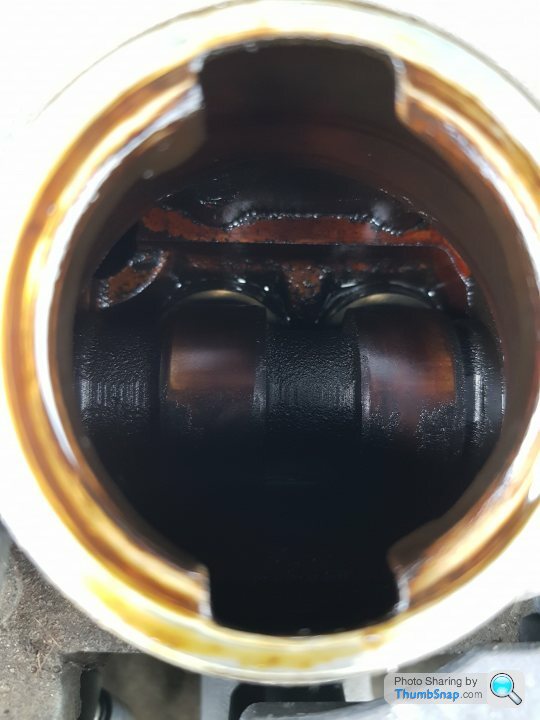
It might not have had anything to do with it, but on the chance it exacerbated it, I'm not using the oil suction device for oil changes again, proper draining from underneath from now on.
Car had service history up till we got it, and then I changed the oil every year (sub 10k).
When I pulled the sump, honestly we had a '56 International Harvester that was cleaner. There were bits of bearing all round no3 cylinder and in the sump so that was that.
Car was still running and didn't sound too bad!
Turns out, it's a known problem:
http://www.v70xc.com/resources/how-to/pdf/01-23-09...
I took this picture through the filler cap. It did NOT look like that a few thousand miles earlier, although I'm guessing being starved of oil would make the old residue carbonise pretty rapidly.
It might not have had anything to do with it, but on the chance it exacerbated it, I'm not using the oil suction device for oil changes again, proper draining from underneath from now on.

One of the guys I used to work with had one of the Honda acty vans, I think they were 1.0L
He reckon it was cheaper not to service it and to run it into the ground
At the time it had close to 100k on it and still going strong with the original oil, filters etc
Seemed stupid to me because you could DIY for probably £40 even if you only did it every 30 or 40k
Although I recall a Cadillac many years ago stating it had 100k intervals
He reckon it was cheaper not to service it and to run it into the ground
At the time it had close to 100k on it and still going strong with the original oil, filters etc
Seemed stupid to me because you could DIY for probably £40 even if you only did it every 30 or 40k
Although I recall a Cadillac many years ago stating it had 100k intervals
matthew King said:
The sludging issues they have in the States is probably down to low fuel quality, and their API oil standards. Europe's ACEA are better, with a higher additive quality.
So far as I'm aware they don't have sludge issues in the US. It seems their "Speedy-Lube" type chains have been strangely successful at keeping people locked into frequent oil changes their cars often don't need - so long as they're run on proper modern oil. When people look inside their oil filler cap and try to make a judgment they're missing the point because all they're looking at is a combination of engine vapour and water condensation which makes the underside of the cap look brown and gunky.
Gassing Station | Home Mechanics | Top of Page | What's New | My Stuff