
What is this resistor? - Boat engine panel repair
Discussion


Hoping the knowledge of PH can help with this one.
Trying to repair an engine panel off a mates boat. It's one of these https://www.vetus-shop.com/engine-panel-type-mp21-... (Although I think it's an 'MP22', which seems to have the volt gauge also.)
The crusty connections on the back of the tachometer look like they will clean up okay (I've pulled it apart further after this photo)

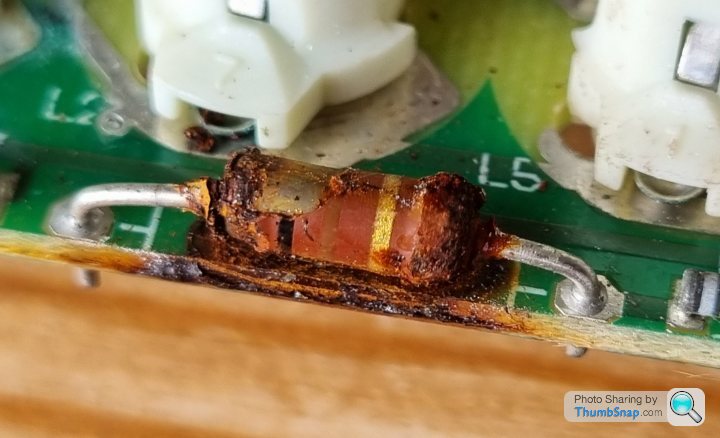
However, there is a dead resistor on the PCB which holds all the warning bulbs, and I can't identify it to replace it.
This is the best photo I can get of it. It seems to be XXX-Black-Brown-Gold (then maybe another band?)
I hunted around online for a photo of a working one. This page has a very similar panel.
https://www.tradeinn.com/waveinn/en/vetus-mp20-21-...
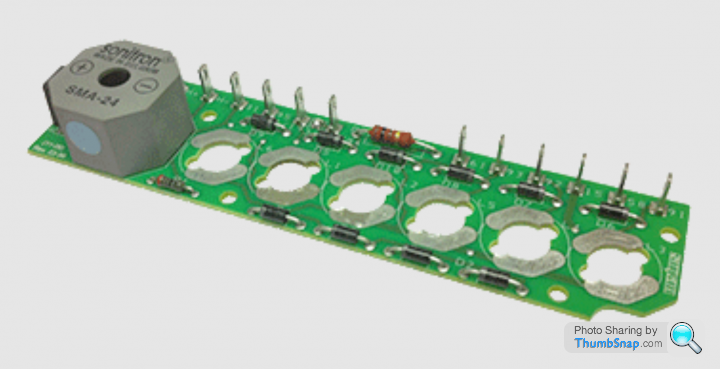
This seems to be Brown-Black-Brown-Gold which I think means 100 Ohm with 5% tolerance (and would line up with my dead one.)
If anybody is able to have a good guess, or even a suggestion like "just bung in a 10ohm, at worst the bulb will be a bit dim" or something, then that would be also helpful!
I notice also that the resistor is quite a bit chunkier than your 'average' resistor, so I'm guessing it is dissipating a bit of current/heat?
If it helps, it's in line with the warning bulb which shows battery voltage. None of the other bulbs seem to have such quite chunky resistors.
Thanks!
Trying to repair an engine panel off a mates boat. It's one of these https://www.vetus-shop.com/engine-panel-type-mp21-... (Although I think it's an 'MP22', which seems to have the volt gauge also.)
The crusty connections on the back of the tachometer look like they will clean up okay (I've pulled it apart further after this photo)
However, there is a dead resistor on the PCB which holds all the warning bulbs, and I can't identify it to replace it.
This is the best photo I can get of it. It seems to be XXX-Black-Brown-Gold (then maybe another band?)
I hunted around online for a photo of a working one. This page has a very similar panel.
https://www.tradeinn.com/waveinn/en/vetus-mp20-21-...
This seems to be Brown-Black-Brown-Gold which I think means 100 Ohm with 5% tolerance (and would line up with my dead one.)
If anybody is able to have a good guess, or even a suggestion like "just bung in a 10ohm, at worst the bulb will be a bit dim" or something, then that would be also helpful!
I notice also that the resistor is quite a bit chunkier than your 'average' resistor, so I'm guessing it is dissipating a bit of current/heat?
If it helps, it's in line with the warning bulb which shows battery voltage. None of the other bulbs seem to have such quite chunky resistors.
Thanks!
Well now that you have found it is 100 ohm, why would you "just bung a 10 ohm one it"?
WRT the size, yes that is due to the power of the resistor.
If you measure yours & then go on ebay, you will find the right size and hence the right power one.
They literally cost pence, just get the right one.
WRT the size, yes that is due to the power of the resistor.
If you measure yours & then go on ebay, you will find the right size and hence the right power one.
They literally cost pence, just get the right one.
Long Answer.....All calculations are approx and not taking any other factors into consideration as nothing else is needed to explain how the circuit functions
The chances are that the manufacturer of the panel has used low wattage warning light bulbs all of the same value
The alternator requires a higher wattage warning light bulb than the other circuits use, a higher wattage bulb is used to gain a low alternator cut-in speed
Sometimes, fitting a higher wattage alternator warning light bulb in the panel can cause problems such as over-heating the panel or melting the plastic that the warning light fits into
Sometimes a bigger bulb holder is required to allow the fitting of a bigger bulb, using the same size bulbs and holders keeps production simple
A 100 Ohm resistor connected in parallel with the alternator warning light bulb increases the current draw of the warning light circuit
1) Example @ 12 Volts
Small Alternator W/Lt Bulb = 2 Watts
2 Watts = 12 Volts x 0.167 Amps
W/Lt Circuit is drawing 0.167 Amps through the alternators rotor field coil
Alternator has a high cut-in speed
2) Example @ 12 Volts
Resistor @ 100 Ohms will draw approximately 0.12 Amps
0.12 Amps + 0.167 Amps (2 Watt W/Lt Bulb) = 0.287 Amps
0.287 Amps is close to the current drawn by a 3.5 Watt Bulb
Alternator has a low cut-in speed
Short Answer.....
Fitting a 100 Ohm resistor with a rating of 3 to 5 Watts or higher will not be a problem
The chances are that the manufacturer of the panel has used low wattage warning light bulbs all of the same value
The alternator requires a higher wattage warning light bulb than the other circuits use, a higher wattage bulb is used to gain a low alternator cut-in speed
Sometimes, fitting a higher wattage alternator warning light bulb in the panel can cause problems such as over-heating the panel or melting the plastic that the warning light fits into
Sometimes a bigger bulb holder is required to allow the fitting of a bigger bulb, using the same size bulbs and holders keeps production simple
A 100 Ohm resistor connected in parallel with the alternator warning light bulb increases the current draw of the warning light circuit
1) Example @ 12 Volts
Small Alternator W/Lt Bulb = 2 Watts
2 Watts = 12 Volts x 0.167 Amps
W/Lt Circuit is drawing 0.167 Amps through the alternators rotor field coil
Alternator has a high cut-in speed
2) Example @ 12 Volts
Resistor @ 100 Ohms will draw approximately 0.12 Amps
0.12 Amps + 0.167 Amps (2 Watt W/Lt Bulb) = 0.287 Amps
0.287 Amps is close to the current drawn by a 3.5 Watt Bulb
Alternator has a low cut-in speed
Short Answer.....
Fitting a 100 Ohm resistor with a rating of 3 to 5 Watts or higher will not be a problem
E-bmw said:
Well now that you have found it is 100 ohm, why would you "just bung a 10 ohm one it"?
[other stuff]
I wasn't totally sure it was 100ohm, I was just going off the crappy low res picture I found plus guesswork. Being a friends boat, just trying as much as possible to not have the magic smoke escape the next time he goes out. If it was mine, I'd probably have just put in a 100 ohm and 'sent it'.[other stuff]
tux850 said:
Have you tried measuring it? Despite how it looks it might still work!
Funnily enough I didn't think to - just tried it now though with my cheapy multimeter and I can't get a reliable reading from it (numbers jump around). Guessing it's a combination of the corrosion, general crustiness of the board and my multimeter. (Side note - I mortified at the spelling mistake in the thread title, but I can't edit it.)
Polly Grigora said:
Long Answer.....
[...Lots of useful explanation..]
Short Answer.....
Fitting a 100 Ohm resistor with a rating of 3 to 5 Watts or higher will not be a problem
This is a brilliant explanation, thanks very much. I've found a 5w 100ohm resistor on eBay and have it on the way. Cheers.[...Lots of useful explanation..]
Short Answer.....
Fitting a 100 Ohm resistor with a rating of 3 to 5 Watts or higher will not be a problem
A 5w resistor is pretty big.
https://www.ebay.co.uk/itm/264448911910?hash=item3...
I would have suspected more like 1/8, 1/4, or even 1/2 watt at the most.
https://www.ebay.co.uk/itm/162326839033?hash=item2...
https://www.ebay.co.uk/itm/262204230322?hash=item3...
https://www.ebay.co.uk/itm/281561235311?hash=item4...
https://www.ebay.co.uk/itm/264448911910?hash=item3...
I would have suspected more like 1/8, 1/4, or even 1/2 watt at the most.
https://www.ebay.co.uk/itm/162326839033?hash=item2...
https://www.ebay.co.uk/itm/262204230322?hash=item3...
https://www.ebay.co.uk/itm/281561235311?hash=item4...
Edited by E-bmw on Thursday 13th July 14:45
Edited by E-bmw on Thursday 13th July 15:22
walamai said:
Polly Grigora said:
Long Answer.....
[...Lots of useful explanation..]
Short Answer.....
Fitting a 100 Ohm resistor with a rating of 3 to 5 Watts or higher will not be a problem
This is a brilliant explanation, thanks very much. I've found a 5w 100ohm resistor on eBay and have it on the way. Cheers.[...Lots of useful explanation..]
Short Answer.....
Fitting a 100 Ohm resistor with a rating of 3 to 5 Watts or higher will not be a problem
Don't be concerned about the dimensions of the resistor, you can if need be bend the resistor wires back on themselves so that they are underneath the resistor body when soldered onto the board or mount the resistor in a vertical position if there's room for it behind the panel

It's all about heat dissipation and the original resistor has overheated, the higher the wattage rating of the resistor the better the heat dissipation
walamai said:
(Side note - I mortified at the spelling mistake in the thread title, but I can't edit it.)
You're forgiven 
walamai said:
Funnily enough I didn't think to - just tried it now though with my cheapy multimeter and I can't get a reliable reading from it (numbers jump around). Guessing it's a combination of the corrosion, general crustiness of the board and my multimeter.
You'd have to take it out of circuit really otherwise other components could have an effect.
walamai said:
(Side note - I mortified at the spelling mistake in the thread title, but I can't edit it.)
I didn't notice until you mentioned it! 
Edited by tux850 on Thursday 13th July 17:18
Scrump said:
What spelling mistake?

Thank you! (Although I don't know why I'm thanking you, the thread title is perfectly fine as it is.)E-bmw said:
I was talking about physical size, it is 24mm long & 8mm in diameter.
Hah, oh right, yeah I hadn't spotted that! Thanks again though Polly, mounting it vertically is a great idea, and there's lots of room. Hopefully having a higher rated one will keep the magic smoke in longer too.


Gassing Station | Home Mechanics | Top of Page | What's New | My Stuff