
Blow torches for stubborn bolts
Discussion


It seems that nearly every video promising the 'best way' to remove stubborn bolts, separate exhaust flanges etc involve a blow torch and so I am thinking I perhaps ought to get one. I won't, or hopefully won't, use it much so don't want to spend too much but I am wondering how cheap I can realistically go without 1) it failing to do the job, or 2) it being unsafe.
Is something like this up to the job? It's first application would be on an exhaust flange where I've got one side free with a nut splitter but the other, more corroded side, didn't have much resembling a nut at all - just a lump of rust. I should've taken a photo so will grab one tomorrow. Access is extremely limit (tucked up just up and behind the engine). I am hoping some heat might expand things such that the rust gives way.
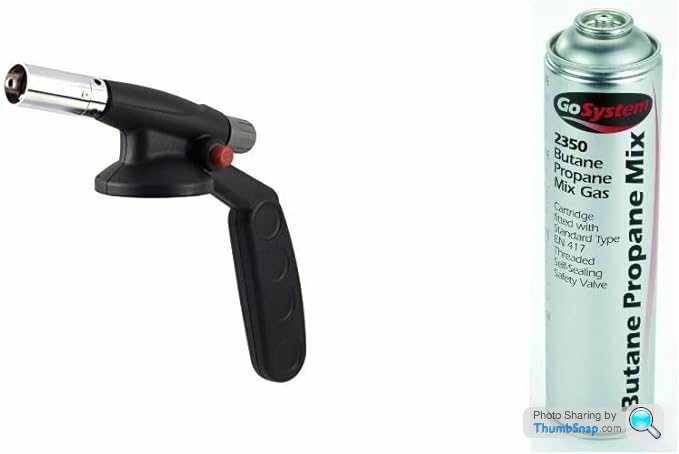
Or would that do little more than a nice creme brulee?
Is something like this up to the job? It's first application would be on an exhaust flange where I've got one side free with a nut splitter but the other, more corroded side, didn't have much resembling a nut at all - just a lump of rust. I should've taken a photo so will grab one tomorrow. Access is extremely limit (tucked up just up and behind the engine). I am hoping some heat might expand things such that the rust gives way.
Or would that do little more than a nice creme brulee?
Edited by tux850 on Saturday 14th October 19:13

I have an induction heater, just a generic Chinese job, its fantastic at loosening up fasteners in awkward places where even a No 1 oxy-acetylene nozzle would struggle, never mind a blowtorch.
This tool has saved me hours of struggling, without waving a flame around too.
I cannot recommend them highly enough.
This tool has saved me hours of struggling, without waving a flame around too.
I cannot recommend them highly enough.
One thing to be aware of is that some cheaper torches will alter the fuel flow when the angle is changed... my first one was a Campingaz one, and it would go from a gentle flame to a roar when inverted. After toasting a few capillary joints I bought a Rothenberger and never looked back.
Also not all ignition is the same... Rothenberger superfire is a single hand instantaneous trigger type, point it at the job and pull the trigger and you have fire. I've tried others where you really need to get it lit and then point.
Also not all ignition is the same... Rothenberger superfire is a single hand instantaneous trigger type, point it at the job and pull the trigger and you have fire. I've tried others where you really need to get it lit and then point.
This is what I'm tackling... Walking through step-by-step to give you some context:
I'm doing the timing belt on a Fiesta Ecoboost and could do with the front exhaust section being completely removed to ease sump removal/refitting. Also, the last MOT had an advisory suggesting the flexi joint might be starting to leak and I can certainly see it is pretty ropey. I have a spare front section (cat, downpipe, flexi up to the flange) so figured this is the perfect time to swap it out.
So, here's the general area:

And it's this flange I am wanting to separate:

As you can see access it limited, although I can drop the exhaust a few inches when the cat is unbolted from the turbo.
I've managed to remove the nut on one side (the left/furthest stud in the photo above, nearest below) with a nut splitter:

Apologies for it being out of focus. Here it is again from a different angle (top most stud this time):

It's the other bolt (bottom most in the photo above) that's causing me grief. There wasn't much in the way of a nut to even split, just a whole load of corrosion, so I've been attacking it with a Dremel but as you can see with me almost working blind it is hard to know what/where I'm cutting noting that I don't have the view that these photos were taken from - this is just from sticking the camera though a gap, turning it around and taking some shots:

(Just noticed in the photo above what looks like a 'ring' around the stud - is that the flange hole? If so, I guess that's a good sign, and it's the corrosion around only half the stud's circumference that's still holding it in place?)
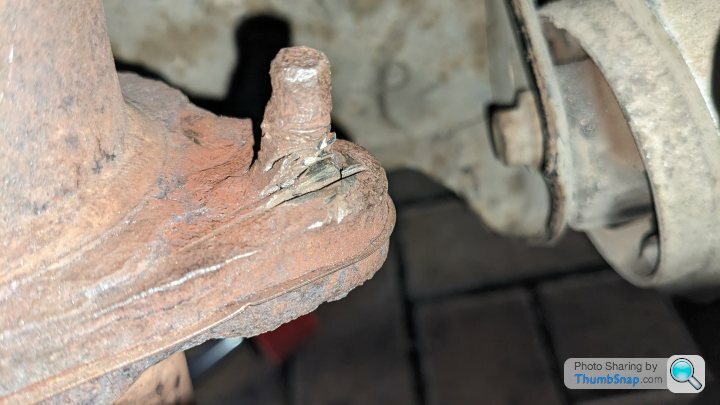
So, going back a few photos, my plan was to heat up the base of the bolt from below in the hope it might weaken the corrosion that surrounds it above, particularly if I keep cycling the process?
I'm doing the timing belt on a Fiesta Ecoboost and could do with the front exhaust section being completely removed to ease sump removal/refitting. Also, the last MOT had an advisory suggesting the flexi joint might be starting to leak and I can certainly see it is pretty ropey. I have a spare front section (cat, downpipe, flexi up to the flange) so figured this is the perfect time to swap it out.
So, here's the general area:
And it's this flange I am wanting to separate:
As you can see access it limited, although I can drop the exhaust a few inches when the cat is unbolted from the turbo.
I've managed to remove the nut on one side (the left/furthest stud in the photo above, nearest below) with a nut splitter:
Apologies for it being out of focus. Here it is again from a different angle (top most stud this time):
It's the other bolt (bottom most in the photo above) that's causing me grief. There wasn't much in the way of a nut to even split, just a whole load of corrosion, so I've been attacking it with a Dremel but as you can see with me almost working blind it is hard to know what/where I'm cutting noting that I don't have the view that these photos were taken from - this is just from sticking the camera though a gap, turning it around and taking some shots:
(Just noticed in the photo above what looks like a 'ring' around the stud - is that the flange hole? If so, I guess that's a good sign, and it's the corrosion around only half the stud's circumference that's still holding it in place?)
So, going back a few photos, my plan was to heat up the base of the bolt from below in the hope it might weaken the corrosion that surrounds it above, particularly if I keep cycling the process?
Edited by tux850 on Sunday 15th October 12:30
Thanks Spaceman, that sounds achievable. Do you think the heat/cool cycling (autocorrect made that 'crying' - quite apt!) alone might be enough? Got very limited access for hammer blows etc from above, but can give things a whack from below.
As for fires, obviously safety is a concern with this. Your comment sounds more than just tongue in cheek, were you referring to the surrounding area rather than the flange/stud/corrosiin itself?
As for fires, obviously safety is a concern with this. Your comment sounds more than just tongue in cheek, were you referring to the surrounding area rather than the flange/stud/corrosiin itself?
I have just done the same job but on a 22 year old Mondeo, a couple of 30 second bursts with the induction heater and the nuts came loose.
Before I had the tool theres no chance I would have got them undone without driving to my mates place and using oxy-acetylene.
If I was you OP I would find a garage that has either gas or an induction heater and pay them to undo those nuts, you can then drive home and crack on with the other tasks.
Before I had the tool theres no chance I would have got them undone without driving to my mates place and using oxy-acetylene.
If I was you OP I would find a garage that has either gas or an induction heater and pay them to undo those nuts, you can then drive home and crack on with the other tasks.
Gassing Station | Home Mechanics | Top of Page | What's New | My Stuff