
Peak average speed
Discussion


I made the 300 mile trip from the north west down to Plymouth to visit the other half’s grandad this week, but before I set off I was having general chat with my dad about driving etc.
We set off early Sunday morning to try and avoid most traffic (me and the mrs both drive hgv’s for a living and wanted to spend as much time as possible of our holiday NOT still sitting in traffic!).
I said I usually set my cruise to 85mph on a long distance drive which gives me about 320 miles before getting too low on fuel and I could get there on one tank and still make good time.
But out of curiosity, if I could cruise at 150mph say, I’d assume I’d be down to 100miles a tank maybe less, so have to stop at least twice so sacrifice stopping time on time gained with speed?
Which got me wondering I wonder what peak speed to mpg would be? Obviously car depending and also I wonder what car would travel at the highest speed whilst returning the highest mpg? Something slippery but not sitting at max rpm to maintain the high speed?
Supercars are aero dynamic but engines make big power so high fuel usage, maybe a McLaren speed tail with a 335D engine.
We set off early Sunday morning to try and avoid most traffic (me and the mrs both drive hgv’s for a living and wanted to spend as much time as possible of our holiday NOT still sitting in traffic!).
I said I usually set my cruise to 85mph on a long distance drive which gives me about 320 miles before getting too low on fuel and I could get there on one tank and still make good time.
But out of curiosity, if I could cruise at 150mph say, I’d assume I’d be down to 100miles a tank maybe less, so have to stop at least twice so sacrifice stopping time on time gained with speed?
Which got me wondering I wonder what peak speed to mpg would be? Obviously car depending and also I wonder what car would travel at the highest speed whilst returning the highest mpg? Something slippery but not sitting at max rpm to maintain the high speed?
Supercars are aero dynamic but engines make big power so high fuel usage, maybe a McLaren speed tail with a 335D engine.
It sounds like there are two questions, how much faster is it worth driving if the extra speed requires extra fuel stops, and which car would be best for making time over a long distance - both assuming traffic and law enforcement weren't concerns.
On the first question, if you increased from 85mph to 90mph you'd cut the total continuous driving time from 3hrs 31 to 3 hrs 20, so you'd reduce it by 11 minutes. I guess it would take maybe 5 minutes to fill up with petrol including coming off and back on the road (assume you pay with an app), so even that first 5mph increment that perhaps requires an extra stop would more than pay back with time saved.
If you could do 150 mph that would be only 2 hours driving, so would save an hour and a half, which would easily dwarf a couple of fill-ups.
I think in general with liquid-fuel cars this is the case, the time spent stopping is small compared to that saved by driving quicker. By contrast, with battery EVs it is often quicker to drive slower and save time charging.
There was a German car magazine which tested fuel consumption at different autobahn speeds, I don't have the link tho. As you'd expect, 3.0 diesels gave about the best balance of speed and tank range.
On the first question, if you increased from 85mph to 90mph you'd cut the total continuous driving time from 3hrs 31 to 3 hrs 20, so you'd reduce it by 11 minutes. I guess it would take maybe 5 minutes to fill up with petrol including coming off and back on the road (assume you pay with an app), so even that first 5mph increment that perhaps requires an extra stop would more than pay back with time saved.
If you could do 150 mph that would be only 2 hours driving, so would save an hour and a half, which would easily dwarf a couple of fill-ups.
I think in general with liquid-fuel cars this is the case, the time spent stopping is small compared to that saved by driving quicker. By contrast, with battery EVs it is often quicker to drive slower and save time charging.
There was a German car magazine which tested fuel consumption at different autobahn speeds, I don't have the link tho. As you'd expect, 3.0 diesels gave about the best balance of speed and tank range.
well, normally the answer would be a remapped BMW 335d. though as fuel tank size will make a difference to total range, i'd upgrade that to a remapped BMW 640d.
oh actually, a BMW M550d. still remapped.
im sure one of them could smash out 450 miles out of a tank, even when cruising at 150mph.
oh actually, a BMW M550d. still remapped.
im sure one of them could smash out 450 miles out of a tank, even when cruising at 150mph.
We used to set off from London to the cottage after 11pm on a Friday night to miss the traffic, and once out of the main network I'd be pinned at the limiter (165 indicated) for a fair chunk of the journey, but the fuel gauge went down in very short order! I found the balance between time/driving interest/wasted time for fuel stops is somewhere around a ton. Might be higher in a diesel.
Having done simulations on this on EV's, on a (modern, fast charging) BEV, it is generally faster overall to just drive as fast as you can and charge up more. With an ICE it would be even more in favour of faster driving with more stops, as the speed-dependent losses in an ICE are relatively several times less than in a BEV.
There are a couple of caveats to this, the main one being that if your range (ICE or BEV) is only a tiny bit short of the destination, you're better off to slow down on the final leg to avoid an unnecessary final stop.
With EV's the rate of charger and distribution (along with availability/queuing etc.) along the route also make a significant impact, but the general "guideline" still stands. Also the above does not apply to a Leaf or a G-Wiz.
There are a couple of caveats to this, the main one being that if your range (ICE or BEV) is only a tiny bit short of the destination, you're better off to slow down on the final leg to avoid an unnecessary final stop.
With EV's the rate of charger and distribution (along with availability/queuing etc.) along the route also make a significant impact, but the general "guideline" still stands. Also the above does not apply to a Leaf or a G-Wiz.
I find over 85mph the mpg starts to rapidly get worse in mine. I had a quick blast at a ‘slightly higher’ speed on the way home and it lost 50 miles of range over about 10 miles.
A D350 Range Rover with over 100 litre tank could be good if it wasn’t such a massive brick. I’m guessing pushing that through the air at over a ton would be guzzling fuel.
A D350 Range Rover with over 100 litre tank could be good if it wasn’t such a massive brick. I’m guessing pushing that through the air at over a ton would be guzzling fuel.
I suspect that the answer is as fast as possible, given how small the time taken to fill up is. I don't think my concentration would stand multiple tanks at VMax however so the driver would be the weak link in this hypothetical situation.
A more interesting question might be if you have to take the increased fuel usage from going faster, divide that cost by your hourly wage and add the resulting time to the journey time, what would be most efficient?
A more interesting question might be if you have to take the increased fuel usage from going faster, divide that cost by your hourly wage and add the resulting time to the journey time, what would be most efficient?
Clarkson did a test, can't remember from where, to Blackpool. If the story line was to be believed he didn't hang about and the Jag xj diesel did a ridiculous mileage.
My older gen 4.2 v8 xj took me from Essex to Glasgow at an indicated average of 70mph at exactly 30mpg, fuel gauge above quarter. So there would be room to up the average speed and still have some left in the tank.
Diesel with a big tank is always going to be the answer though. From what I've read the BMW 2litre could be weapon of choice.
My older gen 4.2 v8 xj took me from Essex to Glasgow at an indicated average of 70mph at exactly 30mpg, fuel gauge above quarter. So there would be room to up the average speed and still have some left in the tank.
Diesel with a big tank is always going to be the answer though. From what I've read the BMW 2litre could be weapon of choice.
Glenn63 said:
I find over 85mph the mpg starts to rapidly get worse in mine. I had a quick blast at a ‘slightly higher’ speed on the way home and it lost 50 miles of range over about 10 miles.
A D350 Range Rover with over 100 litre tank could be good if it wasn’t such a massive brick. I’m guessing pushing that through the air at over a ton would be guzzling fuel.
Constant speed is the key. I frequently travel down the A61 towards Stuttgart, with speeds from 160 - 200kph, but it’s the getting back up to speed that eats the fuel, sitting about 160/170 seems to be the sweet spot. Though, I could be gentler on the accelerator, and just cruise up to these speeds rather than foot to the floor.A D350 Range Rover with over 100 litre tank could be good if it wasn’t such a massive brick. I’m guessing pushing that through the air at over a ton would be guzzling fuel.
Can remember going through Europe on the motorways on a motorbike touring. 16L / 3.5 gallon tank..
At 150mph you're having to pull into every services there are, every 20minutes need to fill up with petrol again; where we saw all the traffic we'd passed going by along the road. Can confirm the fastest way to travel isn't this, it's slower to make distance overall at 150mph on a motorbike. There would be an optimal speed, probably slower on a motorbike as the fuel tanks are smaller.
At 150mph you're having to pull into every services there are, every 20minutes need to fill up with petrol again; where we saw all the traffic we'd passed going by along the road. Can confirm the fastest way to travel isn't this, it's slower to make distance overall at 150mph on a motorbike. There would be an optimal speed, probably slower on a motorbike as the fuel tanks are smaller.
In my experience it's best to drive as fast as you can. Me and a friend once drove 1000 miles in 10 hours. We spent a significant part of the journey driving at Vmax with fuel stops every 45 minutes. We managed to get our fuel stops pretty slick so we weren't stationary for long. If you mess about and waste time at every fuel stop that will noticeably drop your average speed.
lets say a car has a 13 gallon tank, and does 30mpg at 100mph, 25mpg at 120mph, and 20mpg at 140mph. i reckon a BMW 330d would manage that.
13*30 = 390miles @100mph is 3.9 hrs. then a fuel stop, which takes 0.2 hours. so overall 390 miles covered in 4.1hrs, gives a 95.1mph average speed.
13*25 = 325miles @120mph is 2.7 hrs. then a fuel stop of 0.2 hrs, so 325 miles covered in 2.9 hrs, or 112mph average speed.
13*20 = 260miles @140mph is 1.9 hrs. then a fuel stop of 0.2 hrs, so 260 miles covered in 2.1 hrs, or 124mph average speed.
so yeah, with those numbers, you'll cover ground faster if you drive faster, get lower mpg and make more fuel stops.
factoring in cost... travelling 1000 miles...
at 100mph (average speed 95mph) takes 10.5 hrs, uses 33.3 gallons of fuel and costs £226, at £6.80 a gallon.
at 120mph (average speed 112mph) takes 8.93 hrs, uses 40 gallons of fuel, and costs £272
at 140mph (average speed 124mph) takes 8.06 hrs, uses 50 gallons of fuel, and costs £340.
so... over 1000 miles, get there 2.5 hrs sooner, but spend £114 more on fuel - £45 per hour saved.
13*30 = 390miles @100mph is 3.9 hrs. then a fuel stop, which takes 0.2 hours. so overall 390 miles covered in 4.1hrs, gives a 95.1mph average speed.
13*25 = 325miles @120mph is 2.7 hrs. then a fuel stop of 0.2 hrs, so 325 miles covered in 2.9 hrs, or 112mph average speed.
13*20 = 260miles @140mph is 1.9 hrs. then a fuel stop of 0.2 hrs, so 260 miles covered in 2.1 hrs, or 124mph average speed.
so yeah, with those numbers, you'll cover ground faster if you drive faster, get lower mpg and make more fuel stops.
factoring in cost... travelling 1000 miles...
at 100mph (average speed 95mph) takes 10.5 hrs, uses 33.3 gallons of fuel and costs £226, at £6.80 a gallon.
at 120mph (average speed 112mph) takes 8.93 hrs, uses 40 gallons of fuel, and costs £272
at 140mph (average speed 124mph) takes 8.06 hrs, uses 50 gallons of fuel, and costs £340.
so... over 1000 miles, get there 2.5 hrs sooner, but spend £114 more on fuel - £45 per hour saved.
at the extreme - 160mph, 10mpg.
13*10 = 130miles, which takes 0.8 hrs. add in the 0.2 hr fuel stop, 130 miles traveled in an hour, for 130mph average speed.
1000miles would take 7.7hrs, use 100 gallons of fuel, and cost £680.
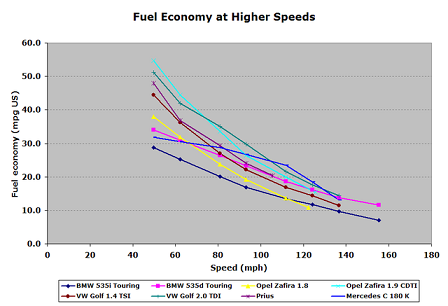
ah here we go, this is a decent graph... they use a BMW 535d, but you get the idea. mpg is in US gallons, so my UK gallon figures were in the right ballpark, ish...
13*10 = 130miles, which takes 0.8 hrs. add in the 0.2 hr fuel stop, 130 miles traveled in an hour, for 130mph average speed.
1000miles would take 7.7hrs, use 100 gallons of fuel, and cost £680.
ah here we go, this is a decent graph... they use a BMW 535d, but you get the idea. mpg is in US gallons, so my UK gallon figures were in the right ballpark, ish...
Edited by brillomaster on Friday 1st December 13:52
Nobody has realised that if you're like driving really quick, yes you probs will be using more petrol at that speed but your doing it for less time, so might even be cheaper in the end, especially if your going really quick so yes using a bit more fuel but for much less time.
I literally always drive as quick as poss as I rekken its cheaper.
I literally always drive as quick as poss as I rekken its cheaper.
Notso said:
Nobody has realised that if you're like driving really quick, yes you probs will be using more petrol at that speed but your doing it for less time, so might even be cheaper in the end, especially if your going really quick so yes using a bit more fuel but for much less time.
I literally always drive as quick as poss as I rekken its cheaper.
Yes, this. This is definitely the correct answer. I literally always drive as quick as poss as I rekken its cheaper.
Panamax said:
In light of modern enforcement, how do people claiming to drive hundreds of miles with 85 on the clock still have a driving licence?
When I'm out on motorways I see hardly anyone doing 80 any more, let alone going faster than that.
M6 north of Manchester is where I see it, or in Germany.When I'm out on motorways I see hardly anyone doing 80 any more, let alone going faster than that.
Notso said:
Nobody has realised that if you're like driving really quick, yes you probs will be using more petrol at that speed but your doing it for less time, so might even be cheaper in the end, especially if your going really quick so yes using a bit more fuel but for much less time.
I literally always drive as quick as poss as I rekken its cheaper.
No, see below, brillomaster worked it outI literally always drive as quick as poss as I rekken its cheaper.
brillomaster said:
lets say a car has a 13 gallon tank, and does 30mpg at 100mph, 25mpg at 120mph, and 20mpg at 140mph. i reckon a BMW 330d would manage that.
13*30 = 390miles @100mph is 3.9 hrs. then a fuel stop, which takes 0.2 hours. so overall 390 miles covered in 4.1hrs, gives a 95.1mph average speed.
13*25 = 325miles @120mph is 2.7 hrs. then a fuel stop of 0.2 hrs, so 325 miles covered in 2.9 hrs, or 112mph average speed.
13*20 = 260miles @140mph is 1.9 hrs. then a fuel stop of 0.2 hrs, so 260 miles covered in 2.1 hrs, or 124mph average speed.
so yeah, with those numbers, you'll cover ground faster if you drive faster, get lower mpg and make more fuel stops.
factoring in cost... travelling 1000 miles...
at 100mph (average speed 95mph) takes 10.5 hrs, uses 33.3 gallons of fuel and costs £226, at £6.80 a gallon.
at 120mph (average speed 112mph) takes 8.93 hrs, uses 40 gallons of fuel, and costs £272
at 140mph (average speed 124mph) takes 8.06 hrs, uses 50 gallons of fuel, and costs £340.
so... over 1000 miles, get there 2.5 hrs sooner, but spend £114 more on fuel - £45 per hour saved.
13*30 = 390miles @100mph is 3.9 hrs. then a fuel stop, which takes 0.2 hours. so overall 390 miles covered in 4.1hrs, gives a 95.1mph average speed.
13*25 = 325miles @120mph is 2.7 hrs. then a fuel stop of 0.2 hrs, so 325 miles covered in 2.9 hrs, or 112mph average speed.
13*20 = 260miles @140mph is 1.9 hrs. then a fuel stop of 0.2 hrs, so 260 miles covered in 2.1 hrs, or 124mph average speed.
so yeah, with those numbers, you'll cover ground faster if you drive faster, get lower mpg and make more fuel stops.
factoring in cost... travelling 1000 miles...
at 100mph (average speed 95mph) takes 10.5 hrs, uses 33.3 gallons of fuel and costs £226, at £6.80 a gallon.
at 120mph (average speed 112mph) takes 8.93 hrs, uses 40 gallons of fuel, and costs £272
at 140mph (average speed 124mph) takes 8.06 hrs, uses 50 gallons of fuel, and costs £340.
so... over 1000 miles, get there 2.5 hrs sooner, but spend £114 more on fuel - £45 per hour saved.
Panamax said:
In light of modern enforcement, how do people claiming to drive hundreds of miles with 85 on the clock still have a driving licence?
When I'm out on motorways I see hardly anyone doing 80 any more, let alone going faster than that.
80 on the clock is 77 in my car. I got on the m6 at Chorley set my cruise to 80 and pretty much left it alone, bar a couple 50mph roadwork sections, all the way to Plymouth. I wasn’t the fastest on the road but not to many were going quicker. When I'm out on motorways I see hardly anyone doing 80 any more, let alone going faster than that.
I was surprised how many were driving at about truck speed though. Most seem to be trundling along at <60 these days. Even in my wagon I overtake more cars than other trucks.
Gassing Station | General Gassing | Top of Page | What's New | My Stuff