
Epoxy mortar for coping stones
Discussion


Hi everybody
I have coping stones on my roof and the pointing in the gaps regularly fails - the mortar doesn’t adhere well or there is movement. This results in leaks. I am having the issue resolved by removing the stones and redoing the detailing underneath so failing of the pointing will not result in a leak. However, I wondered if anybody is aware of some sort of epoxy waterproof mortar pointing replacement which bonds well to smooth stones? The roofer says the pointing always fails with time but he’s not aware of a better product - but thinks there must be something better for the usage.
Does anybody have any suggestions please?
Thanks
I have coping stones on my roof and the pointing in the gaps regularly fails - the mortar doesn’t adhere well or there is movement. This results in leaks. I am having the issue resolved by removing the stones and redoing the detailing underneath so failing of the pointing will not result in a leak. However, I wondered if anybody is aware of some sort of epoxy waterproof mortar pointing replacement which bonds well to smooth stones? The roofer says the pointing always fails with time but he’s not aware of a better product - but thinks there must be something better for the usage.
Does anybody have any suggestions please?
Thanks
I’ve used this stuff to point between the slate coping stones on our garden wall.
Original mortar pointing failed after 3 years, this stuff is still good after 5 years.
Drop the tube into a bucket of hot water before use otherwise it’s a nightmare to squeeze out. Can be ‘thumbed’ into gaps and nicely shaped.
https://www.toolstation.com/soudal-repair-express/...
Original mortar pointing failed after 3 years, this stuff is still good after 5 years.
Drop the tube into a bucket of hot water before use otherwise it’s a nightmare to squeeze out. Can be ‘thumbed’ into gaps and nicely shaped.
https://www.toolstation.com/soudal-repair-express/...
CT1 for copings? That’s going to get expensive fast. As said above, normal mortar with an SBR slurry to the top of the wall, the underside of the copings and a splash in the mix. Also, do the copings have a sufficient overhang with a drip groove in them? Both are essential for long term performance.
I’ve fought battles with coping stone details on cavity parapet walls on 2 houses. Mortar is ok for the bed to fix the stones but it will fail in the first winter if used in the joints. Detailing is important to ensure water tightness and issues I’ve had have been fixed by putting a correctly dressed lead detail under the coping stones.
Current house has a very large parapet with artificial stone mouldings (crushed stone/resin mix). The manufacturers of these products provide their own jointing compound but that is also no good as it has failed. The previous owners had the same issue because at some point someone has ground out the jointing compound and replaced it with something masticky - I’m guessing CT1. I’m having issues with leaks where the old jointing compound remains so this year it’s on my to-do list to repoint the bed and replace all the remaining joints with the CT1 as it looks like it’s doing a job.
I’ll take some pictures later.
Current house has a very large parapet with artificial stone mouldings (crushed stone/resin mix). The manufacturers of these products provide their own jointing compound but that is also no good as it has failed. The previous owners had the same issue because at some point someone has ground out the jointing compound and replaced it with something masticky - I’m guessing CT1. I’m having issues with leaks where the old jointing compound remains so this year it’s on my to-do list to repoint the bed and replace all the remaining joints with the CT1 as it looks like it’s doing a job.
I’ll take some pictures later.
PhilboSE said:
I’ve fought battles with coping stone details on cavity parapet walls on 2 houses. Mortar is ok for the bed to fix the stones but it will fail in the first winter if used in the joints. Detailing is important to ensure water tightness and issues I’ve had have been fixed by putting a correctly dressed lead detail under the coping stones.
Current house has a very large parapet with artificial stone mouldings (crushed stone/resin mix). The manufacturers of these products provide their own jointing compound but that is also no good as it has failed. The previous owners had the same issue because at some point someone has ground out the jointing compound and replaced it with something masticky - I’m guessing CT1. I’m having issues with leaks where the old jointing compound remains so this year it’s on my to-do list to repoint the bed and replace all the remaining joints with the CT1 as it looks like it’s doing a job.
I’ll take some pictures later.
I’ve also used CT1 for pointing ridge tiles on the advice of a roofer working next door, mortar pointing was continually failing and a real messy job.Current house has a very large parapet with artificial stone mouldings (crushed stone/resin mix). The manufacturers of these products provide their own jointing compound but that is also no good as it has failed. The previous owners had the same issue because at some point someone has ground out the jointing compound and replaced it with something masticky - I’m guessing CT1. I’m having issues with leaks where the old jointing compound remains so this year it’s on my to-do list to repoint the bed and replace all the remaining joints with the CT1 as it looks like it’s doing a job.
I’ll take some pictures later.
wolfracesonic said:
CT1 for copings? That’s going to get expensive fast. As said above, normal mortar with an SBR slurry to the top of the wall, the underside of the copings and a splash in the mix. Also, do the copings have a sufficient overhang with a drip groove in them? Both are essential for long term performance.
I have copings like this in two locations on my house which are leaking. In one location I’m having redone properly - removed, the underlying problem resolved and then put back. Unfortunately my house was not built well. The copings need to be move out slightly to give more of an overhang and lead is needed across the cavity. However, at the front of the house which is three story in that part, I would rather avoid a huge scaffolding to redo them properly so a solution using ct1 (or other suggestion) using a cherry picker is a preferred solution to see if it works before incurring substantial cost. The front of the house has been done much better than the first location so I am hoping that filling the gaps will be sufficient to stop the problem. If that fails, a large scaffold is needed and I’ll get the same done at the front as I’m doing in the first location.
Thanks for everybody’s posts.
Watching with interest...
Front wall of my place used to have coping stones with a flat top, and a whole 5mm overhang beyond the wall, no drip groove at all.
I replaced the coping stones with much wider ones, and ones that have a single slope, draining away from the wall towards the roof, try reduce the dribble down the back of your neck as you walk through the door. I put a good 75mm overhang out the front, cleaned the drip groove completely, etc.
It is only after the rain that I relised the stones are porous, so when they dry (Scotland, so maybe next summer, or armagedon) I will be painting them with a sealer.
Front wall of my place used to have coping stones with a flat top, and a whole 5mm overhang beyond the wall, no drip groove at all.
I replaced the coping stones with much wider ones, and ones that have a single slope, draining away from the wall towards the roof, try reduce the dribble down the back of your neck as you walk through the door. I put a good 75mm overhang out the front, cleaned the drip groove completely, etc.
It is only after the rain that I relised the stones are porous, so when they dry (Scotland, so maybe next summer, or armagedon) I will be painting them with a sealer.


ShakMan said:
Hi, I have been reading this thread with interest. I have this stone mantle on the top of my house and you can see the mortar has failed and there is no drip channel on the mortar either causing rain water to dissipate and dirty the render.
What do people here suggest?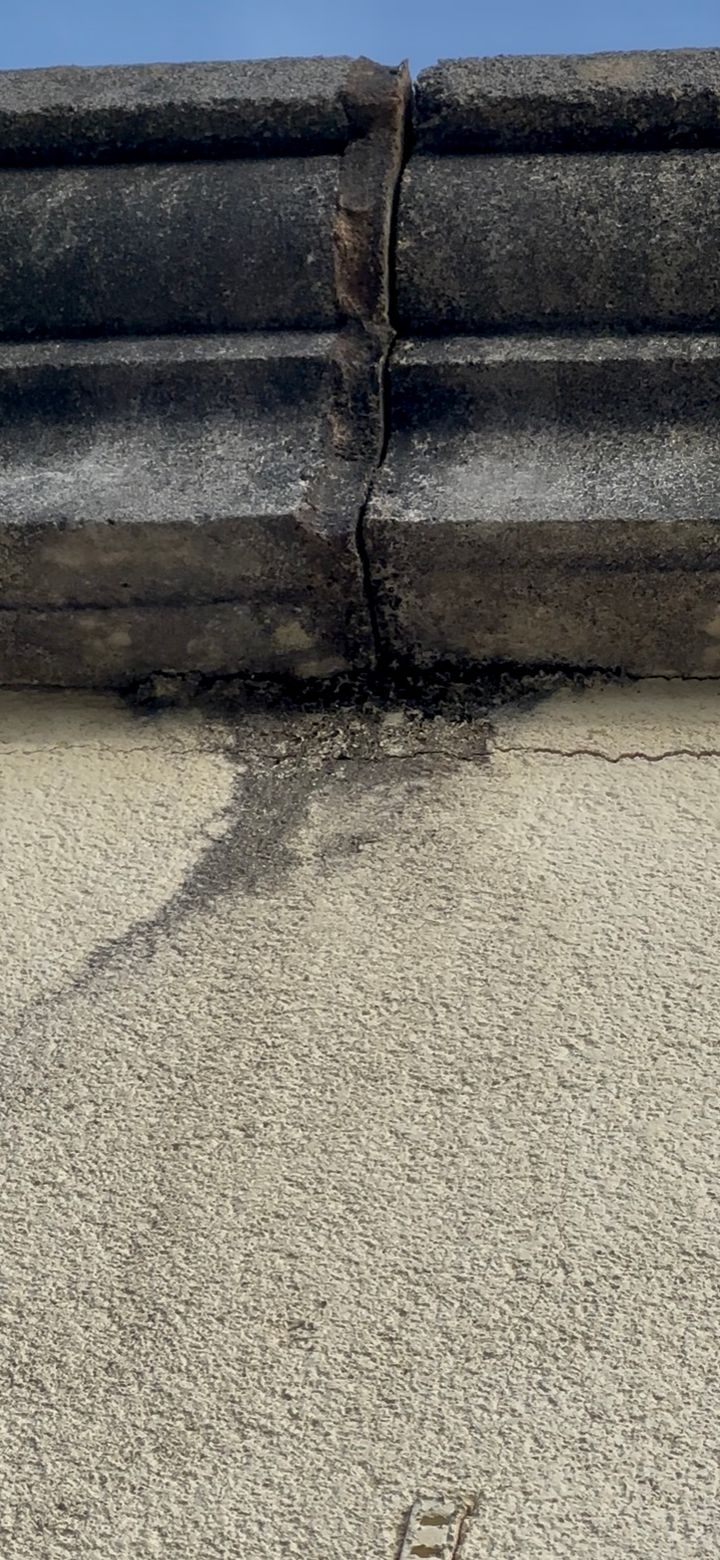
I don't think the lack of drip channel is the issue (though easily fixed in 2 seconds with a grinder), it's the gap from top to bottom causing the leak.What do people here suggest?
Mortar hasn't exactly failed either, the stone has moved for some reason and split the joint as it widened.
Ideally just empty the joint and remake it with fresh mortar. Whole stone might need rebedding depending on where the movement went. Render looks loose at the top so that might come away if you fiddle with the stone.
Gassing Station | Homes, Gardens and DIY | Top of Page | What's New | My Stuff