
Wikipedia - thoughts?
Discussion


I love Wikipedia, I use it very often & do subscribe a monthly donation.
However, many young folk I know are very dismissive of it almost with a “take it with a pinch of salt” kind attitude, can’t trust it.
I get that it’s live & anyone can suggest/make edits so it has the potential to be incorrect, but has anyone seen anything on it that glaringly off?
(Are kids just told to dismiss wiki as a source to stop them being lazy researching things for school etc or are there genuine concerns on it’s content?”
However, many young folk I know are very dismissive of it almost with a “take it with a pinch of salt” kind attitude, can’t trust it.
I get that it’s live & anyone can suggest/make edits so it has the potential to be incorrect, but has anyone seen anything on it that glaringly off?
(Are kids just told to dismiss wiki as a source to stop them being lazy researching things for school etc or are there genuine concerns on it’s content?”
bigpriest said:
I can happily read any number of Wiki articles without getting irritated by content. Check the references is the best advice. It's objective, straightforward and a breath of fresh air compared to social media or YouTube. I'd trust it over any of the main media outlets.
This ^^^AndyAudi said:
I get that it’s live & anyone can suggest/make edits so it has the potential to be incorrect, but has anyone seen anything on it that glaringly off?
I think it a modern day marvel that so little you find on it is inaccurate. I would say that it's one of the most useful tools on the internet. In much the same way a traditional print encyclopaedia works, it is only intended as a jumping off point to enable more focused enquiry.
If you're looking up something that many people do (e.g. a biography of Queen Victoria) then it's almost certainly accurate and unbiased (and perhaps more so than a traditionally edited source where experts can make mistakes with fewer people to check them).
The more obscure your query gets (e.g. something specialist relating to your field of work) the less accurate and potentially more biased it is (as not many people will have edited the page and some might have vested interests).
The more obscure your query gets (e.g. something specialist relating to your field of work) the less accurate and potentially more biased it is (as not many people will have edited the page and some might have vested interests).
AndyAudi said:
I love Wikipedia, I use it very often & do subscribe a monthly donation.
However, many young folk I know are very dismissive of it almost with a “take it with a pinch of salt” kind attitude, can’t trust it.
I get that it’s live & anyone can suggest/make edits so it has the potential to be incorrect, but has anyone seen anything on it that glaringly off?
(Are kids just told to dismiss wiki as a source to stop them being lazy researching things for school etc or are there genuine concerns on it’s content?”
Wikipedia is not considered an authorative source, so you can't quote it on your project/paper/thesis. Teachers will tell you not to reference Wikipedia. However, many young folk I know are very dismissive of it almost with a “take it with a pinch of salt” kind attitude, can’t trust it.
I get that it’s live & anyone can suggest/make edits so it has the potential to be incorrect, but has anyone seen anything on it that glaringly off?
(Are kids just told to dismiss wiki as a source to stop them being lazy researching things for school etc or are there genuine concerns on it’s content?”
Wikipedia is often fully referenced so you can use it to get to other sources.
As for personal use, it's very good for basic facts like finding out what year Hugh Dowding was born, for controversial topics it's too easily edited to be trustworthy.
purplepolarbear said:
If you're looking up something that many people do (e.g. a biography of Queen Victoria) then it's almost certainly accurate and unbiased (and perhaps more so than a traditionally edited source where experts can make mistakes with fewer people to check them).
The more obscure your query gets (e.g. something specialist relating to your field of work) the less accurate and potentially more biased it is (as not many people will have edited the page and some might have vested interests).
I'd agree with this take. I've found some glaring errors in articles few people would know (or care) about. For the more mainstream stuff which is easily verified by multiple sources I think it is fairly trustworthy.The more obscure your query gets (e.g. something specialist relating to your field of work) the less accurate and potentially more biased it is (as not many people will have edited the page and some might have vested interests).
Beware the circular references feedback loops though - it is a real phenomenon.
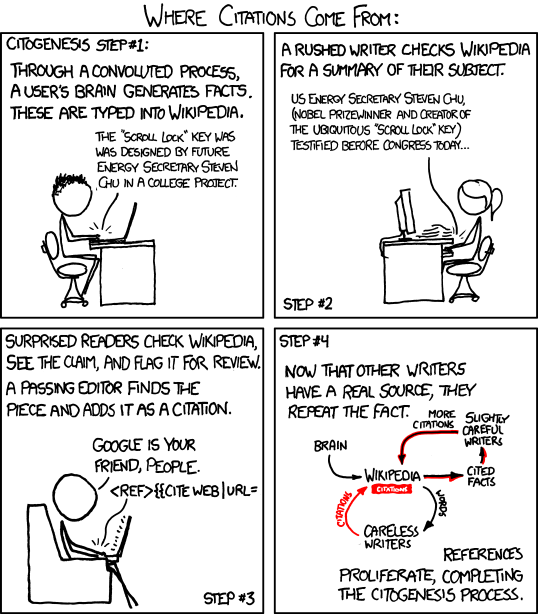
Credit xkcd.com
AndyAudi said:
I love Wikipedia, I use it very often & do subscribe a monthly donation.
However, many young folk I know are very dismissive of it almost with a “take it with a pinch of salt” kind attitude, can’t trust it.
I get that it’s live & anyone can suggest/make edits so it has the potential to be incorrect, but has anyone seen anything on it that glaringly off?
(Are kids just told to dismiss wiki as a source to stop them being lazy researching things for school etc or are there genuine concerns on it’s content?”
I'd wager these "young folk" will probably take something as fact once they've seen a few TikToks on it though, it's interesting how there's a generational shift in where people do their research. It does seem there's a move away from taking the time to look into the original data source of any information and that those with a bigger platform (but not the MSM) must be speaking "facts". However, many young folk I know are very dismissive of it almost with a “take it with a pinch of salt” kind attitude, can’t trust it.
I get that it’s live & anyone can suggest/make edits so it has the potential to be incorrect, but has anyone seen anything on it that glaringly off?
(Are kids just told to dismiss wiki as a source to stop them being lazy researching things for school etc or are there genuine concerns on it’s content?”
I think there's a use for every channel of information certainly and I'm a fan of and do donate to Wiki. The collective management and citation of it does for me add to its integrity.
C5_Steve said:
I'm a fan of and do donate to Wiki. The collective management and citation of it does for me add to its integrity.
Me too. Money well spent/contributed.It's a brilliant source of information on almost anything, and if you want more detail or corroboration you remain entirely free to do your own research. In summary, nothing to lose; everything to gain from using Wikipedia.
NNH said:
I've been an occasional editor since 2006, and I find it frustrating that some pages have a "guardian" who will revert any edit, no matter how well-researched and cited it is.
Contest it, there's too much of that. I've not encountered it but presumably my hobby horses are uncontroversial.LimaDelta said:
I'd agree with this take. I've found some glaring errors in articles few people would know (or care) about. For the more mainstream stuff which is easily verified by multiple sources I think it is fairly trustworthy.
Beware the circular references feedback loops though - it is a real phenomenon.
Credit xkcd.com
Isn't that a woozle by another name?Beware the circular references feedback loops though - it is a real phenomenon.
Credit xkcd.com
Gassing Station | The Lounge | Top of Page | What's New | My Stuff