
2024 Jeep Wrangler Rubicon | UK Review
Never change, Jeep. Never change

One of the interesting things about spending time on both sides of the Atlantic is the chance it gives to see the car world from both ends of a telescope. The last Jeep Wrangler I drove in the States a couple of years ago was about as basic as they come, being a two-door with a cloth roof, a V6 engine that seemed better at delivering noise than progress and a six-speed manual gearbox. It was a simple, rugged SUV which cost the equivalent of about £30,000 at the time, explaining its huge popularity over there - last year Jeep moved 155,000 in the US, down from a peak of 240,000 as recently as 2018.
But on our side of the pond, the Wrangler has long been a much more exotic proposition. Jeep only sells a few hundred each year, with that figure limited by CO2 fleet averages more than limited demand. As such we only get the binary choice between five-door hardtop versions in Sahara and Rubicon trim. Our sole powerplant is now the 2.0-litre turbocharged four-cylinder petrol engine with an eight-speed auto as standard. Yet despite a range that kicks off at £61,125 for the Sahara, and £63,125 for the Rubicon, Jeep UK managing director Kris Cholmondeley says a significant percentage of British buyers immediately spend a big extra chunk more on modifying their new cars.
Some mild revisions gave Jeep all the excuse necessary to offer the chance to get reacquainted with the pared-back range, driving on both road and green lanes in the beautiful Yorkshire Dales. There were some Grand Cherokees along, too - which is why you’ll see them in some of the pictures - but this story is exclusively about the more rugged charms of the modestly tweaked Wrangler.


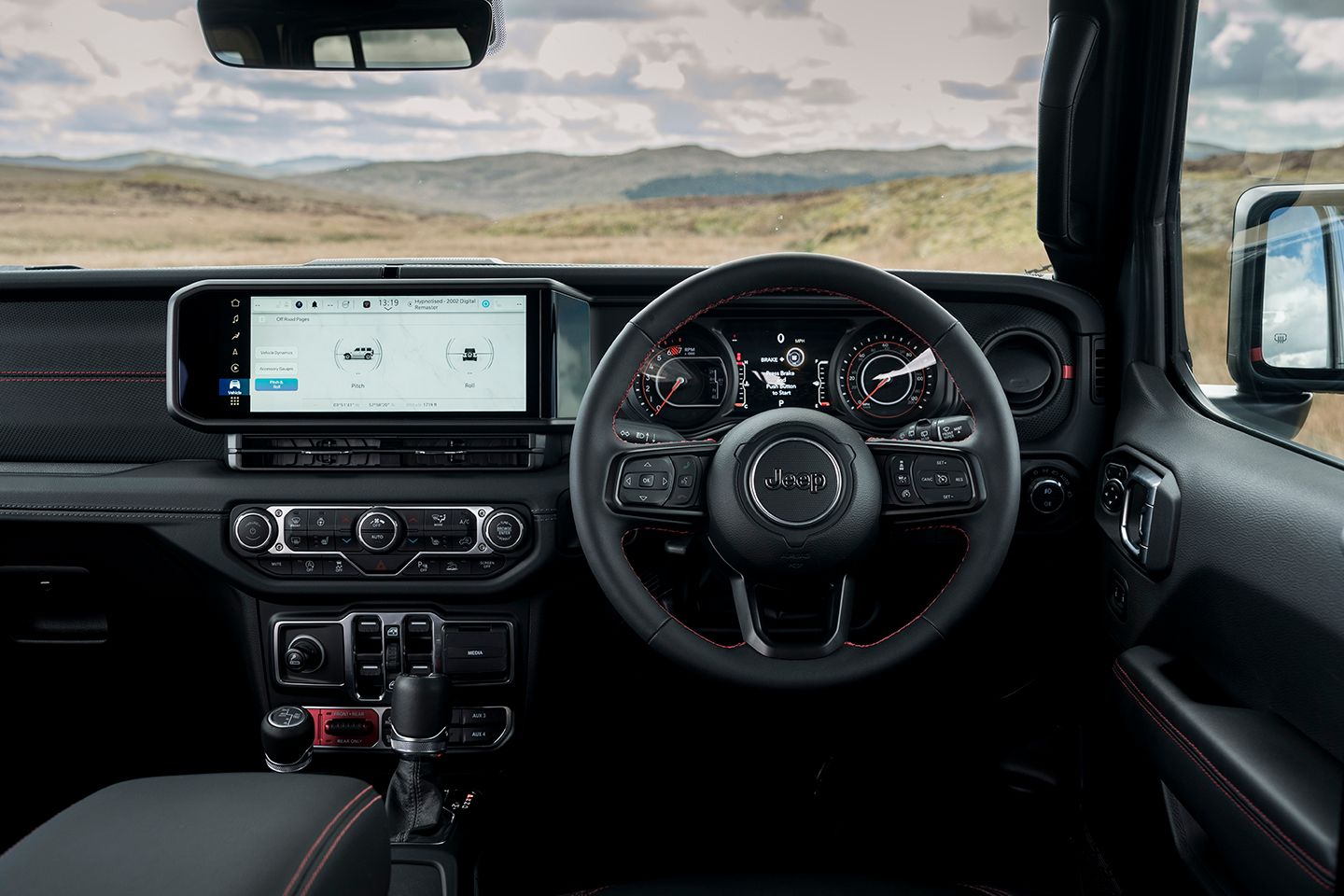
Answering ‘what's new?’ won’t take long. The Wrangler has always evolved at a gentle pace throughout its long life, and the JL facelift is likely one that only Jeep nerds will be able to spot from the outside. For the record the seven-slot radiator grille is new and the headlights are now LED units. There are bigger changes in the cabin with a new 12.3-inch touchscreen in the centre of the dashboard. UK spec will remain generous - as you’d expect given the pricing - with both Sahara and Rubicon getting heated power-adjustable seats, leather trim, and a nine-speaker Alpine audio system. Various active safety systems including forward collision warning are now standard, as are front and rear parking sensors and a reversing camera. But there is no 360-degree camera system, or automatic off-road modes. The front and rear differentials get locked by a rocker switch, with four-wheel drive and low range selected by a big mechanical lever next to the gear selector. The old-school impression is reinforced by the presence of an honest-to-goodness cigarette lighter in the dashboard, not just a 12V port.
While the Sahara is more road-friendly, the Rubicon is designed for harder off-road duty. It gets smaller 17-inch wheels that can mount fatter and chunkier tyres, plus a lower-ratio rear axle and an electrically disconnectable anti-roll bar to increase wheel articulation. Given the choice of which one to drive, I naturally went for the Rubicon.
Most of the experience feels very familiar. It’s a shame that the option of the diesel engine has gone. The old 2.1-litre four-cylinder was loud and crude but boasted abundant torque and a real sense of unstoppability that matched the character of the car. It could also return semi-decent fuel economy, and although the 2.0-litre petrol has an official combined figure of 24.8mpg in the Rubicon, the trip computer suggested it was barely managing half that when grinding its way over some of the rougher and rockier bits of Yorkshire. On the upside, the turbo engine’s manners are much better on road, and its upper-end punch gives the Wrangler a sense of enthusiasm the diesel never managed, which is definitely a plus when overtaking. The petrol’s 7.6-second 0-62mph time is more than two seconds quicker.
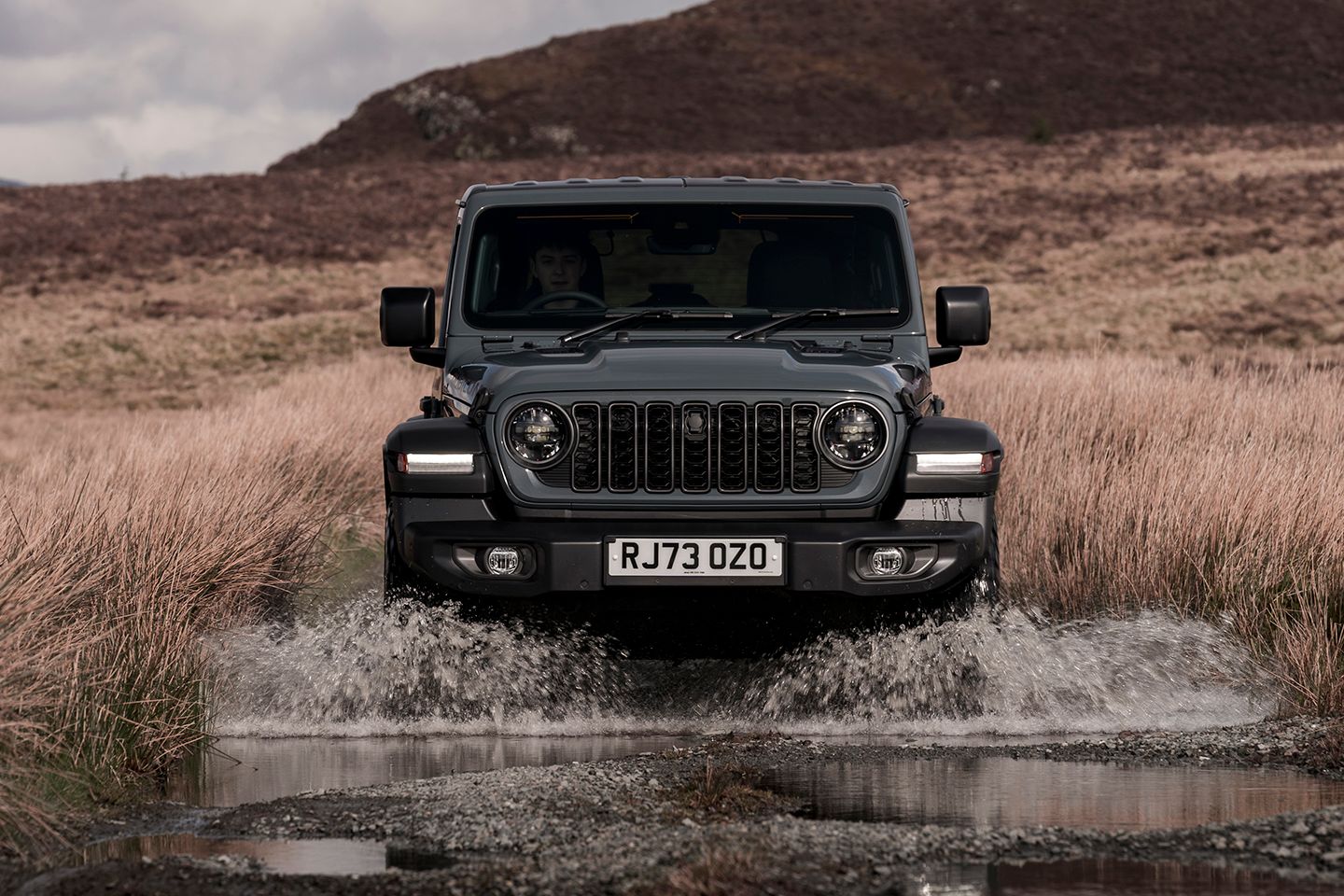

The Wrangler also handles much better than you would expect given the combination of a separate chassis, live axles at both ends and recirculating ball steering. The ride is definitely busy at lower speeds, especially on rougher surfaces, and tackling dips and compressions at speed creates some slight floatiness as the dampers struggle to counter and digest the wheel travel. But the low-geared steering feels impressively precise for a non-rack system, especially compared with my memories of the much more wayward helm in the Ineos Grenadier.
Although the Wrangler’s on-road limits are low, especially riding on BF Goodrich Mud Terrain tyres, they are well-flagged enough that there is no excuse in deliberately transgressing them. And as Britain has grown busier and traffic slower - something that seems to hold true even in the quieter bits of North Yorkshire - having a car that doesn’t naturally break speed limits has become a bit of a bonus. The archaic suspension doesn’t feel anything like the limitation it probably should do; Jeep has been building it long enough to have tamed it impressively well.
Heading away from the tarmac in a Wrangler is always like the moment in a nature film when a penguin dives off an iceberg into the ocean, transforming from clumsy waddle to effortless swimming. The Jeep is okay on road, but it is excellent off it, and though our tour of some rocky, muddy lanes was well short of a trip to the actual Rubicon Trail, or some proper mud-plugging, it was enough to prove that the Wrangler can take most stuff in its stride. It obviously isn’t click-and-go like a Terrain Response-equipped Land Rover, there is the need to consider the right combination of gear ratios and differentials before tackling something. But it deals with slippery rocks and sapping mud without breaking sweat.


While the Wrangler has long been a minority choice in the UK, Jeep deserves praise for keeping faith with its most famous model. The market for traditional off-roaders has changed massively as buyers have switched to either posher lifestyle models or double-cab pickups. Prices have also increased substantially - the facelifted Wrangler is close to being 50 per cent more expensive than the launch-spec JL generation was back in 2019. But before anyone gets too punchy over that, the Wrangler remains cheaper than the Ineos Grenadier - which is bigger and more powerful, but markedly less precise on road and not obviously more talented off it.
The Wrangler’s disregard for fashion has long since been a big part of its charm. Yes, it’s nice that it can now integrate with your phone and deliver Apple CarPlay, but the core appeal is the fact that so much of the experience recognisably dates back to the dawn of Jeep - like the vintage view forwards over the bonnet that falls away to the separate front wings, and the rushing air sound created by its outhouse aerodynamics as speed rises. There really is nothing else like it left in Europe. How many modern cars can you truly say that about?
SPECIFICATION | 2024 JEEP WRANGLER RUBICON
Engine: 2.0-litre four-cylinder petrol, turbocharged
Gearbox: Eight-speed auto, switchable four-wheel drive with low range
Power (hp): 272@5,250rpm
Torque (lb ft): 295@3,000rpm
0-60mph: 7.6 secs
Top speed: 99 mph (limited)
Weight: 2,100 kg
CO2: 269g/km
MPG: 24.8
Price: from £63,125




The last time I looked at one of these, I was genuinely keen on it for its off road abilities. However I don’t hage the luxury of owning an off road toy that can’t double up for family duties
And it is here where the Wrangler falls apart for me. I can’t be bothered to go and Google the NCAP rating of this generation of Wrangler, but I believe it is 1 star. I cannot remember exactly what is cited as the issue but I think passengers fare poorly in a side impact.
It’s not a deal breaker for some, and I await the scoffing of those who take their kids to school in a Morgan or whatever.
However if I’m spending that kind of money on a new car, that should be an all-rounder, then I want it to be safe enough.
Bri much like running a series Landie as a daily. Doable but not advisable!
Maybe as a second car?
It’s an off road vehicle which you can use on road, and the latter is where the compromises are felt.
The Grand Cherokee also in the promo shots is much more the New Defender competitor; air suspension, modes 4wd, better road manners etc
It's basically a Defender, but a bit better to drive and a lot easier to live with as the interior is actually very good. Plus you get to take the roof (and doors) off if you wish.
It's compromised, but they do the family runaround duties fine, and look pretty cool. I'm a die hard Defender fan though, so prefer to suffer more.
I wouldn't pay 63k plus for a new one and the used prices have also firmed up but i guess so have many other cars, they're all too expensive now.. I'll keep looking for a good used one, definately on my hit list..
I wouldn't pay 63k plus for a new one and the used prices have also firmed up but i guess so have many other cars, they're all too expensive now.. I'll keep looking for a good used one, definately on my hit list..
Silly money though, I get why with all the added kit, wonder if a more basic version would do well in the UK? Obviously we won't get to find out, but a basic, closer to £30k, dream on, version would actually tempt me.
The final comment
There really is nothing else like it left in Europe. How many modern cars can you truly say that about?
MX5?
Is there anything else like it? another small affordable? roadster left in Europe?
500c
Is there anything else like it? another small, citycar, 2+2 convertible?
I'm sure there's more examples.
Still, I like the Jeep.
Recirculating ball steering, is this better for off reading? I know it was used in normal cars in the past, BMW 5 series had it as did Mercedes SLK iirc, never highly rated for steering feel or accuracy, but still being in this and the ineos for example, is that because it is more robust or what?
It’s an off road vehicle which you can use on road, and the latter is where the compromises are felt.
The Grand Cherokee also in the promo shots is much more the New Defender competitor; air suspension, modes 4wd, better road manners etc
Biggest mistake people make is comparing them to a car, they're not, nor are they an SUV, they do make a great daily drive if you don't live in a city, and despite the foibles I would routinely drive to the south of France from St Malo in both the 2dr & 4dr, you just learn not to drive them like a car and accept it.
Waaaay too expensive now though- the last new one I bought in 2014 cost me £24k with the VAT off for a 4dr high spec 'Overland' model, and I don't think they can justify £65-70k for one (hence the rotting lump of iron on my driveway) - I think FCA realised the residuals were so high that by selling 400 a year in the UK they can basically charge what they want
I think I'll always have one in my garage, it just might not be running...

More recently another mate imported a yellow 3 door from Japan which he subsequently sold on to a female celeb and former wife of rock star who had it collected from his place in the Scottish Borders and delivered to her beach home in Cornwall/Devon
I must admit I’d be tempted by a 3dr soft top basic one .. if no idea why

Edit: seems she crashed it not long after getting it
https://www.dailymail.co.uk/tvshowbiz/article-1229...
It used to be that ball/box steering was cheaper to produce (that may not be the case now it's a minority choice), and since people buying beam-axle off-roaders with soft knobbly tyres weren't exactly going to be looking for the very best in steering accuracy and tactile feel, there was no incentive for traditional off-roaders to switch to rack/pinion.
It used to be that ball/box was easier to add power assistance to (handy when PAS was optional on many cars) and was felt by many drivers to be more stable at high speed. This is why so many American cars retained ball/box for so long - they were big, heavy cars that their buyers wanted to be mechanically durable and well suited for driving in straight lines at decent speeds. Same for the German manufacturers - the box was widely seen as being superior for high-speed autobahn use since it was less twitchy than a rack.
Gassing Station | General Gassing | Top of Page | What's New | My Stuff