
VAT on imported goods
Discussion


Recently had some speakers shipped over from Denmark. Was expecting a chucky invoice (20%) plus handling.
Delivery chap handed me the invoice below…
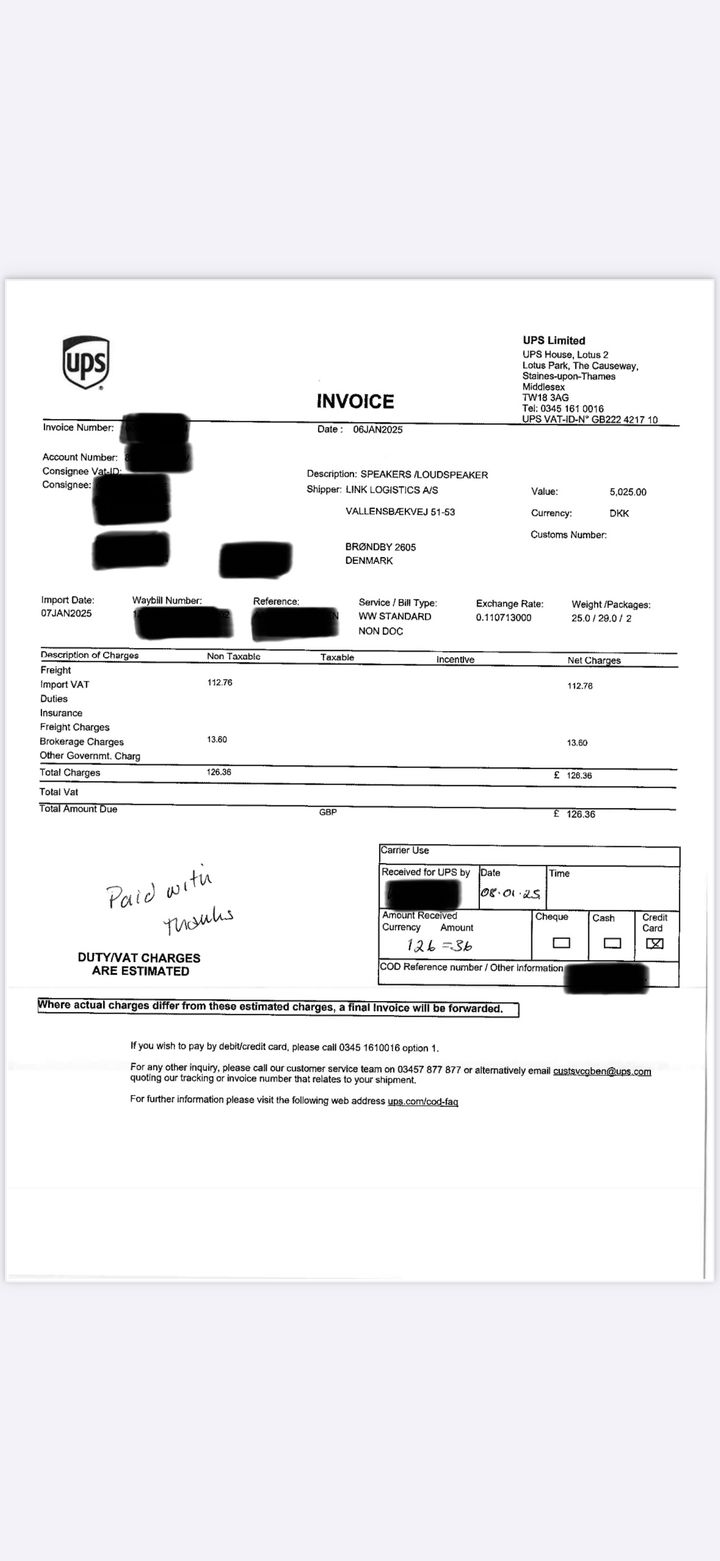
Question is, should i be expecting a further invoice?? Or is this legit?
Obvs its appears a result, but the seller will reimburse duties anyway so inwant to be sure of any further liabilities that may come to pass.
Delivery chap handed me the invoice below…
Question is, should i be expecting a further invoice?? Or is this legit?
Obvs its appears a result, but the seller will reimburse duties anyway so inwant to be sure of any further liabilities that may come to pass.

Liability is with the shipper, they are the ones who declared the value and would have signed the documents confirming the value for shipping.
Rightly or wrongly I would be paying that invoice and moving on.
The likely hood that anyone will ever look into anything is slim to none after all it has been imported and you have paid the charges to do so.
Rightly or wrongly I would be paying that invoice and moving on.
The likely hood that anyone will ever look into anything is slim to none after all it has been imported and you have paid the charges to do so.
I'd pay the bill and move on. UPS should be aware of what is required sending an item to the UK. At least they've declared something and not like some where I've received stuff from overseas and they've left it to HMRC who via the courier sting you for 20% plus a courier 'admin and handling fee 
It does say the duty amount is an 'estimate' and you may get a final bill. If so what is the current status?
It does say the duty amount is an 'estimate' and you may get a final bill. If so what is the current status?
Countdown said:
foxsasha said:
DoubleSix said:
Looks like an error with the currency, but where does the liability sit? im concerned it sits with me as the purchaser.
Liability is with you. I was about to ask if 20% VAT rate was correct, but even if it was 5%, it would have been more than that on 5k EUR!
Perhaps it is wise to pay it and move on quickly - they are professionals and all that, and you are just a layman, so how are you to know if what they are asking for is or is not correct?
Perhaps it is wise to pay it and move on quickly - they are professionals and all that, and you are just a layman, so how are you to know if what they are asking for is or is not correct?
Countdown said:
foxsasha said:
DoubleSix said:
Looks like an error with the currency, but where does the liability sit? im concerned it sits with me as the purchaser.
Liability is with you. I'm inclined to suspect the receiver is responsible for UK taxes. Although in this case I'd have paid the bill and moved on.
The liability for the currency error on the paperwork lies with the shipper, as the originator of the document. The liability to acquit the correct taxes and duties lies with the recipient.
If the customs department suspect that the accompanying document is not correct, they may request further clarification from the shipper and/or recipient, especially where prepayment has occurred. So if DoubleSix were asked to provide a copy of the purchase invoice, then he would invoiced accordingly by customs. Unless there is clear evidence that that DoubleSix explicitly requested the shipper to undervalue the goods, then he is in the clear from further sanction.
The shipper in this case could always just plead administrative error in terms of the currency code, unless further investigation shows that they've done it before with other customers in the UK. Also it is not unknown for customs officers to consult outside sources (Google, Ebay, Amazon, etc) when they suspect an item to be undervalued.
In other cases of non-purchased goods crossing borders, arbitrary valuations are often used. E.g. for moving used musical instruments into the EU, 50% of current list price is used as the "cote argus". This produced a situation where it made sense to buy another (more modestly-priced) piano for my house in Burgundy, than to export the Bösendorfer I have at my Swiss address, as French customs wanted the not insignificant sum of 20% VAT on half its new value.
If the customs department suspect that the accompanying document is not correct, they may request further clarification from the shipper and/or recipient, especially where prepayment has occurred. So if DoubleSix were asked to provide a copy of the purchase invoice, then he would invoiced accordingly by customs. Unless there is clear evidence that that DoubleSix explicitly requested the shipper to undervalue the goods, then he is in the clear from further sanction.
The shipper in this case could always just plead administrative error in terms of the currency code, unless further investigation shows that they've done it before with other customers in the UK. Also it is not unknown for customs officers to consult outside sources (Google, Ebay, Amazon, etc) when they suspect an item to be undervalued.
In other cases of non-purchased goods crossing borders, arbitrary valuations are often used. E.g. for moving used musical instruments into the EU, 50% of current list price is used as the "cote argus". This produced a situation where it made sense to buy another (more modestly-priced) piano for my house in Burgundy, than to export the Bösendorfer I have at my Swiss address, as French customs wanted the not insignificant sum of 20% VAT on half its new value.
Countdown said:
How would DoubleSix pay the correct VAT to the Danish equivalent of HMRC?
UK VAT upon importation to a private individual is due to HMRC not the VAT authority of the foreign vendor, ever since the UK left the EU. For a period before that, the (private) recipient paid the VAT of the seller's country along with the net price; that element was then declared by the vendor and paid to his/her local VAT authority. In any case, the figures on the document clearly indicate a rate of 20% (once converted from DKK to GBP), whereas the VAT rate in Denmark is 25%.Upon closer inspection, perhaps UPS made the currency code error and maybe the seller's original invoice that accompanied the goods was indeed quoted in EUR. In which case, there is a faint chance that the error could be detected in the future, perhaps when UPS try to reconcile the amount of VAT they have collected on behalf of HMRC with what HMRC then demand from them according to their own documentation, where the possible full-fat EUR invoice might still lurk.
But given the volumes being processed each day and the general incompetence of both parties, I reckon DoubleSix has got away with it. Pay quickly and STFU is always a good policy in these cases
At work we purchase a reasonable volume (€~150k annually) of goods from (and manufactured in) Denmark, for which we are always invoiced in EUR. My UBS e-banking always defaults to a DKK payment screen, which I have to manually change to EUR each time.
Michael_B said:
Countdown said:
How would DoubleSix pay the correct VAT to the Danish equivalent of HMRC?
UK VAT upon importation to a private individual is due to HMRC not the VAT authority of the foreign vendor, ever since the UK left the EU. For a period before that, the (private) recipient paid the VAT of the seller's country along with the net price; that element was then declared by the vendor and paid to his/her local VAT authority. In any case, the figures on the document clearly indicate a rate of 20% (once converted from DKK to GBP), whereas the VAT rate in Denmark is 25%.When the Importer is a VAt registered business it's relatively straightforward to apply Reverse charge VAT and add the VAT underpayment to your quarterly VAT return but I'm struggling to see how a private individual who isn't registered for VAT would go about it.
Completely O/T but a lot of foreign vendors get round Import VAT simply by marking the item as "Sample".

I've imported a few things from the US, it's not unknown for the VAT to be wrong or simply not charged at all.
On one occasion I was overcharged a few quid, trying to get that sorted was a complete farce, so when it's the other way I'm comfortable not bothering.
But these are smaller amounts, having a bill of a grand potentially out there is not nice.
On one occasion I was overcharged a few quid, trying to get that sorted was a complete farce, so when it's the other way I'm comfortable not bothering.
But these are smaller amounts, having a bill of a grand potentially out there is not nice.
Gassing Station | Finance | Top of Page | What's New | My Stuff