
spannering your worst mistakes
Discussion


owned lots of classics so very used to changing brake parts , bleeding brakes etc.
So on the trusty Mitsubishi outlander PHEV mk3 2016 , at 126,000 miles thought time to replace the pads and discs , had noticed the rears where binding , so with new Bilstein calipers at £ 60 each , Bilstein discs at £25 and pads £26 . bought a set from Germany . , plus 2 litres of dot4 brake fluid . ( manual hand brake not electric)
removed each side and manually bled the brakes with son in passenger seat , had a nice flow of oil with no bubbles at the calipers , topping up resevoir as required. .
Then started engine brake straight to the floor , checked resovoir , low so topped up . tried again same thing vacumm pump engaging . brake marginally better , left overnight. cold morning started car , once heated up heard vacumm pump brake service required light illuminated checked resevouir .... almost empty !! . Topped up , so by now nearly 2 lites of brake fluid used. pedal still not right .. Called AA as we had home service , chap said fairly sure to bleed the brakes it has to be done with car plugged in .OBD
He was right we plugged in and followed the procedure .........all good ....err no on completion had good brakes drove around the block all good .
AA left . The following morning drove a mile to the local Screwfix on the journey , the brake service required light illuminated again but this time the brake pedal went to floor ......with no brakes .. luckily no other traffic around so Hazard lights on . and used the regenetrive braking mode on the car to slow down using the engine to slowly getting the cas back home using hand brake . parked up and booked in to local dealership for service
guessing that the brake master cylinder seals have failed with the brake fluid being sucked into the brake booster and vacumn ... will wait to see thge outcome
So on the trusty Mitsubishi outlander PHEV mk3 2016 , at 126,000 miles thought time to replace the pads and discs , had noticed the rears where binding , so with new Bilstein calipers at £ 60 each , Bilstein discs at £25 and pads £26 . bought a set from Germany . , plus 2 litres of dot4 brake fluid . ( manual hand brake not electric)
removed each side and manually bled the brakes with son in passenger seat , had a nice flow of oil with no bubbles at the calipers , topping up resevoir as required. .
Then started engine brake straight to the floor , checked resovoir , low so topped up . tried again same thing vacumm pump engaging . brake marginally better , left overnight. cold morning started car , once heated up heard vacumm pump brake service required light illuminated checked resevouir .... almost empty !! . Topped up , so by now nearly 2 lites of brake fluid used. pedal still not right .. Called AA as we had home service , chap said fairly sure to bleed the brakes it has to be done with car plugged in .OBD
He was right we plugged in and followed the procedure .........all good ....err no on completion had good brakes drove around the block all good .
AA left . The following morning drove a mile to the local Screwfix on the journey , the brake service required light illuminated again but this time the brake pedal went to floor ......with no brakes .. luckily no other traffic around so Hazard lights on . and used the regenetrive braking mode on the car to slow down using the engine to slowly getting the cas back home using hand brake . parked up and booked in to local dealership for service
guessing that the brake master cylinder seals have failed with the brake fluid being sucked into the brake booster and vacumn ... will wait to see thge outcome
Edited by Purosangue on Friday 12th December 16:38
More of these here: https://www.pistonheads.com/gassing/topic.asp?h=0&...
Purosangue said:
owned lots of classics so very used to changing brake parts , bleeding brakes etc.
So on the trusty Mitsubishi outlander PHEV mk3 2016 , at 126,000 miles thought time to replace the pads and discs , had noticed the rears where binding , so with new Bilstein calipers at £ 60 each , Bilstein discs at £25 and pads £26 . bought a set from Germany . , plus 2 litres of dot4 brake fluid . ( manual hand brake not electric)
removed each side and manually bled the brakes with son in passenger seat , had a nice flow of oil with no bubbles at the calipers , topping up resevoir as required. .
Then started engine brake straight to the floor , checked resovoir , low so topped up . tried again same thing vacumm pump engaging . brake marginally better , left overnight. cold morning started car , once heated up heard vacumm pump brake service required light illuminated checked resevouir .... almost empty !! . Topped up , so by now nearly 2 lites of brake fluid used. pedal still not right .. Called AA as we had home service , chap said fairly sure to bleed the brakes it has to be done with car plugged in .OBD
He was right we plugged in and followed the procedure .........all good ....err no on completion had good brakes drove around the block all good .
AA left . The following morning drove a mile to the local Screwfix on the journey , the brake service required light illuminated again but this time the brake pedal went to floor ......with no brakes .. luckily no other traffic around so Hazard lights on . and used the regenetrive braking mode on the car to slow down using the engine to slowly getting the cas back home using hand brake . parked up and booked in to local dealership for service
guessing that the brake master cylinder seals have failed with the brake fluid being sucked into the brake booster and vacumn ... will wait to see thge outcome
If you have used that much fluid it must be leaving the closed system somewhere, that being the case it should be pretty easy to find where it is going.So on the trusty Mitsubishi outlander PHEV mk3 2016 , at 126,000 miles thought time to replace the pads and discs , had noticed the rears where binding , so with new Bilstein calipers at £ 60 each , Bilstein discs at £25 and pads £26 . bought a set from Germany . , plus 2 litres of dot4 brake fluid . ( manual hand brake not electric)
removed each side and manually bled the brakes with son in passenger seat , had a nice flow of oil with no bubbles at the calipers , topping up resevoir as required. .
Then started engine brake straight to the floor , checked resovoir , low so topped up . tried again same thing vacumm pump engaging . brake marginally better , left overnight. cold morning started car , once heated up heard vacumm pump brake service required light illuminated checked resevouir .... almost empty !! . Topped up , so by now nearly 2 lites of brake fluid used. pedal still not right .. Called AA as we had home service , chap said fairly sure to bleed the brakes it has to be done with car plugged in .OBD
He was right we plugged in and followed the procedure .........all good ....err no on completion had good brakes drove around the block all good .
AA left . The following morning drove a mile to the local Screwfix on the journey , the brake service required light illuminated again but this time the brake pedal went to floor ......with no brakes .. luckily no other traffic around so Hazard lights on . and used the regenetrive braking mode on the car to slow down using the engine to slowly getting the cas back home using hand brake . parked up and booked in to local dealership for service
guessing that the brake master cylinder seals have failed with the brake fluid being sucked into the brake booster and vacumn ... will wait to see thge outcome
Check every fitting you worked on for evidence of fluid in the first instance.
E-bmw said:
Purosangue said:
owned lots of classics so very used to changing brake parts , bleeding brakes etc.
So on the trusty Mitsubishi outlander PHEV mk3 2016 , at 126,000 miles thought time to replace the pads and discs , had noticed the rears where binding , so with new Bilstein calipers at £ 60 each , Bilstein discs at £25 and pads £26 . bought a set from Germany . , plus 2 litres of dot4 brake fluid . ( manual hand brake not electric)
removed each side and manually bled the brakes with son in passenger seat , had a nice flow of oil with no bubbles at the calipers , topping up resevoir as required. .
Then started engine brake straight to the floor , checked resovoir , low so topped up . tried again same thing vacumm pump engaging . brake marginally better , left overnight. cold morning started car , once heated up heard vacumm pump brake service required light illuminated checked resevouir .... almost empty !! . Topped up , so by now nearly 2 lites of brake fluid used. pedal still not right .. Called AA as we had home service , chap said fairly sure to bleed the brakes it has to be done with car plugged in .OBD
He was right we plugged in and followed the procedure .........all good ....err no on completion had good brakes drove around the block all good .
AA left . The following morning drove a mile to the local Screwfix on the journey , the brake service required light illuminated again but this time the brake pedal went to floor ......with no brakes .. luckily no other traffic around so Hazard lights on . and used the regenetrive braking mode on the car to slow down using the engine to slowly getting the cas back home using hand brake . parked up and booked in to local dealership for service
guessing that the brake master cylinder seals have failed with the brake fluid being sucked into the brake booster and vacumn ... will wait to see thge outcome
If you have used that much fluid it must be leaving the closed system somewhere, that being the case it should be pretty easy to find where it is going.So on the trusty Mitsubishi outlander PHEV mk3 2016 , at 126,000 miles thought time to replace the pads and discs , had noticed the rears where binding , so with new Bilstein calipers at £ 60 each , Bilstein discs at £25 and pads £26 . bought a set from Germany . , plus 2 litres of dot4 brake fluid . ( manual hand brake not electric)
removed each side and manually bled the brakes with son in passenger seat , had a nice flow of oil with no bubbles at the calipers , topping up resevoir as required. .
Then started engine brake straight to the floor , checked resovoir , low so topped up . tried again same thing vacumm pump engaging . brake marginally better , left overnight. cold morning started car , once heated up heard vacumm pump brake service required light illuminated checked resevouir .... almost empty !! . Topped up , so by now nearly 2 lites of brake fluid used. pedal still not right .. Called AA as we had home service , chap said fairly sure to bleed the brakes it has to be done with car plugged in .OBD
He was right we plugged in and followed the procedure .........all good ....err no on completion had good brakes drove around the block all good .
AA left . The following morning drove a mile to the local Screwfix on the journey , the brake service required light illuminated again but this time the brake pedal went to floor ......with no brakes .. luckily no other traffic around so Hazard lights on . and used the regenetrive braking mode on the car to slow down using the engine to slowly getting the cas back home using hand brake . parked up and booked in to local dealership for service
guessing that the brake master cylinder seals have failed with the brake fluid being sucked into the brake booster and vacumn ... will wait to see thge outcome
Check every fitting you worked on for evidence of fluid in the first instance.
Doing the rear discs and pads on my R8 V10. Jacked up, wheel off, parking brake released (can't get the disc off otherwise), in gear (4x4). Started raining, went in and left it.
Next morning, resumed the (easy) job. Before I attacked the disc I went to put an axle stand underneath, jacked it up just a little more with my low profile trolley jack to give room for the axle stand. Front wheel left the ground - handbrake is OFF - car rolled backwards.
Axle stand through the rear bodywork and trolley jack sideways, crushed, with the side handle burried in the floor pan. £900 repair and repaint later, all done (though there is still the dent in the floor pan). Amazing professional repair.
I have joked that the whole job was STILL cheaper than using a garage and OEM discs, including all parts, plus the damage!
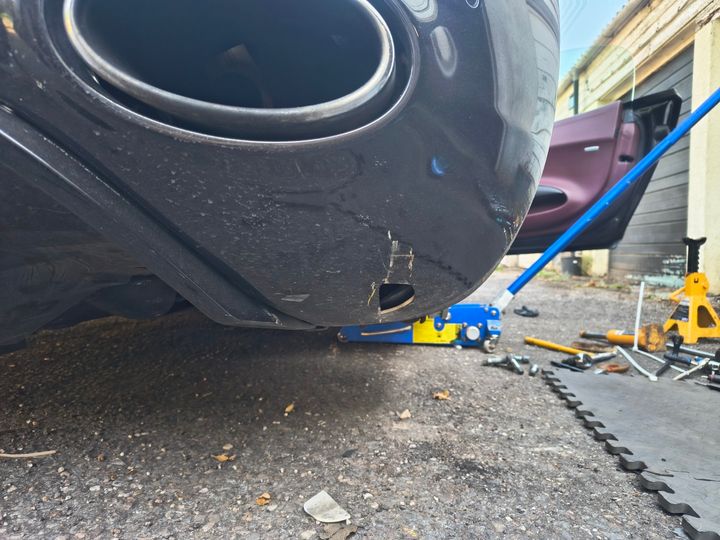
Next morning, resumed the (easy) job. Before I attacked the disc I went to put an axle stand underneath, jacked it up just a little more with my low profile trolley jack to give room for the axle stand. Front wheel left the ground - handbrake is OFF - car rolled backwards.
Axle stand through the rear bodywork and trolley jack sideways, crushed, with the side handle burried in the floor pan. £900 repair and repaint later, all done (though there is still the dent in the floor pan). Amazing professional repair.
I have joked that the whole job was STILL cheaper than using a garage and OEM discs, including all parts, plus the damage!
Griffith4ever said:
Doing the rear discs and pads on my R8 V10. Jacked up, wheel off, parking brake released (can't get the disc off otherwise), in gear (4x4). Started raining, went in and left it.
Next morning, resumed the (easy) job. Before I attacked the disc I went to put an axle stand underneath, jacked it up just a little more with my low profile trolley jack to give room for the axle stand. Front wheel left the ground - handbrake is OFF - car rolled backwards.
Axle stand through the rear bodywork and trolley jack sideways, crushed, with the side handle burried in the floor pan. £900 repair and repaint later, all done (though there is still the dent in the floor pan). Amazing professional repair.
I have joked that the whole job was STILL cheaper than using a garage and OEM discs, including all parts, plus the damage!
christ i feel your pain , Next morning, resumed the (easy) job. Before I attacked the disc I went to put an axle stand underneath, jacked it up just a little more with my low profile trolley jack to give room for the axle stand. Front wheel left the ground - handbrake is OFF - car rolled backwards.
Axle stand through the rear bodywork and trolley jack sideways, crushed, with the side handle burried in the floor pan. £900 repair and repaint later, all done (though there is still the dent in the floor pan). Amazing professional repair.
I have joked that the whole job was STILL cheaper than using a garage and OEM discs, including all parts, plus the damage!
i never like having to take off rear callipers with the car jacked up and hand brake released
glad you got it sorted
Purosangue said:
christ i feel your pain ,
i never like having to take off rear callipers with the car jacked up and hand brake released
glad you got it sorted
I was amazed at what I actually got away with. The jack rolling on its side stopped the disc & car from grounding out, along with the axle stand in teh bumper!! The jack side handle was VERY close to trashing the cill. Missed it by a few mm.i never like having to take off rear callipers with the car jacked up and hand brake released
glad you got it sorted
Repair was in for a week, entire rear off, plastic patched, braced, painted - you'd never know. Took the opportunity to replace the old knackered under-pan air scoops at the same time
E-bmw said:
If you have used that much fluid it must be leaving the closed system somewhere, that being the case it should be pretty easy to find where it is going.
Check every fitting you worked on for evidence of fluid in the first instance.
I have put some stories on the other diy disaster thread...Check every fitting you worked on for evidence of fluid in the first instance.
But this reminds me of using an old gunson ezebleed system with a spare trailer tyre.
Bottom line the tyre was flat and I somehow syphoned a shed load of brake fluid into the tyre!
I was beginning to wonder where it was going.
Got myself a bleeding kit with a pump after that
(Ps don't undo the master cylinder connector without releasing the pressure first - a mistake you only make once...)
Gassing Station | Home Mechanics | Top of Page | What's New | My Stuff