
DIY sensor clean or pay someone?
Discussion


I have noticed a few spots on my Nikon D7200.
It's about £50 for my local camera shop to clean it or I can DIY it. What would you do?
If you would DIY it what cleaning kit would you use?
I am tight and would rather not pay £50 but it's more about having to make two trips over there and they want the camera for 5 days.
It's about £50 for my local camera shop to clean it or I can DIY it. What would you do?
If you would DIY it what cleaning kit would you use?
I am tight and would rather not pay £50 but it's more about having to make two trips over there and they want the camera for 5 days.

I’ve cleaned my sensor a few times. Every time you change a lens there is a risk of dust and in most case you won’t see it in the final photos. You certainly don’t need a clean room and camera shops don’t have one either.
As said, just get the right size for your sensor and read the instructions.
As said, just get the right size for your sensor and read the instructions.
A friend of mine cleaned the sensor in my Panasonic - while I sat beside him! In the few months since he used the stuff he had to spread on it, it had deteriorated and left a sticky goo over most of the sensor. I took it to a camera shop and they refused to try to clean it, saying it would take too long with no guarantee of success. I followed their advice re solvent and it took me over 40 hours to remove all the stuff. I had a moan on PH about it. I was livid, but I'm still talking to my friend, but not when I've got a camera in my hands.
There was no warning on the cleaner as to longevity. If you do want to DIY, I'd suggest testing whatever fluid or other material you use before venturing near your camera, let alone sensor.
I now clean the interior of my camera after removing my lens outside my house, and once a month if I've removed the lens inside the house. It's proved effective and I've had no problems, that's in over a year I think. I have two cameras and pick the lenses I expect to use before leaving home, although I take another lens or so.
If my method of cleaning fails to clear the debris, I'll take it to my local camera shop, but so far, so good.
I invert the camera on a desktop tripod, remove the lens, lightly - very lightly - dust the sensor if there's been evidence of a spot, and then use a little puffer to blow into the recess. If no trace of debris on the sensor, I just use the blower.
A new sensor for my camera comes to over £300 fitted.
There was no warning on the cleaner as to longevity. If you do want to DIY, I'd suggest testing whatever fluid or other material you use before venturing near your camera, let alone sensor.
I now clean the interior of my camera after removing my lens outside my house, and once a month if I've removed the lens inside the house. It's proved effective and I've had no problems, that's in over a year I think. I have two cameras and pick the lenses I expect to use before leaving home, although I take another lens or so.
If my method of cleaning fails to clear the debris, I'll take it to my local camera shop, but so far, so good.
I invert the camera on a desktop tripod, remove the lens, lightly - very lightly - dust the sensor if there's been evidence of a spot, and then use a little puffer to blow into the recess. If no trace of debris on the sensor, I just use the blower.
A new sensor for my camera comes to over £300 fitted.
I've been cleaning the sensors on my cameras since I got my first DSLR in 2006. I use as bottle of cleaning fluid and a swab. You don't need to have cleanroom conditions - after all the inside of your camera is exposed to dust every time you change lenses. In addition, with many lenses, every time you focus or zoom your lens you are pumping dust into your lens and into your camera.
If you are going to clean your sensor, make sure that you first use your camera's built-in ultrasonic sensor-cleaning function to dislodge any loose dust and dirt. And if your camera needs battery power to hold the mirror up or shutter open, then make sure the battery is freshly charged. Your camera likely has a sensor cleaning mode that will hold the mirror up or shutter open until the camera is powered off.
Then use a little cleaning fluid on the sensor swab, and wipe in gentle but deliberate movements. Use a decent light to illuminate the sensor so you can see when it's clean. But it may be impossible to remove every single speck of dust. And there's really no need to. Lots of editing software can identify dust and can remove it for you digitally. There's no photograph on earth taken outside of a cleanroom where some dust or dirt didn't get onto the sensor or film. The best you can do is mitigate it.
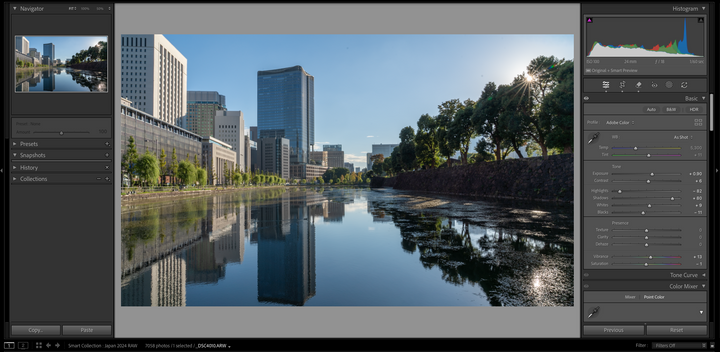
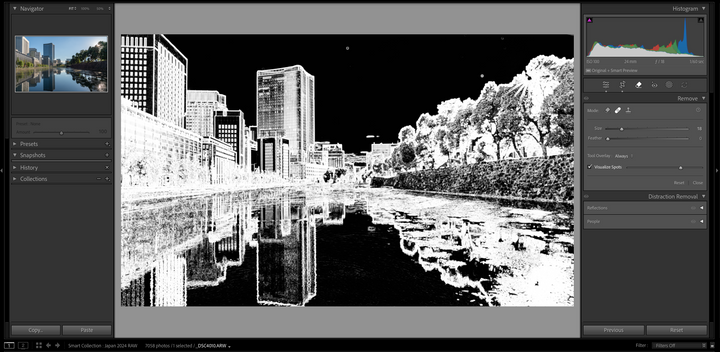
If you use Lightroom, press Q then A to show a black and white mask which will show you all of the dust spots. For example, here's a photo taken in Tokyo last year, in normal develop view, and then "Visualize Spots" mode. It's easy to see where the dust spots are!
If you are going to clean your sensor, make sure that you first use your camera's built-in ultrasonic sensor-cleaning function to dislodge any loose dust and dirt. And if your camera needs battery power to hold the mirror up or shutter open, then make sure the battery is freshly charged. Your camera likely has a sensor cleaning mode that will hold the mirror up or shutter open until the camera is powered off.
Then use a little cleaning fluid on the sensor swab, and wipe in gentle but deliberate movements. Use a decent light to illuminate the sensor so you can see when it's clean. But it may be impossible to remove every single speck of dust. And there's really no need to. Lots of editing software can identify dust and can remove it for you digitally. There's no photograph on earth taken outside of a cleanroom where some dust or dirt didn't get onto the sensor or film. The best you can do is mitigate it.
If you use Lightroom, press Q then A to show a black and white mask which will show you all of the dust spots. For example, here's a photo taken in Tokyo last year, in normal develop view, and then "Visualize Spots" mode. It's easy to see where the dust spots are!
breamster said:
I have noticed a few spots on my Nikon D7200.
It's about £50 for my local camera shop to clean it or I can DIY it. What would you do?
If you would DIY it what cleaning kit would you use?
I am tight and would rather not pay £50 but it's more about having to make two trips over there and they want the camera for 5 days.
I just DIY cleaned my old D7200 sensor a few months ago, it had accumulated a lot of dust spots over a few years of rally photography since its last shop clean.It's about £50 for my local camera shop to clean it or I can DIY it. What would you do?
If you would DIY it what cleaning kit would you use?
I am tight and would rather not pay £50 but it's more about having to make two trips over there and they want the camera for 5 days.
I was going to have to courier it away for a shop clean as nowhere nearby does it, and has been relegated to backup camera status for me now so I figured I wasn't risking much trying it myself.
I bought a cheap K&F Concept sensor cleaning kit and it was straightforward enough, though it took me 3 or 4 attempts before I managed to avoid leaving streaks behind. Don't use too much cleaning fluid, IIRC it said 1-2 drops on the swab but it was tricky to get small enough drops from the bottle, so 1 drop worked best.
Five days to clean a sensor, blimey.
On the rare occasion I get a troublesome spot of dust I use a Rocket blower: https://www.wexphotovideo.com/giottos-aa1900-rocke...
On the rare occasion I get a troublesome spot of dust I use a Rocket blower: https://www.wexphotovideo.com/giottos-aa1900-rocke...

I’d do it yourself. I’m repeating what others have said but just make sure you don’t use too much liquid, and get a kit from a reputable maker or one suggested by a decent camera shop. I got some Visible Dust kits from WEX and they’ve been no trouble.
I had to get a kit as I’d taken a camera to an LCE branch 50 miles away for a one hour clean…the first time I did that it was great, but second time they’d left a hair on the sensor which was visible even at f2.8. You’re better off doing a job like this yourself - it’s quite simple once you get past the fear factor.
I had to get a kit as I’d taken a camera to an LCE branch 50 miles away for a one hour clean…the first time I did that it was great, but second time they’d left a hair on the sensor which was visible even at f2.8. You’re better off doing a job like this yourself - it’s quite simple once you get past the fear factor.
Gassing Station | Photography & Video | Top of Page | What's New | My Stuff