
Shed Insulation
Discussion


Finished my shed towards the end of autumn and so far there hasn't been any leaks, a little condensation on the roof panels but that's it.
Now spring is around the corner starting to think about insulating it and boarding it up before I properly start to move things in.
My idea was to use either kingspan or rockwool in between the battons and then either OSB or plywood on top. Couple of questions
1) between the panel and insulation & insulation & internal board, do I need to line it with plastic or some vapour barrier to stop any water getting through to the insulation? Or overthinking it?
2) thinking OSB due to it being cheaper but any pro/con between using plywood instead?
Anything else to consider before going for it?
Now spring is around the corner starting to think about insulating it and boarding it up before I properly start to move things in.
My idea was to use either kingspan or rockwool in between the battons and then either OSB or plywood on top. Couple of questions
1) between the panel and insulation & insulation & internal board, do I need to line it with plastic or some vapour barrier to stop any water getting through to the insulation? Or overthinking it?
2) thinking OSB due to it being cheaper but any pro/con between using plywood instead?
Anything else to consider before going for it?
I contemplated similar after I rebuilt my shed (Re-roof with EPDM, new floor and replaced some rotten outer boards)
In the end I decided not to insulate and just boarded out the inside walls with OSB
My concerns were
The gap between outer shiplap and inner OSB was only 5 cm so can't pack a lot of insulation in
If I used rockwool type material had worries about it getting damp and being sealed between the OSB and outer boards rotting both
If I used Foil faced PIR it would have been OK although I still had concerns about damp between the outer boards and OSB inner face but for the benefits of fitting it in a shed that is just used for winter storage it didn't seem worth the effort and cost
In the end I decided not to insulate and just boarded out the inside walls with OSB
My concerns were
The gap between outer shiplap and inner OSB was only 5 cm so can't pack a lot of insulation in
If I used rockwool type material had worries about it getting damp and being sealed between the OSB and outer boards rotting both
If I used Foil faced PIR it would have been OK although I still had concerns about damp between the outer boards and OSB inner face but for the benefits of fitting it in a shed that is just used for winter storage it didn't seem worth the effort and cost
I have exactly the same setup - shiplap external and OSB internal with approx 60mm gap between them (battens as internal frame obviously) and I am trying to figure out the best way to insulate - there is a gap at the top between the roof and the OSB so plenty of air movement but its bloody cold and draughty and now im getting condensation as well.......brilliant.
Think i might put some thin Kingspan between and see how I get on....
Also the base is raised off the floor and I am going to properly insulate this and place vapor barrier on earth beneath (some 2-3ft gap.
Think i might put some thin Kingspan between and see how I get on....
Also the base is raised off the floor and I am going to properly insulate this and place vapor barrier on earth beneath (some 2-3ft gap.
We had some machinery delivered at work and I blagged the shipping crate
The base became my new shed base (which was chipboard on battens and had deteriorated due to roof leaks)
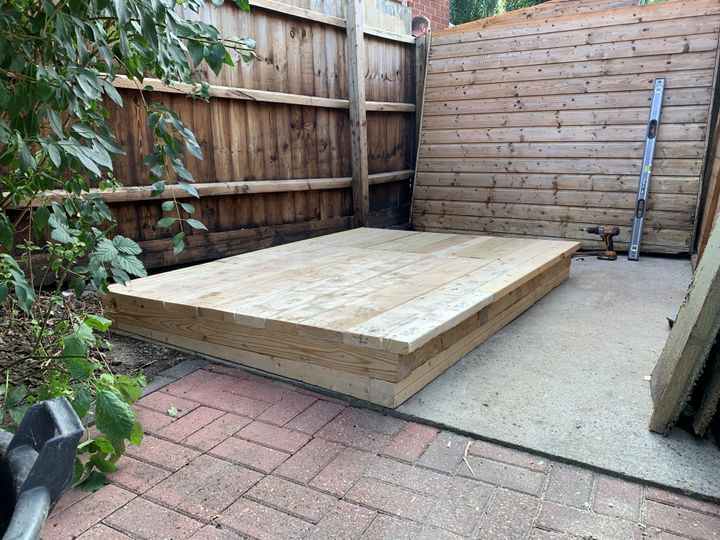
Had to repair the bottom edges of the sides and re-roofed using EPDM on top of new OSB
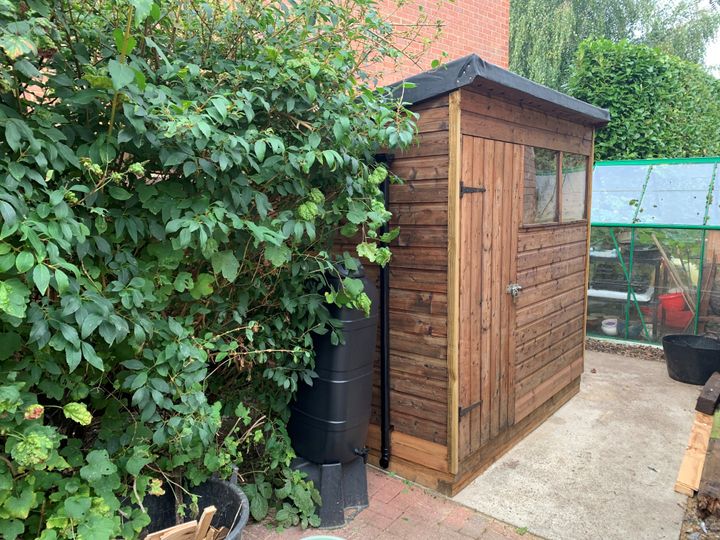
Whole thing is on a concrete pad (with a small fall)
OSB inner walls as per previous post and I've never seen any condensation issues
The base became my new shed base (which was chipboard on battens and had deteriorated due to roof leaks)
Had to repair the bottom edges of the sides and re-roofed using EPDM on top of new OSB
Whole thing is on a concrete pad (with a small fall)
OSB inner walls as per previous post and I've never seen any condensation issues
Insulation is only worthwhile if you're going to be heating the internal space - but why would you do that to a shed, they're so thermally leaky.
Otherwise you will only encourage condensation to form which will rot the shed quicker.
Sheds are intended to get wet, breathe, and dry out.with the changes in the weather.
Otherwise you will only encourage condensation to form which will rot the shed quicker.
Sheds are intended to get wet, breathe, and dry out.with the changes in the weather.
PhilboSE said:
Insulation is only worthwhile if you're going to be heating the internal space - but why would you do that to a shed, they're so thermally leaky.
Otherwise you will only encourage condensation to form which will rot the shed quicker.
Sheds are intended to get wet, breathe, and dry out.with the changes in the weather.
That's largely nonsense!Otherwise you will only encourage condensation to form which will rot the shed quicker.
Sheds are intended to get wet, breathe, and dry out.with the changes in the weather.
Insulation will limit the temperature swings day/night of an unheated building.
Insulated surfaces are less prone to condensation as they warm up when warm moist air hits them, instead of staying cold and maximising condensation.
But, the final solution to condensation involves heat IMHO.

OutInTheShed said:
PhilboSE said:
Insulation is only worthwhile if you're going to be heating the internal space - but why would you do that to a shed, they're so thermally leaky.
Otherwise you will only encourage condensation to form which will rot the shed quicker.
Sheds are intended to get wet, breathe, and dry out.with the changes in the weather.
That's largely nonsense!Otherwise you will only encourage condensation to form which will rot the shed quicker.
Sheds are intended to get wet, breathe, and dry out.with the changes in the weather.
Insulation will limit the temperature swings day/night of an unheated building.
Insulated surfaces are less prone to condensation as they warm up when warm moist air hits them, instead of staying cold and maximising condensation.
But, the final solution to condensation involves heat IMHO.
A) who cares about temperature swings day/night of a shed?
B) who adds heat to a shed to solve the problem of condensation that you created by adding insulation…
I suggest you google “interstitial condensation in sheds” and just read the AI digest.
I’m working in a reasonably well insulated house at the moment, it is going through a major refurb and currently has no gas, so it has no heating apart from a fan heater in one of the rooms where we take our breaks. During the cold spell a few weeks ago it was often colder inside the house than outside, I think insulating a shed would do more harm than good.
Little Lofty said:
I m working in a reasonably well insulated house at the moment, it is going through a major refurb and currently has no gas, so it has no heating apart from a fan heater in one of the rooms where we take our breaks. During the cold spell a few weeks ago it was often colder inside the house than outside, I think insulating a shed would do more harm than good.
Well insulated buildings are often cooler than outdoors during the day.We have a moderately well insulated house here, when the heating is off, it's regularly cooler indoors than out, at certain times of day. The hallway, which gets little sun is often say 15 at noon if the garden is 20. But the hallway will still be 12 around dawn when it's 5 outdoors.
Back to sheds, extreme case, I had a metal shed with terrible condensation on the inside of the roof. Which was greatly improved by insulation. More importantly, the metal stuff in there didn't suffer condensation.
One exception might be a wood shed, where the day/night temperature swings might help dry firewood?
Didn't realise a question would cause so much agro...
Does seem to be 2 sepearte schools of thought, one is no insulation keep good airflow and there will be no significant condensation, the other is insulation is fine and the reduction in temp swings is what keeps the condensation away.
Anyway the main reason I want to explore insulation is firstly once the boards are up then it's a pain to do it and secondly as much as it is just a shed, ideally want to try to avoid condensation and mould and stop rusting/wear on tools and other items to be stored in there.
I think I will give it a few more months, get to spring when the weather warms up and see what it looks like and decide from there. In the mean time I will just use some strips of board I have around to put up and start being able to hang parts
Does seem to be 2 sepearte schools of thought, one is no insulation keep good airflow and there will be no significant condensation, the other is insulation is fine and the reduction in temp swings is what keeps the condensation away.
Anyway the main reason I want to explore insulation is firstly once the boards are up then it's a pain to do it and secondly as much as it is just a shed, ideally want to try to avoid condensation and mould and stop rusting/wear on tools and other items to be stored in there.
I think I will give it a few more months, get to spring when the weather warms up and see what it looks like and decide from there. In the mean time I will just use some strips of board I have around to put up and start being able to hang parts
Edited by bobski1 on Thursday 29th January 08:52
It's a bit of a binary situation IMO; do it property or not at all.
Doing it properly requires proper structural buildup akin to a garden room, from the outside in: cladding, airgap, breather membrane (Tyvek etc), structure, insulation, AVCL, internal facing. You also need to aim for relative air tightness and then still control ventilation (trickle vents etc.). As some of your structure is already up, it's probably too late to do a proper job.
But don't take my word for it. This has been discussed many times before such as here. "Equus" was an architect and planning advisor, pretty authorative.
Doing it properly requires proper structural buildup akin to a garden room, from the outside in: cladding, airgap, breather membrane (Tyvek etc), structure, insulation, AVCL, internal facing. You also need to aim for relative air tightness and then still control ventilation (trickle vents etc.). As some of your structure is already up, it's probably too late to do a proper job.
But don't take my word for it. This has been discussed many times before such as here. "Equus" was an architect and planning advisor, pretty authorative.
Gassing Station | Homes, Gardens and DIY | Top of Page | What's New | My Stuff