
Lintel or not?
Discussion


Hi All
We want to remove the arch in the photos below and widen the gap as much as possible.
What no one at all (including a structural surveyor!) can tell us is whether there is a lintel above the arch and if there is, where does it start and finish?
A bit like buying a dog and barking yerself, I've started to lose my patience with the so-called experts.
So....not being a builder, I've started drilling holes!
What I've found - the arch is made up of a shaped wooden box structure, but of course I cannot see what's above it.
So, I thought I'd drill a couple of other inspection holes and the truth is Idk what I'm looking for....
My cheap flexible camera is now stuck in the wall and I'm very cross!
How do I find someone who knows what they're doing and any clues to the lintel from my photos?
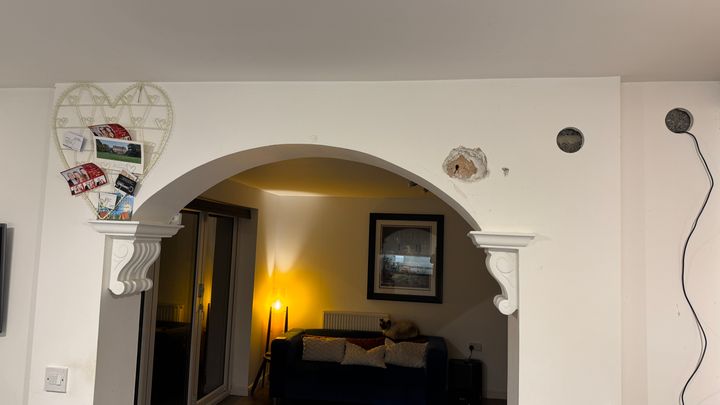
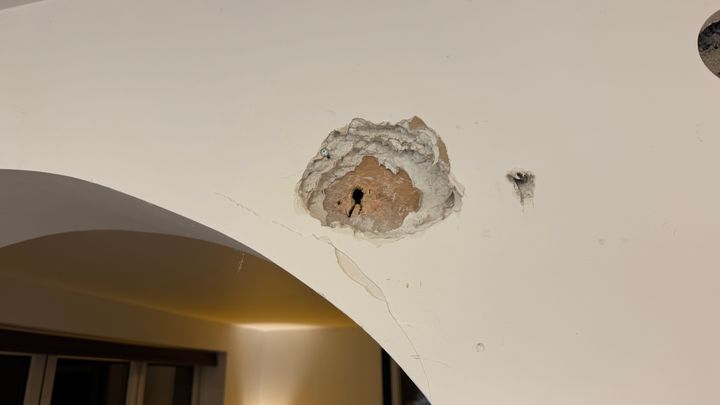
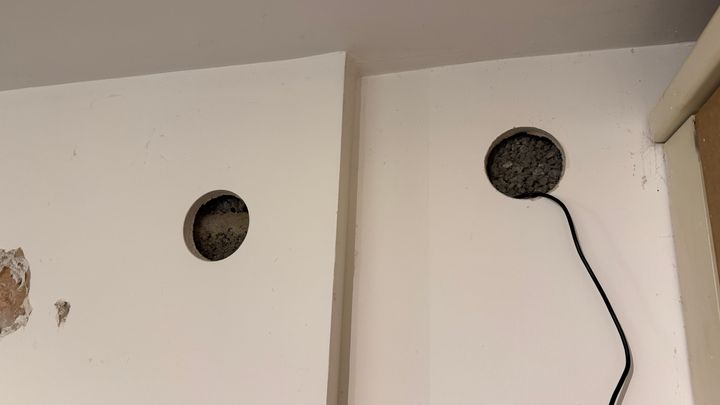
We want to remove the arch in the photos below and widen the gap as much as possible.
What no one at all (including a structural surveyor!) can tell us is whether there is a lintel above the arch and if there is, where does it start and finish?
A bit like buying a dog and barking yerself, I've started to lose my patience with the so-called experts.
So....not being a builder, I've started drilling holes!
What I've found - the arch is made up of a shaped wooden box structure, but of course I cannot see what's above it.
So, I thought I'd drill a couple of other inspection holes and the truth is Idk what I'm looking for....
My cheap flexible camera is now stuck in the wall and I'm very cross!
How do I find someone who knows what they're doing and any clues to the lintel from my photos?
What's above it?
If it's supporting a brick wall, there will be a lintel or steel beam of some sort.
If it's just stud walls or floor, nothing may be needed.
I had a vacation job in a DIY store, we sold 'arch kits' made of expanded metal to plaster over.
If the house is one of a row, what have the neighbours got?
Might have been double doors when built?
You could take away plaster and plaster board etc until you find what's there, you can't guess what some loon has done in the past.
Of course if there is no lintel there, that's not the same as saying one isn't 'needed' but clearly it's stood up for a while.
If it's supporting a brick wall, there will be a lintel or steel beam of some sort.
If it's just stud walls or floor, nothing may be needed.
I had a vacation job in a DIY store, we sold 'arch kits' made of expanded metal to plaster over.
If the house is one of a row, what have the neighbours got?
Might have been double doors when built?
You could take away plaster and plaster board etc until you find what's there, you can't guess what some loon has done in the past.
Of course if there is no lintel there, that's not the same as saying one isn't 'needed' but clearly it's stood up for a while.
My starting point is to assume there will be a lintel over there of some form, likely a steel beam. The only way to be certain is to open up more of the wall. How old is the house? Older the more likely it’s loadbearing.
Below that sounds like possibly a timber arch former.
Is the wall loadbearing - are the joists above sitting on it (check the floor boards run parallel to the wall - joists sit on wall)? Is there a masonry wall above it at first floor?
Its possible, but not certain, that the floor joists run parallel to the wall but that there is a wall above (usually between front and back bedrooms, which supports ceiling joists and / or roof members).
The above is based on massive assumptions, we need more info really.
Below that sounds like possibly a timber arch former.
Is the wall loadbearing - are the joists above sitting on it (check the floor boards run parallel to the wall - joists sit on wall)? Is there a masonry wall above it at first floor?
Its possible, but not certain, that the floor joists run parallel to the wall but that there is a wall above (usually between front and back bedrooms, which supports ceiling joists and / or roof members).
The above is based on massive assumptions, we need more info really.
Edited by Imasurv on Wednesday 4th March 20:31
Thanks all
We've lived in the house since it was built in 2003 and the arch is original.
I guess it is "structural" as there is a bedroom above.
Assuming there's a lentil, I guess it would be the minimum length required for the original archway?
So, if we wanted to remove the arch and widen the gap, we'd need a longer lentil, presumably the famous RSJ (for Gavin & Stacey fans)?
We've lived in the house since it was built in 2003 and the arch is original.
I guess it is "structural" as there is a bedroom above.
Assuming there's a lentil, I guess it would be the minimum length required for the original archway?
So, if we wanted to remove the arch and widen the gap, we'd need a longer lentil, presumably the famous RSJ (for Gavin & Stacey fans)?
I have recently removed an arch between our bedroom and the "dressing room" bit between our bedroom and the bog. The arch bits were just plaster over a timber former. The lintel was about 4" (ie. a 2 x 4 piece of wood) above the top of the arch. As others have said, I think you've been drilling holes in slightly the wrong places.
JohnnyUK said:
Thanks all
We've lived in the house since it was built in 2003 and the arch is original.
I guess it is "structural" as there is a bedroom above.
Assuming there's a lentil, I guess it would be the minimum length required for the original archway?
So, if we wanted to remove the arch and widen the gap, we'd need a longer lentil, presumably the famous RSJ (for Gavin & Stacey fans)?
What is directly above the arch upstairs? Floor? A wall? If so what type of wall? We've lived in the house since it was built in 2003 and the arch is original.
I guess it is "structural" as there is a bedroom above.
Assuming there's a lentil, I guess it would be the minimum length required for the original archway?
So, if we wanted to remove the arch and widen the gap, we'd need a longer lentil, presumably the famous RSJ (for Gavin & Stacey fans)?
If it turns out it looks to be supporting a wall upstairs you will never know for certain where whatever begins and ends without taking off some plaster properly. Drilling holes might give you an idea but that’s it.
JohnnyUK said:
Assuming there's a lentil, I guess it would be the minimum length required for the original archway?
So, if we wanted to remove the arch and widen the gap, we'd need a longer lentil, presumably the famous RSJ (for Gavin & Stacey fans)?
'Predictive text causes house collapse...'So, if we wanted to remove the arch and widen the gap, we'd need a longer lentil, presumably the famous RSJ (for Gavin & Stacey fans)?
I converted a doorway to an arch by getting the lentil, sorry lintel, raised and fixing a wooden box underneath. Try drilling a small hole above the middle of the arch between the top of the arch and the ceiling and see what you hit.
I suspect there was a double door there originally and he's done what I did.
I prefer arches to rectangles but the corbels are a bit ugly; you could just remove those and fair the curve in.
Have you checked to see which way the floorboards (and therefore the joists, but at right angles) run upstairs?
Given that the walls either side are blockwork, I'm going to say there's a fair chance the wall is loadbearing, with the joists running through the arch (from foreground of image to background) rather than across it (left to right in the image). So, there will be a lintel of some kind. However, I would be beyond amazed if the arch itself is loadbearing - it looks entirely decorative to me. I'm guessing the house is from the 70s or 80s?
Given that the walls either side are blockwork, I'm going to say there's a fair chance the wall is loadbearing, with the joists running through the arch (from foreground of image to background) rather than across it (left to right in the image). So, there will be a lintel of some kind. However, I would be beyond amazed if the arch itself is loadbearing - it looks entirely decorative to me. I'm guessing the house is from the 70s or 80s?
We removed a dividing wall to create a larger room instead of two rooms. A builder did the work as part of a bigger one. He checked the area above, looked at joist direction, what was above, by cutting away the ceiling as a repair would have been needed anyway. Result was a non-supporting timber framed wall so no lintel needed. If one was needed then it would have been put in. Wall was removed, ceiling repaired and the whole ceiling re-skimmed. A small crack appeared at ajoing in the repair after several months but that was cured. No other issues after 9 years.
The arch in question.....do a proper job cutting access to check if load bearing. You will be finding out the scope of the job and even if you don't proceed a repair will be needed anyway. Don't trust to luck! Don't guess! Don't assume!
The arch in question.....do a proper job cutting access to check if load bearing. You will be finding out the scope of the job and even if you don't proceed a repair will be needed anyway. Don't trust to luck! Don't guess! Don't assume!
andy43 said:
If there's no solid wall above it taking the floor up directly above the arch is the only way to check which way the joists run.
A suitably specced 150 UB for floor joists (I'm guessing at that) will be a lot less expensive than a bigger steel for joists and a brick wall.
This.A suitably specced 150 UB for floor joists (I'm guessing at that) will be a lot less expensive than a bigger steel for joists and a brick wall.
Take upstairs carpet up and observe where the boarding is nailed down. That should tell you the direction of the joists. My guess is that for a new build the opening won't be structural - the joists will likely run across and that arch will just be boarding.
Alternatively, cut another inspection hole further along the arch and further up.
Simpo Two said:
Swervin_Mervin said:
Alternatively, cut another inspection hole further along the arch and further up.
It doesn't need an inspection hole; a simple masonry drill will tell you if you've hit a lintel because lintels are 1,000x harder than plaster.Always best to use a 75mm holesaw too, so you can fill the holes with downlighters if the arch has to stay.


Gassing Station | Homes, Gardens and DIY | Top of Page | What's New | My Stuff