
Public chargers - not getting speed expected
Discussion


Apologies if discussed elsewhere - I couldn't find a dedicated thread (for public chargers).
Have managed to avoid need for fast charging since getting a home point installed - but needed to use urgently the other day.
50kW car (Renault Zoe), 75kW charger (Pod-point dual-station-thingy, of which I was the only car connected.
Initially looking good - rose progressively up to 37kW. But then within a minute or so dropped to c.17kW for the remainder of the session - which I abandoned after 10 minutes.
Not impressed that when needing fast (ish) charge boost, and paying full rate for it, but only getting 1/3 of that rate. Is this normal? Or perhaps a fault with this specific unit?
It was cold, circa 5 deg C - although car had been charging at home for 15mins then done a 2 mile journey - but could cold weather be a significant factor limiting DC charging rate?
OH's car therefore I don't charge it much - although when acquired 6 months ago before home charger I saw similar 17kW when plugged into the same unit (it's the nearest one) - but on those occasions there was another vehicle plugged in - those others typically drawing 25kW-37kW-50kW from memory. At least that was explainable by balancing draw.
Is this juts a 'feature' of fast chargers / pod-points, Zoe's, chilly-ish weather? Experiences welcomed - thanks.
Have managed to avoid need for fast charging since getting a home point installed - but needed to use urgently the other day.
50kW car (Renault Zoe), 75kW charger (Pod-point dual-station-thingy, of which I was the only car connected.
Initially looking good - rose progressively up to 37kW. But then within a minute or so dropped to c.17kW for the remainder of the session - which I abandoned after 10 minutes.
Not impressed that when needing fast (ish) charge boost, and paying full rate for it, but only getting 1/3 of that rate. Is this normal? Or perhaps a fault with this specific unit?
It was cold, circa 5 deg C - although car had been charging at home for 15mins then done a 2 mile journey - but could cold weather be a significant factor limiting DC charging rate?
OH's car therefore I don't charge it much - although when acquired 6 months ago before home charger I saw similar 17kW when plugged into the same unit (it's the nearest one) - but on those occasions there was another vehicle plugged in - those others typically drawing 25kW-37kW-50kW from memory. At least that was explainable by balancing draw.
Is this juts a 'feature' of fast chargers / pod-points, Zoe's, chilly-ish weather? Experiences welcomed - thanks.
Edited by C-J on Tuesday 17th March 19:31
Battery would not have been up to temperature to charge quickly by then, it takes quite a while for that to happen which is why new EVs pre condition while navigating to a charger
Battery charging speed also depends on the curve, it will charge usually very slowly up to about 20% then full speeds 20-80 before dying off again
On a Zoe 50kw charging is a absolute max, you’ll be lucky to get that outside of a warm day , if you had continued to charge it would have climbed again but not to 50
Battery charging speed also depends on the curve, it will charge usually very slowly up to about 20% then full speeds 20-80 before dying off again
On a Zoe 50kw charging is a absolute max, you’ll be lucky to get that outside of a warm day , if you had continued to charge it would have climbed again but not to 50
Edited by Quattr04. on Tuesday 17th March 17:00
Thanks for sharing - the SoC was 45% so whilst I understand that there would be a charge curve I was hoping that after 10 mins it would have ramped back up to somewhere near that 37kW.
We only had 10 mins to spare - perhaps longer might have seen the rate climb more.
I'll pop back in more perfect conditions and try again - although back in late August (i.e. warm!) I don't recall seeing more than 25kW - and that was only briefly.
We only had 10 mins to spare - perhaps longer might have seen the rate climb more.
I'll pop back in more perfect conditions and try again - although back in late August (i.e. warm!) I don't recall seeing more than 25kW - and that was only briefly.
Edited by C-J on Tuesday 17th March 17:17
The Zoe's charging curve is pretty flat for the first 50% or so, it shouldn't be dipping to <25kW unless you're at a pretty high SoC. At that charge level, 37kW is about right:

Battery temperature certainly can limit charge speeds, but I still wouldn't expect it to be that low at that temperature and nor would I have expected it to peak at 37kW then drop off if that was the limit. I'm not familiar with the Zoe specifically, though.
Battery temperature certainly can limit charge speeds, but I still wouldn't expect it to be that low at that temperature and nor would I have expected it to peak at 37kW then drop off if that was the limit. I'm not familiar with the Zoe specifically, though.
Zoe ZE50 charging speed by SOC % and battery temperature:
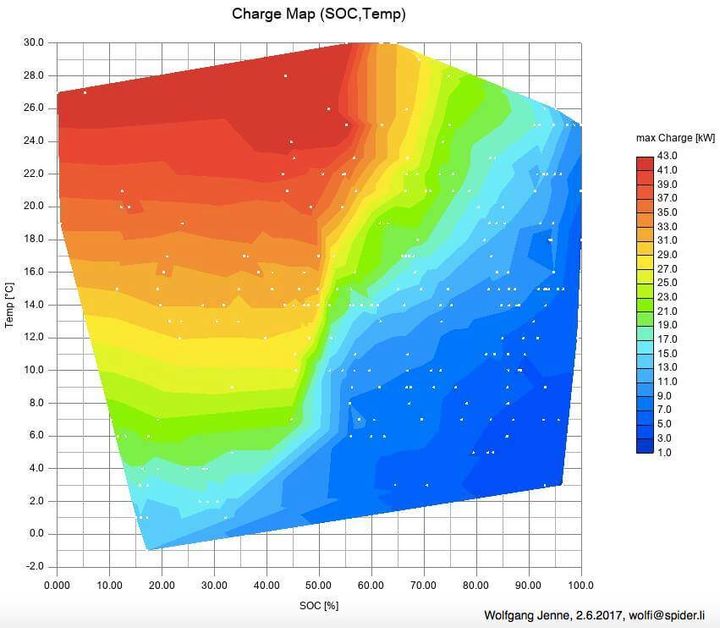
(image found on https://lektri.co/2022/03/29/renault-zoe-in-winter... )
Would seem to suggest that your experience is normal.
Someone online guessed that since the Zoe was designed to charge at only 22 kW, the addition of CCS charging later didn't change the battery cells' fundamental chemistry, so they depend on a warm battery to achieve the headline rate.
Edit - as noted, this must be the original Zoe which charged at up to 43 kW AC, not the later ZE50 which charged at up to 50 kW DC with CCS. However the battery limitations may be similar.
(image found on https://lektri.co/2022/03/29/renault-zoe-in-winter... )
Would seem to suggest that your experience is normal.
Someone online guessed that since the Zoe was designed to charge at only 22 kW, the addition of CCS charging later didn't change the battery cells' fundamental chemistry, so they depend on a warm battery to achieve the headline rate.
Edit - as noted, this must be the original Zoe which charged at up to 43 kW AC, not the later ZE50 which charged at up to 50 kW DC with CCS. However the battery limitations may be similar.
Edited by samoht on Tuesday 17th March 19:49
Another great graph - really useful for understanding impact of the different parameters. Cheers.
Thanks for the link too.
I noticed that the 2017 date on the graph is 2 years before the Zoe 50 (with CCS fast charging) was I think released - either way the principles are presumably the same. The assumption around when the headline rate applies could sadly be true!
Thanks for the link too.
I noticed that the 2017 date on the graph is 2 years before the Zoe 50 (with CCS fast charging) was I think released - either way the principles are presumably the same. The assumption around when the headline rate applies could sadly be true!
Good point - I'd not picked up that it was battery temp.
From what I've read, battery temp needs obd2 dongle plus tailored App to read.
I've just downloaded the App (CanZe) - but will need to research and order a suitable dongle. My generic one is no longer in my possession - however there are mixed reports on which ones work.
In the meantime, keen to hear of any Zoe 50 (or 40) owners using DC fast chargers.
From what I've read, battery temp needs obd2 dongle plus tailored App to read.
I've just downloaded the App (CanZe) - but will need to research and order a suitable dongle. My generic one is no longer in my possession - however there are mixed reports on which ones work.
In the meantime, keen to hear of any Zoe 50 (or 40) owners using DC fast chargers.
Edited by C-J on Tuesday 17th March 21:25
Edited by C-J on Tuesday 17th March 21:26
As per my edit, apologies for the confusion on the Zoe version, so this chart can only be suggestive of the behaviour of a ZE50. Unfortunately it's the best I could find.
One thought that crossed my mind - in cold weather, you may be better off waiting to start a charge from a lower SoC, due to how the battery warms up while charging.
In my old Citroen e-C4 (46 kWh), a DC fast charge from 10% to 90% would warm the battery from 8°C to 25°C, from some combination of active battery heating while charging and simple internal resistance of the battery.
I've tried to show two possible charging sessions on the chart, both starting at 8°C, with the upwards gradient approximately representing the battery warming during charging.
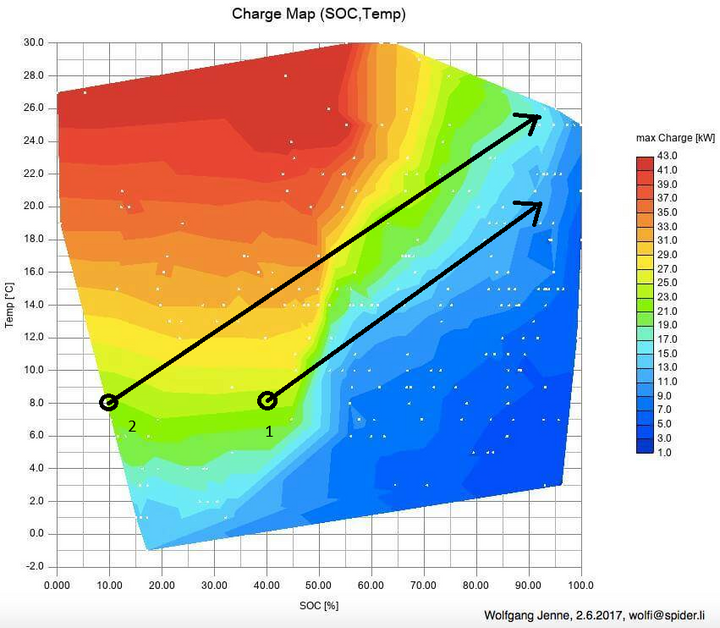
If you plug in at say battery temp 8°C and SoC 40% (case 1 on the chart), you'll add 5% or so at an 'ok' charge rate, and then hit the 'wall' with the battery still cold, and charging rate will slow to a crawl. If instead of stopping to charge then, you carried on driving until you got down to 10% SoC and then plugged in (case 2), with the battery still at 8°C, you'd add 40% charge before hitting the wall. But while charging up to 50%, the battery would warm up to say 16°C, so at the halfway mark you'd then get a much quicker rate for the 'top half' of the battery.
Looking at the colours traversed by each line, it would seem quite possible in cold weather for the 10%-90% charge to take less time than the 40%-90% one - not merely a higher average power, but actually a shorter elapsed time from start to finish.
One thought that crossed my mind - in cold weather, you may be better off waiting to start a charge from a lower SoC, due to how the battery warms up while charging.
In my old Citroen e-C4 (46 kWh), a DC fast charge from 10% to 90% would warm the battery from 8°C to 25°C, from some combination of active battery heating while charging and simple internal resistance of the battery.
I've tried to show two possible charging sessions on the chart, both starting at 8°C, with the upwards gradient approximately representing the battery warming during charging.
If you plug in at say battery temp 8°C and SoC 40% (case 1 on the chart), you'll add 5% or so at an 'ok' charge rate, and then hit the 'wall' with the battery still cold, and charging rate will slow to a crawl. If instead of stopping to charge then, you carried on driving until you got down to 10% SoC and then plugged in (case 2), with the battery still at 8°C, you'd add 40% charge before hitting the wall. But while charging up to 50%, the battery would warm up to say 16°C, so at the halfway mark you'd then get a much quicker rate for the 'top half' of the battery.
Looking at the colours traversed by each line, it would seem quite possible in cold weather for the 10%-90% charge to take less time than the 40%-90% one - not merely a higher average power, but actually a shorter elapsed time from start to finish.
C-J said:
Not impressed that when needing fast (ish) charge boost, and paying full rate for it, but only getting 1/3 of that rate. Is this normal? Or perhaps a fault with this specific unit?
Just on this point, you only pay for the kWh you actually receive, regardless of the charging speed. The speed you are getting for such little driving before reaching the charger sounds about right while it is cold. The new Renault 5 needs 30-45 minutes of driving with a fast charger set as the first stop in the nav, not the end destination, for pre conditioning of the battery to occur and even then fall into the right SOC/temperature window to hit peak speeds and that is assuming that there are no issues with the charger itself.
uktrailmonster said:
C-J said:
Not impressed that when needing fast (ish) charge boost, and paying full rate for it, but only getting 1/3 of that rate. Is this normal? Or perhaps a fault with this specific unit?
Just on this point, you only pay for the kWh you actually receive, regardless of the charging speed. C-J said:
Not impressed that when needing fast (ish) charge boost, and paying full rate for it, but only getting 1/3 of that rate. Is this normal? Or perhaps a fault with this specific unit?
It was cold, circa 5 deg C - although car had been charging at home for 15mins then done a 2 mile journey - but could cold weather be a significant factor limiting DC charging rate?
I found this out the other day, after four years of driving an EV, you would have thought I would have known by now.It was cold, circa 5 deg C - although car had been charging at home for 15mins then done a 2 mile journey - but could cold weather be a significant factor limiting DC charging rate?
Took the Audi down to the local rapid chargers with around 50% charge, I wanted to see if it was all OK as we have a trip in a few weeks and the car has never been rapid charged before.
I plugged it in, and the max it would take is 50kW (the car can take twice that at 50%) with a message on the dash saying 27 minutes until full charge speed or something like that anyway.
I think this is the first time I have ever rapid-charged any of the EVs cold before. It would suck if you had to rapid-charge in a hurry from cold.
TheRainMaker said:
I think this is the first time I have ever rapid-charged any of the EVs cold before. It would suck if you had to rapid-charge in a hurry from cold.
Relatively niche use-case for people who can charge at home, I guess. Probably a bit more of an issue for anyone relying entirely on DC charging. kambites said:
uktrailmonster said:
C-J said:
Not impressed that when needing fast (ish) charge boost, and paying full rate for it, but only getting 1/3 of that rate. Is this normal? Or perhaps a fault with this specific unit?
Just on this point, you only pay for the kWh you actually receive, regardless of the charging speed. Charging speed is the reason I ended up going for a Polestar over an NiroEV.
The Polestar has a much higher charging rate, and the curve on a cold day compared to the eNiro or NiroEV or Kona was just much, much better. I also ran in to a Kona owner who loved the car, the range and the reliability, but found long journeys where the stopping was perhaps 30-40mins while he watched other cars come and go from the neighbouring charger in 15minutes for the same charge...
The Polestar has a much higher charging rate, and the curve on a cold day compared to the eNiro or NiroEV or Kona was just much, much better. I also ran in to a Kona owner who loved the car, the range and the reliability, but found long journeys where the stopping was perhaps 30-40mins while he watched other cars come and go from the neighbouring charger in 15minutes for the same charge...
kambites said:
TheRainMaker said:
I think this is the first time I have ever rapid-charged any of the EVs cold before. It would suck if you had to rapid-charge in a hurry from cold.
Relatively niche use-case for people who can charge at home, I guess. Probably a bit more of an issue for anyone relying entirely on DC charging. Goatwidcoat said:
The speed you are getting for such little driving before reaching the charger sounds about right while it is cold. The new Renault 5 needs 30-45 minutes of driving with a fast charger set as the first stop in the nav, not the end destination, for pre conditioning of the battery to occur and even then fall into the right SOC/temperature window to hit peak speeds and that is assuming that there are no issues with the charger itself.
Really useful to know - thanksGassing Station | EV and Alternative Fuels | Top of Page | What's New | My Stuff