
Discussion


The linked study appears to be making claims about the situation between now and 2030, i.e. over the next four years.
However if you buy a new car, gas boiler or heat pump today, it'll typically still be in use in 15-20 years, i.e. until 2040-45.
Therefore obviously the choices we make as a society today about new EVs and heat pumps need to consider the situation in 2040, which this paper doesn't.
If we get to 2040 and suddenly start demanding people now scrap perfectly working nearly-new petrol cars and gas boilers, no-one will be very happy!
ETA the other clearly wrong assumption is that it's equally efficient to burn fuel in car engines as gas in power stations (they assume one-third for each) - in fact our gas power stations are 50% efficient, so even if all EV charging corresponds to additional gas-fired generation, there is still a significant saving in CO2.
https://www.statista.com/statistics/548943/thermal...
However if you buy a new car, gas boiler or heat pump today, it'll typically still be in use in 15-20 years, i.e. until 2040-45.
Therefore obviously the choices we make as a society today about new EVs and heat pumps need to consider the situation in 2040, which this paper doesn't.
If we get to 2040 and suddenly start demanding people now scrap perfectly working nearly-new petrol cars and gas boilers, no-one will be very happy!
ETA the other clearly wrong assumption is that it's equally efficient to burn fuel in car engines as gas in power stations (they assume one-third for each) - in fact our gas power stations are 50% efficient, so even if all EV charging corresponds to additional gas-fired generation, there is still a significant saving in CO2.
https://www.statista.com/statistics/548943/thermal...
Edited by samoht on Wednesday 18th March 21:59
samoht said:
The linked study appears to be making claims about the situation between now and 2030, i.e. over the next four years.
However if you buy a new car, gas boiler or heat pump today, it'll typically still be in use in 15-20 years, i.e. until 2040-45.
Therefore obviously the choices we make as a society today about new EVs and heat pumps need to consider the situation in 2040, which this paper doesn't.
If we get to 2040 and suddenly start demanding people now scrap perfectly working nearly-new petrol cars and gas boilers, no-one will be very happy!
ETA the other clearly wrong assumption is that it's equally efficient to burn fuel in car engines as gas in power stations (they assume one-third for each) - in fact our gas power stations are 50% efficient, so even if all EV charging corresponds to additional gas-fired generation, there is still a significant saving in CO2.
https://www.statista.com/statistics/548943/thermal...
I think the point being made is that for renewable demand to equal renewable supply—essentially achieving net zero—the government's plan to move the 2035 target forward to 2030 is simply not practical.However if you buy a new car, gas boiler or heat pump today, it'll typically still be in use in 15-20 years, i.e. until 2040-45.
Therefore obviously the choices we make as a society today about new EVs and heat pumps need to consider the situation in 2040, which this paper doesn't.
If we get to 2040 and suddenly start demanding people now scrap perfectly working nearly-new petrol cars and gas boilers, no-one will be very happy!
ETA the other clearly wrong assumption is that it's equally efficient to burn fuel in car engines as gas in power stations (they assume one-third for each) - in fact our gas power stations are 50% efficient, so even if all EV charging corresponds to additional gas-fired generation, there is still a significant saving in CO2.
https://www.statista.com/statistics/548943/thermal...
Edited by samoht on Wednesday 18th March 21:59
Internationally, the emphasis on the electrification of transport as a primary means to reduce emissions is misplaced and, in some countries, very damaging. Currently, only in France is it on the cusp of becoming desirable. Everywhere else, the electrification of lorries and buses should be prioritised over private EVs. A "clickbait" title simply serves to get people to read the argument.
Furthermore, the NESO modelling mentioned is well out of date; initiatives like carbon capture and hydrogen generation are "dead in the water." Technologies like home heat pumps remain unpopular due to high costs, and there is virtually no infrastructure for electric HGVs.
Perhaps the biggest flaw highlighted regarding PV (Solar) and wind is the lack of storage. Without it, we simply cannot meet demand and must rely on alternatives. Looking at today’s generation levels, I would say that is a very valid point.
Fred Smith said:
Have they made that assumption in the study? Have you read the study?
Yes, and yes.The original study said:
A key parameter of our modelling is the heat-engine coefficient relating heat and work (electrical
and mechanical), that the laws of thermodynamics impose. We use a single value of three throughout,
for simplicity and because this best exposes the relationships among choices open to us. Also we meas-
ure fossil-fuel usage and CO2 emissions in kW and kWh, as seen already in section 2. Although these
are unconventional units for the purpose, they simplify the discussions. These choices are discussed
more fully in the SM. So in our models, 1 kWhe of electricity from a gas-fired power station consumes
3 kWhg of fossil gas and emits 3 kWhCO2 of CO2 emissions. Similarly, a heat pump that takes 1 kWe of
electricity provides 3 kW of heat and replaces a gas boiler using 3 kWg of gas to give 3 kW of heat and
3 kWCO2. That makes the heat pump carbon-neutral, rather than beneficial.
https://iopscience.iop.org/article/10.1088/2753-37...and mechanical), that the laws of thermodynamics impose. We use a single value of three throughout,
for simplicity and because this best exposes the relationships among choices open to us. Also we meas-
ure fossil-fuel usage and CO2 emissions in kW and kWh, as seen already in section 2. Although these
are unconventional units for the purpose, they simplify the discussions. These choices are discussed
more fully in the SM. So in our models, 1 kWhe of electricity from a gas-fired power station consumes
3 kWhg of fossil gas and emits 3 kWhCO2 of CO2 emissions. Similarly, a heat pump that takes 1 kWe of
electricity provides 3 kW of heat and replaces a gas boiler using 3 kWg of gas to give 3 kW of heat and
3 kWCO2. That makes the heat pump carbon-neutral, rather than beneficial.
Edited by samoht on Thursday 19th March 10:13
ashenfie said:
I think the point being made is that for renewable demand to equal renewable supply essentially achieving net zero the government's plan to move the 2035 target forward to 2030 is simply not practical.
Internationally, the emphasis on the electrification of transport as a primary means to reduce emissions is misplaced and, in some countries, very damaging. Currently, only in France is it on the cusp of becoming desirable. Everywhere else, the electrification of lorries and buses should be prioritised over private EVs. A "clickbait" title simply serves to get people to read the argument.
Furthermore, the NESO modelling mentioned is well out of date; initiatives like carbon capture and hydrogen generation are "dead in the water." Technologies like home heat pumps remain unpopular due to high costs, and there is virtually no infrastructure for electric HGVs.
Perhaps the biggest flaw highlighted regarding PV (Solar) and wind is the lack of storage. Without it, we simply cannot meet demand and must rely on alternatives. Looking at today s generation levels, I would say that is a very valid point.
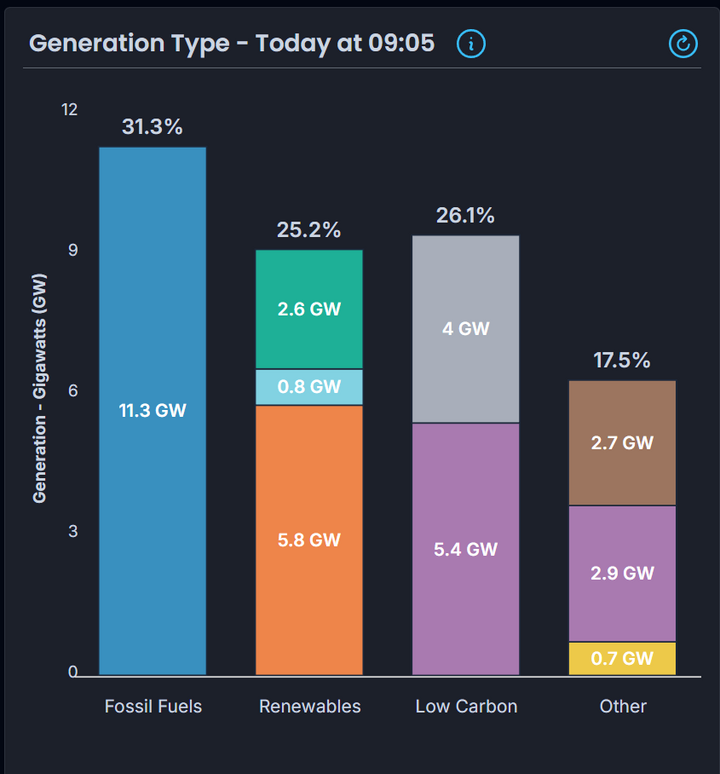
The storage problem could be partially (if not largely) solved by EV and house batteries.Internationally, the emphasis on the electrification of transport as a primary means to reduce emissions is misplaced and, in some countries, very damaging. Currently, only in France is it on the cusp of becoming desirable. Everywhere else, the electrification of lorries and buses should be prioritised over private EVs. A "clickbait" title simply serves to get people to read the argument.
Furthermore, the NESO modelling mentioned is well out of date; initiatives like carbon capture and hydrogen generation are "dead in the water." Technologies like home heat pumps remain unpopular due to high costs, and there is virtually no infrastructure for electric HGVs.
Perhaps the biggest flaw highlighted regarding PV (Solar) and wind is the lack of storage. Without it, we simply cannot meet demand and must rely on alternatives. Looking at today s generation levels, I would say that is a very valid point.
Our two EVs can hold enough power to run the house for 3 days in winter, including the heat pump. In the summer, the house battery will last all day, the cars would last 10 days.
No real need for masses of grid storage, just get all the cars onto the grid whenever and wherever they are parked. Charge them up using solar/wind, drive home, plug in, run your house or feed some back into the grid when needed.
Infrastructure costs might be prohibitive in the short term, but the bits that have a limited lifespan (the batteries) are paid for by the consumer.
Gassing Station | EV and Alternative Fuels | Top of Page | What's New | My Stuff