
United flight hits vehicle while landing
Discussion


I saw the headline and thought it was another vehicle on the runway / taxiway incident.
It wasn’t - the truck was on a road outside the airport
https://www.bbc.com/news/articles/cp8p3r8dek1o
It wasn’t - the truck was on a road outside the airport
https://www.bbc.com/news/articles/cp8p3r8dek1o

Captain Steeeve (sic) has put a good video together about it: https://www.youtube.com/watch?v=IZE88BsKwqA
smallpaul said:
The runway seems to have an unusually short displaced threshold.
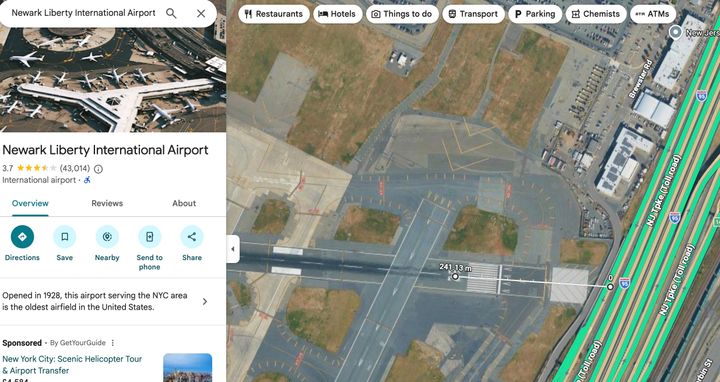
According to my calculator, if aiming for just beyond the threshold an aircraft would be roughly 12 metres above the roadway on a 3 degrees glide-slope. Assuming the roadway sits on the same level as the runway.
You’d be aiming for the aiming point, which are the big white rectangles 1000 feet down the runway from the threshold. This is where the PAPIs bring you down. This should give you a threshold crossing height of about 50 feet and would mean you *should* be more than 50 feet above the highway / motorway. According to my calculator, if aiming for just beyond the threshold an aircraft would be roughly 12 metres above the roadway on a 3 degrees glide-slope. Assuming the roadway sits on the same level as the runway.
It’s not unusual for PAPIs to be out of service, which can be somewhat annoying. But on a visual approach you’d still set up some kind of backup that would give you some vertical profile guidance - like tuning the ILS or loading the last segment of an RNAV approach for the landing runway. I haven’t read too much detail but I assume they were doing the ‘stadium visual’ approach to 29 rather than a circling approach.
At the end of the day an approach like this is going to be hand flown and will often have you turning to final at 2 miles and about 600 feet. You’d never really call them a stable approach and in challenging conditions it’s very easy to find yourself below the vertical profile and with ‘three reds’ on the PAPIs. But that’s why we execute missed approaches and go around for another try. We’ve probably all been there, though, and on most airports you’d get away with three - or even four - reds showing on the PAPIs, just not here.
I’m afraid it’s just another example of practices in the USA that just don’t really go on at major airports elsewhere. The only place you routinely do something like this in Europe is Nice, but you don’t have American ATC pressuring you and it’s done in a fairly orderly fashion.
48k said:
Crumpet said:
At the end of the day an approach like this is going to be hand flown and will often have you turning to final at 2 miles and about 600 feet.
How about establishing on final at 375 feet and 1 mile out? 
Edited by 48k on Tuesday 5th May 10:44
 (Funnily enough they changed it to 500 feet because the data wasn’t looking so stable!)
CrgT16 said:
Why didn t the pilot abort the landing of glide angle, etc was not ideal?
That’s something only the crew will know. Possible reasons include fatigue (don’t underestimate how tiring long haul flying is and how it affects judgement, decision making and reaction time), weather (sometimes the aircraft just sinks or balloons up), PAPIs inoperative (so limited guidance) and reach all the way to negligence.
Any experienced pilot will have, at some point in their career, continued an approach which they’ve subsequently looked back on and realised they should’ve gone around - I certainly have. Making that call to go around at the end of a 12 hour flight is tougher than you might think, especially if you think you can easily make it in. But we get paid to make that decision, so it should be a no-brainer really. I went around off a couple of unstable approaches last year and there’s always a moment of hesitation where you think ‘it’s fine, I’ve got it’ and consider continuing - maybe that’s what they did here.
Crumpet said:
That s something only the crew will know.
Possible reasons include fatigue (don t underestimate how tiring long haul flying is and how it affects judgement, decision making and reaction time), weather (sometimes the aircraft just sinks or balloons up), PAPIs inoperative (so limited guidance) and reach all the way to negligence.
Any experienced pilot will have, at some point in their career, continued an approach which they ve subsequently looked back on and realised they should ve gone around - I certainly have. Making that call to go around at the end of a 12 hour flight is tougher than you might think, especially if you think you can easily make it in. But we get paid to make that decision, so it should be a no-brainer really. I went around off a couple of unstable approaches last year and there s always a moment of hesitation where you think it s fine, I've got it and consider continuing - maybe that s what they did here.
I'm pondering whether the outcome would have been much different, even if they had gone around? If the rate of sink markedly increased close in, to the point of a g/a, then perhaps they'd still going down enough to hit whatever they hit anyway, before climbing away.Possible reasons include fatigue (don t underestimate how tiring long haul flying is and how it affects judgement, decision making and reaction time), weather (sometimes the aircraft just sinks or balloons up), PAPIs inoperative (so limited guidance) and reach all the way to negligence.
Any experienced pilot will have, at some point in their career, continued an approach which they ve subsequently looked back on and realised they should ve gone around - I certainly have. Making that call to go around at the end of a 12 hour flight is tougher than you might think, especially if you think you can easily make it in. But we get paid to make that decision, so it should be a no-brainer really. I went around off a couple of unstable approaches last year and there s always a moment of hesitation where you think it s fine, I've got it and consider continuing - maybe that s what they did here.
Gassing Station | Boats, Planes & Trains | Top of Page | What's New | My Stuff