
How to permanently fix this table
Discussion


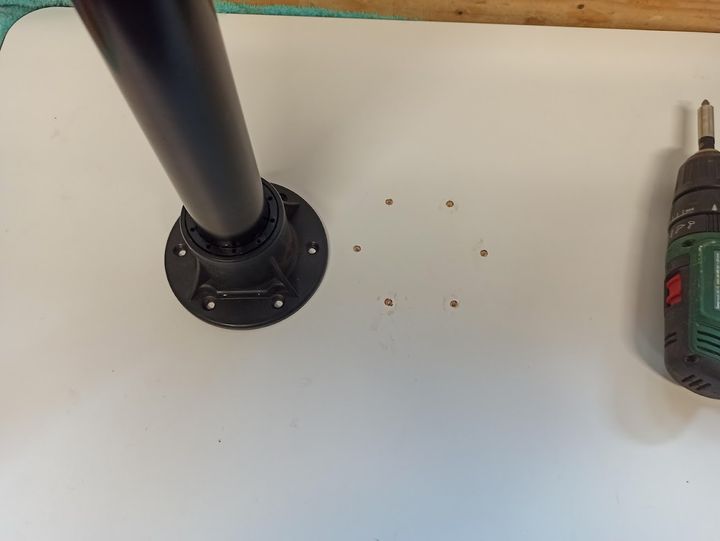
Our campervan came with a table with a single leg but the screws have pulled out of the leg mount which sits on the bottom of the table.
It's not the best design, the table is only around 13mm so not much material for any screws to bite into, and due to the single leg, any weight put on the edges of the table creates quite a lot of leverage on the leg mount.
I could just rotate the mount and drill some new holes, but I feel like the same thing will happen again.
I thought it would be better to first mount something with some more surface area to the table, then screw the mount through that and into the table?
Materials I have kicking around:
- 13mm mdf
- 18mm mdf
- 3mm hardboard
- 3mm plywood
- screws
edit: to clarify, the mount sits under the table top, not into the floor.
It's not the best design, the table is only around 13mm so not much material for any screws to bite into, and due to the single leg, any weight put on the edges of the table creates quite a lot of leverage on the leg mount.
I could just rotate the mount and drill some new holes, but I feel like the same thing will happen again.
I thought it would be better to first mount something with some more surface area to the table, then screw the mount through that and into the table?
Materials I have kicking around:
- 13mm mdf
- 18mm mdf
- 3mm hardboard
- 3mm plywood
- screws
edit: to clarify, the mount sits under the table top, not into the floor.
Edited by Tim Cognito on Saturday 16th May 09:23
Look at using threaded inserts & machine screws rather than wood screws - they spread th load much better. This is just a pointer as there are lots of different sizes & types available:
https://www.ebay.co.uk/shop/threaded-inserts?_nkw=...
Using 18mm MDF as a spreader may help but mainly because you can then use much deeper inserts I'd go for at least M6x20 ish. Can you cope with the leg being 18mm longer?
https://www.ebay.co.uk/shop/threaded-inserts?_nkw=...
Using 18mm MDF as a spreader may help but mainly because you can then use much deeper inserts I'd go for at least M6x20 ish. Can you cope with the leg being 18mm longer?
Arnold Cunningham said:
I sometimes find a bit of superglue (I use mitre bond) in each hole, letting it, reinforces the mdf around the screw hole enough to be stronger than original without major modifications.
That is interesting, do you let the superglue dry and then screw into it or put the screws in and let it dry?FarmyardPants said:
If you can rotate the collar, you can make 6 new screw holes. Combined with some wood glue on the whole circular area, that should hold it. Assuming you never want to dismantle it again of course.
The mount is plastic, and the bottom of the table has a laminate on it, so I'm not sure wood glue would adhere very well to either side.1. Drill all the way through and create a round plate with corresponding holes for the table top and use machine screws to hold it. May not be the best looking fix.
2. Buy 2 legs and fix them in the same way as the original but spread apart so there is less leverage when leaning on the cornet.
3. Fix another piece of wood under the table where the leg fits, screwed and glued to the table. Then fit leg with longer screws. May have to cut the leg to fit.
Each of these will have some kind of disadvantage over the original setup, but will probably work better.
2. Buy 2 legs and fix them in the same way as the original but spread apart so there is less leverage when leaning on the cornet.
3. Fix another piece of wood under the table where the leg fits, screwed and glued to the table. Then fit leg with longer screws. May have to cut the leg to fit.
Each of these will have some kind of disadvantage over the original setup, but will probably work better.
Mr Pointy said:
Look at using threaded inserts & machine screws rather than wood screws - they spread th load much better. This is just a pointer as there are lots of different sizes & types available:
https://www.ebay.co.uk/shop/threaded-inserts?_nkw=...
Using 18mm MDF as a spreader may help but mainly because you can then use much deeper inserts I'd go for at least M6x20 ish. Can you cope with the leg being 18mm longer?
Now we're talkin', they look very good.https://www.ebay.co.uk/shop/threaded-inserts?_nkw=...
Using 18mm MDF as a spreader may help but mainly because you can then use much deeper inserts I'd go for at least M6x20 ish. Can you cope with the leg being 18mm longer?
18mm longer leg wouldn't be the end of the world, might make it a bit heavy depending on how big I do the spreader.
I’d screw a larger plate to the leg, then screw that larger plate to the underside of the table. I’d probably use something like Sticks Like Sh*t to glue the plate to the table as well. The thickness of the plate will help with stability and stop the screws being pulled out, and it won’t matter if the table top sits a couple of mil higher because of the thickness of the plate.
A wider mounting will spread the load and make it stronger. Try something from the boat world like https://www.force4.co.uk/item/Force-4/Top-for-Pede...
As the screws have pulled out without doing other damage, I suspect either it's got wet or the screws were over tightened or the pilot holes were a bit big, or the table top is poor material.
If you insert matchsticks in the holes with plenty of glue to saturate the ply/mdf of the table top it should turn out stronger.
Any glue will do, Araldite warmed with a hot air gun or hairdryer to make it runny is one choice. It will penetrate well and set strong.
If you want to make it much stronger, then a ply pad twice the diameter of the circular bit is a good call.
Ply thicker than 3mm would be preferred. Maybe two layers of 3mm if that's what you have. Maybe the first layer 10mm bigger all around?
Gluing ply to the bottom of the table, you can either find a glue that sticks to the laminate, or peel off the laminate.
Epoxy sticks to some laminate plastics, hot melt glue or contact adhesive are other possibilities.
Many other fixes are perfectly valid, choice would be based on what's to hand.
One mate of mine would have TIG welded a much bigger flange to the top of the leg in the time I've spent typing this!
If you insert matchsticks in the holes with plenty of glue to saturate the ply/mdf of the table top it should turn out stronger.
Any glue will do, Araldite warmed with a hot air gun or hairdryer to make it runny is one choice. It will penetrate well and set strong.
If you want to make it much stronger, then a ply pad twice the diameter of the circular bit is a good call.
Ply thicker than 3mm would be preferred. Maybe two layers of 3mm if that's what you have. Maybe the first layer 10mm bigger all around?
Gluing ply to the bottom of the table, you can either find a glue that sticks to the laminate, or peel off the laminate.
Epoxy sticks to some laminate plastics, hot melt glue or contact adhesive are other possibilities.
Many other fixes are perfectly valid, choice would be based on what's to hand.
One mate of mine would have TIG welded a much bigger flange to the top of the leg in the time I've spent typing this!
Tim Cognito said:
FarmyardPants said:
If you can rotate the collar, you can make 6 new screw holes. Combined with some wood glue on the whole circular area, that should hold it. Assuming you never want to dismantle it again of course.
The mount is plastic, and the bottom of the table has a laminate on it, so I'm not sure wood glue would adhere very well to either side.Inserts are the usual way to sort it.
As I have the tools for it (as in nice sharp brad point wood drills and a drill block) what I do is drill an 8mm or 10mm hole (cant remember which one), insert a matching jointing dowel with plenty of D3 glue so it saturated any surrounding voids, then cut it off flush once dry.
Then tap & drill to fit the screws.
Doesn't require particularly sound material to go into unlike a plastic or metal insert and is much more resistant to pulling as the area is much larger.
ETA: if it's only a thin top ***make very sure*** that you use a depth stop to avoid coming out the other side with the drill!
As I have the tools for it (as in nice sharp brad point wood drills and a drill block) what I do is drill an 8mm or 10mm hole (cant remember which one), insert a matching jointing dowel with plenty of D3 glue so it saturated any surrounding voids, then cut it off flush once dry.
Then tap & drill to fit the screws.
Doesn't require particularly sound material to go into unlike a plastic or metal insert and is much more resistant to pulling as the area is much larger.
ETA: if it's only a thin top ***make very sure*** that you use a depth stop to avoid coming out the other side with the drill!
Edited by JoshSm on Saturday 16th May 15:04
Tim Cognito said:
That is interesting, do you let the superglue dry and then screw into it or put the screws in and let it dry?
Depends how knackered it is. Generally letting it dry first works because you're then screwing in to a solid thing and relying on mechanical holding of the screws. This is what I generally do.Arnold Cunningham said:
Tim Cognito said:
That is interesting, do you let the superglue dry and then screw into it or put the screws in and let it dry?
Depends how knackered it is. Generally letting it dry first works because you're then screwing in to a solid thing and relying on mechanical holding of the screws. This is what I generally do.What you can do if adding glue is fill the hole, put the screw it to force the glue into the surrounding material, then take it out again until it dries. Maybe also clamp the affected area to press it flat if it pulled apart.
I'm sure other glues could be made to work, but superglue is strong, and also soaks well into the MDF. PVA is a bit weak IMVHO. Epoxy is strong, but won't really soak in. My old kitchen table was in a terrible state, but this approach got it usable again.
Nothing to be lost by giving it a go, this is a low effort thing that if it doesn't work, leaves you on no worse position than when you started.
Nothing to be lost by giving it a go, this is a low effort thing that if it doesn't work, leaves you on no worse position than when you started.
Gassing Station | Homes, Gardens and DIY | Top of Page | What's New | My Stuff