
Discussion


Had bats flying around for many years.but only last week decided to try a get a picture of some
I set the camera (Canon 77D) on Manual focus and hoped that i would catch one as it flee past.
Came out better than expected
Is there any tips to get it a bit more clearer The flash is a Nissin Di700A and i have set the lens
EFS 18-135mm IS on manual at an estimated 6m at f7.1with a shuuter speed of 1/80 iso 400 hoping the flash will 'freeze' the movement. zoom in on the white blob!!
Comments welcomed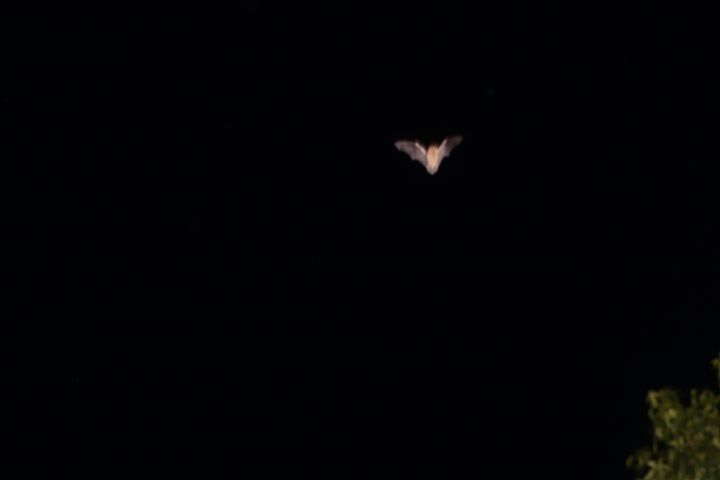
I set the camera (Canon 77D) on Manual focus and hoped that i would catch one as it flee past.
Came out better than expected
Is there any tips to get it a bit more clearer The flash is a Nissin Di700A and i have set the lens
EFS 18-135mm IS on manual at an estimated 6m at f7.1with a shuuter speed of 1/80 iso 400 hoping the flash will 'freeze' the movement. zoom in on the white blob!!
Comments welcomed
Not a bad effort at all. Using a wider aperture if your lens allows, as well as upping the iso will allow your flash to use less power which will result in a shorter flash duration. Your shutter speed is more or less irrelevant when making exposures lit mainly by flash, so it doesn't matter whether you set it to 1/15th sec or 1/250th sec - as long as your camera supports that flash sync speed.
Either way, the lack of sharpness is all over which suggests that your problem isn't really motion blur, but focus. You likely can't use autofocus in the dark, so you can either pre-focus at a distance that you think the bats will be, or calculate your likely depth of field and focus at the hyperfocal distance, which is the distance that you can set that allows as much foreground to be acceptably sharp while still focusing to infinity.
Using the calculator at https://www.photopills.com/calculators/dof and plugging in f/7.1 and 135mm for you lens as well as Canon APS-C, you get a hyperfocal distance of 134.72m which would give you a depth of field of acceptable sharpness from 67.36m to infinity.
But it's likely that the bats are much closer than 64m away from you, so you will need to focus closer. Just be aware thet when you do that, you will have a much shallower depth of field. If the bats are flying overhead, then they are probably no more than 10m from you. So if you focused at 10m, you can see that your near limit is 9.32m and your far limit is 10.79m. That's a meter and a half depth of field and if the bat isn't within that distance ranger, you're going to have an out-of-focus bat!
So do your best to estimate the distance and then take shots by adjusting focus slightly. And use lots of trial and error!
But really a consumer zoom lens with a max aperture of f/7.1 at 135mm is not at all well suited to shooting in the dark. This is the kind of scenario where a longer, faster lens would really pay dividends. But you'd still need a lot of luck to get the focus right!
Either way, the lack of sharpness is all over which suggests that your problem isn't really motion blur, but focus. You likely can't use autofocus in the dark, so you can either pre-focus at a distance that you think the bats will be, or calculate your likely depth of field and focus at the hyperfocal distance, which is the distance that you can set that allows as much foreground to be acceptably sharp while still focusing to infinity.
Using the calculator at https://www.photopills.com/calculators/dof and plugging in f/7.1 and 135mm for you lens as well as Canon APS-C, you get a hyperfocal distance of 134.72m which would give you a depth of field of acceptable sharpness from 67.36m to infinity.
But it's likely that the bats are much closer than 64m away from you, so you will need to focus closer. Just be aware thet when you do that, you will have a much shallower depth of field. If the bats are flying overhead, then they are probably no more than 10m from you. So if you focused at 10m, you can see that your near limit is 9.32m and your far limit is 10.79m. That's a meter and a half depth of field and if the bat isn't within that distance ranger, you're going to have an out-of-focus bat!
So do your best to estimate the distance and then take shots by adjusting focus slightly. And use lots of trial and error!
But really a consumer zoom lens with a max aperture of f/7.1 at 135mm is not at all well suited to shooting in the dark. This is the kind of scenario where a longer, faster lens would really pay dividends. But you'd still need a lot of luck to get the focus right!
Lunar 8-10ft is more the distance!
And it really is a case of there it is ,there it isnt...lol
But good info... I do go out and tske a pic of one of the trees i use as a refernece point... and with touching the barrel move it to Man focus. Will look at ther flash power.. after all it costs nothing nowadays.. unlike when i first started!
And it really is a case of there it is ,there it isnt...lol
But good info... I do go out and tske a pic of one of the trees i use as a refernece point... and with touching the barrel move it to Man focus. Will look at ther flash power.. after all it costs nothing nowadays.. unlike when i first started!
If it's 8-10ft and your lens is at 135mm your depth of field will be "waffer-thin" (read in French accent).
I'd photograph an object at that distance and set your flash power to manual and dial it down to where you get a decent exposure of the object in the dark. That will eliminate the need for monitor preflashes which delay your exposure. I suspect that professionals would use some sort of radar or IR trigger connected to the shutter release - similar to the light-sensitive ones that people use to capture lightning during storms. That will vastly improve your hit rate and then you can focus on getting the focus right!
See:
https://cognisys-inc.com/scout-camera-trapping.htm...
https://winterberrywildlife.ouroneacrefarm.com/202...
I'd photograph an object at that distance and set your flash power to manual and dial it down to where you get a decent exposure of the object in the dark. That will eliminate the need for monitor preflashes which delay your exposure. I suspect that professionals would use some sort of radar or IR trigger connected to the shutter release - similar to the light-sensitive ones that people use to capture lightning during storms. That will vastly improve your hit rate and then you can focus on getting the focus right!
See:
https://cognisys-inc.com/scout-camera-trapping.htm...
https://winterberrywildlife.ouroneacrefarm.com/202...
Edited by LunarOne on Wednesday 22 July 15:50
Bats are a tough challenge. A small fast-moving target of uncertain range in darkness... it's 'know your settings' time.
I used more field of view than I would have liked, just to make sure of getting the thing in the frame. Aperture - can't remember but smaller than I'd have liked to stand a fighting chance of getting it roughly in focus, ISO - loads, to make sure the flash goes as far as possible. Flash - I think I set it to full blast, can't remember. So the ISO and the flash hopefully offset the small aperture. Then see what you get and adjust accordingly. Will post some results tomorrow.
I used more field of view than I would have liked, just to make sure of getting the thing in the frame. Aperture - can't remember but smaller than I'd have liked to stand a fighting chance of getting it roughly in focus, ISO - loads, to make sure the flash goes as far as possible. Flash - I think I set it to full blast, can't remember. So the ISO and the flash hopefully offset the small aperture. Then see what you get and adjust accordingly. Will post some results tomorrow.
LunarOne said:
Using the calculator at https://www.photopills.com/calculators/dof and plugging in f/7.1 and 135mm for you lens as well as Canon APS-C, you get a hyperfocal distance of 134.72m which would give you a depth of field of acceptable sharpness from 67.36m to infinity.
You just forgot to factor in what the focus was actually set to.Gassing Station | Photography & Video | Top of Page | What's New | My Stuff