
Wooden summerhouse floor disintegrating
Discussion


Hi all, paid to have this wooden summerhouse installed on a new concrete slab around seven years ago and this year discovered that the floor was rotted and sinking.
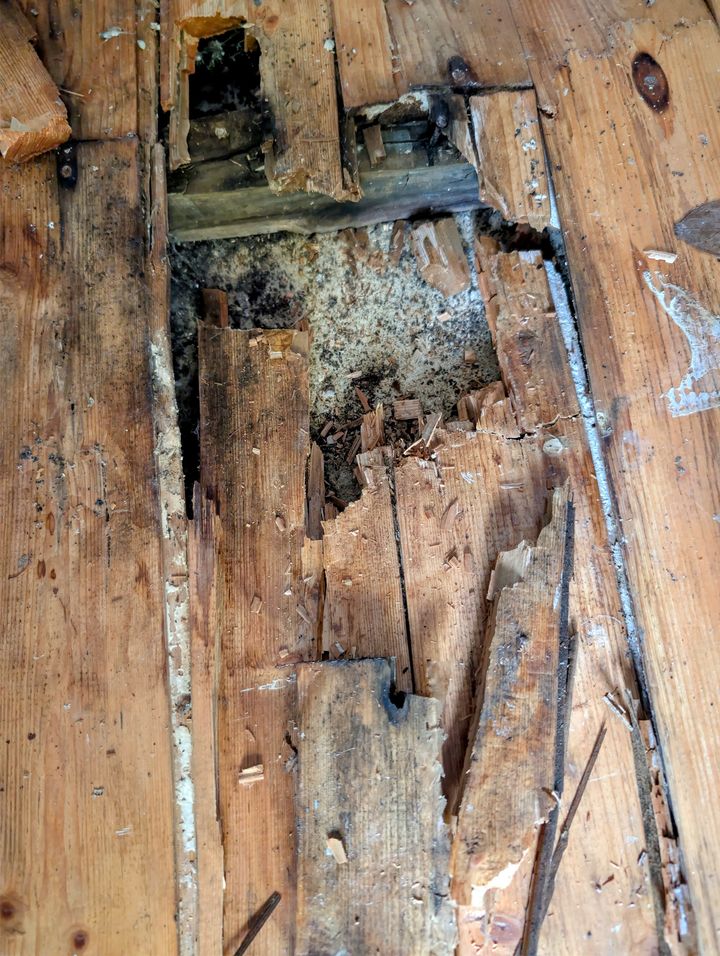
I've got some OSB to replace the flooring but wondered what additional steps can be taken to prevent the same thing happening?
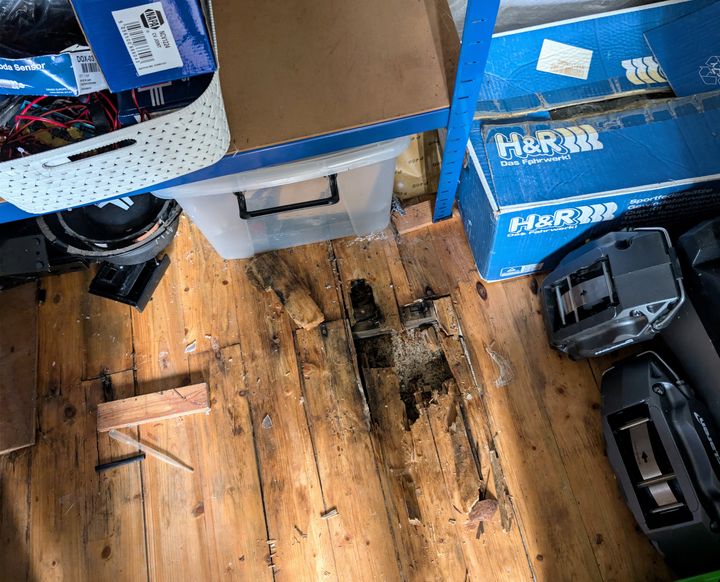
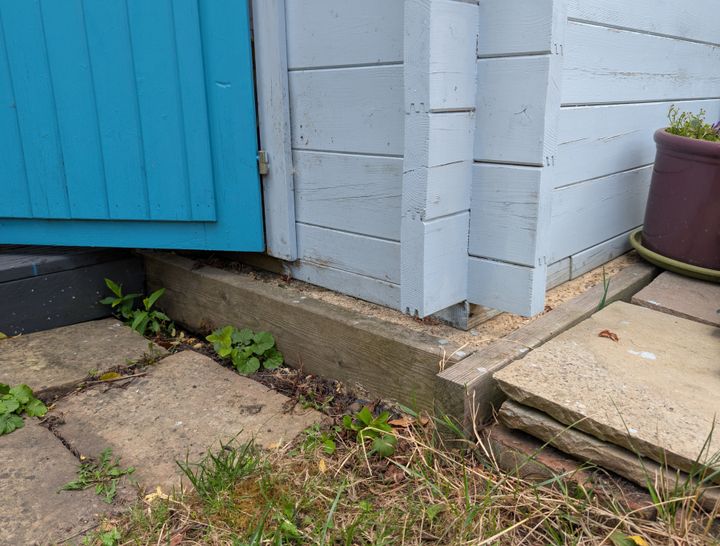
I've got some OSB to replace the flooring but wondered what additional steps can be taken to prevent the same thing happening?
Looks like either the concrete is on wet ground and damp is coming up, or rain is running down the walls and pooling under the building?
I would suggest a damp proof membrane under the floor as well as raising the floor off the concrete.
As a minimum, raise the floor bearers on blocks with something impervious like plastic as a barrier between the concrete and any wood.
Make sure rain cannot get on topp of the damp course.
When the floor is raised off the concrete, you may need to take steps to keep rodents out.
I would suggest a damp proof membrane under the floor as well as raising the floor off the concrete.
As a minimum, raise the floor bearers on blocks with something impervious like plastic as a barrier between the concrete and any wood.
Make sure rain cannot get on topp of the damp course.
When the floor is raised off the concrete, you may need to take steps to keep rodents out.
Thanks for all the advice, the summerhouse is situated under trees and it has moss growing on the roof so is damp for most seasons apart from summer, I don't believe there's any leaks but it does get quite humid inside (I've moved fragile stuff and anything with fabric out of there due to this).
I had a look at a timber outhouse/glamping pod recently when on holiday and they have some sort of damp proof membrane between the concrete and the wood, is it worth doing the same when the woods replaced?
I've got a couple of car jacks, would they be sufficient to do a side at at time or is there a special type of jack that maybe more suitable?
Cheers.
I had a look at a timber outhouse/glamping pod recently when on holiday and they have some sort of damp proof membrane between the concrete and the wood, is it worth doing the same when the woods replaced?
I've got a couple of car jacks, would they be sufficient to do a side at at time or is there a special type of jack that maybe more suitable?
Cheers.
JoshSm said:
Probably be quicker and easier to just dismantle then rebuild onto a new (treated) base than to try to replace the whole floor in-situ.
It's not like wooden buildings aren't simple to pull apart.
getting them back together can be a problem as likely to find more rotting wood or damage when taking apartIt's not like wooden buildings aren't simple to pull apart.
untakenname said:
Thanks for all the advice, the summerhouse is situated under trees and it has moss growing on the roof so is damp for most seasons apart from summer, I don't believe there's any leaks but it does get quite humid inside (I've moved fragile stuff and anything with fabric out of there due to this).
I had a look at a timber outhouse/glamping pod recently when on holiday and they have some sort of damp proof membrane between the concrete and the wood, is it worth doing the same when the woods replaced?
I've got a couple of car jacks, would they be sufficient to do a side at at time or is there a special type of jack that maybe more suitable?
If it's humid inside then again you need to improve the airflow with some vents. As for the floor search for plastic shed base & you will get hits for modular grids like these:I had a look at a timber outhouse/glamping pod recently when on holiday and they have some sort of damp proof membrane between the concrete and the wood, is it worth doing the same when the woods replaced?
I've got a couple of car jacks, would they be sufficient to do a side at at time or is there a special type of jack that maybe more suitable?
https://www.amazon.co.uk/ECODECK-Greenhouse-10x8ft...
It's much more difficult to retrofit but if you can lift the shed up without it sagging too much you might be able to slide them underneath. I suspect more than two jacks would be needed though.
untakenname said:
Thanks for all the advice, the summerhouse is situated under trees and it has moss growing on the roof so is damp for most seasons apart from summer, I don't believe there's any leaks but it does get quite humid inside (I've moved fragile stuff and anything with fabric out of there due to this).
I had a look at a timber outhouse/glamping pod recently when on holiday and they have some sort of damp proof membrane between the concrete and the wood, is it worth doing the same when the woods replaced?
I've got a couple of car jacks, would they be sufficient to do a side at at time or is there a special type of jack that maybe more suitable?
Cheers.
I'd remove the dead floor boards and then try lifting the floor bearers or whatever, you can probably lever them up a few mm at a time at each point of contact in turn, and insert wedges or shims, rinse and repeat, until you can get new bearers under?I had a look at a timber outhouse/glamping pod recently when on holiday and they have some sort of damp proof membrane between the concrete and the wood, is it worth doing the same when the woods replaced?
I've got a couple of car jacks, would they be sufficient to do a side at at time or is there a special type of jack that maybe more suitable?
Cheers.
A jack might work if there are only a few lifting points.
Some jobs, the 'method statement' is best made up as you go along trying things.
JoshSm said:
Probably be quicker and easier to just dismantle then rebuild onto a new (treated) base than to try to replace the whole floor in-situ.
It's not like wooden buildings aren't simple to pull apart.
Agreed but I think I'd be looking at composite joists (Recycled plastic) and then a mesh vent arrangement to allow airflow underneath so the wooden floor doesn't rot again It's not like wooden buildings aren't simple to pull apart.
Alternatively a composite floor on the composite joists and then no need to vent
My big shed and office has rotted away at the base, it is a timber shiplap/Dunster house. There is a perimeter drain, but it leaks onto the slab. We only bought this house a few years ago with the shed. Lots of my lower timbers have got rot, and the summer has caused gaps to appear due to shrinkage. I am just leaving it and will replace the whole thing when it falls down.
My shed thing was sat on a frame made of 2x4s which was mounted to plastic posts concreted into the ground, so it was about 3 - 6" or so off the soil (ground slopes down).
Above this frame was some plastic DPM, then a matrix of 2x2s with a line of 2x3s around the edge with celotex in between, then the floorboards on top.
Despite all this it still rotted in sections. https://www.pistonheads.com/gassing/topic.asp?h=0&...
Yours looks very similar to mine, the very bottom line of wood is probably the 2x3s and the floorboards will be sat on this.
I jacked mine up, then screwed 2x4s into the corners and removed the jack, if you do this you might find it lifts up leaving the 2x3s and the floor behind, maybe
Then you can repair, or probably replace the whole frame, add a dpm and something to lift it off the concrete pad.
Above this frame was some plastic DPM, then a matrix of 2x2s with a line of 2x3s around the edge with celotex in between, then the floorboards on top.
Despite all this it still rotted in sections. https://www.pistonheads.com/gassing/topic.asp?h=0&...
Yours looks very similar to mine, the very bottom line of wood is probably the 2x3s and the floorboards will be sat on this.
I jacked mine up, then screwed 2x4s into the corners and removed the jack, if you do this you might find it lifts up leaving the 2x3s and the floor behind, maybe
Then you can repair, or probably replace the whole frame, add a dpm and something to lift it off the concrete pad.
Gassing Station | Homes, Gardens and DIY | Top of Page | What's New | My Stuff