
Discussion


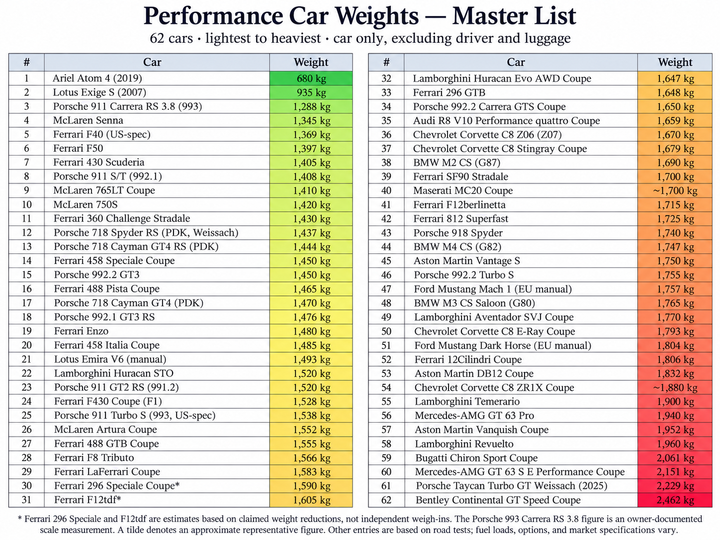
As car enthusiasts watch the slow end of manual transmissions, naturally aspirated motors, and pure ICE vehicles, I thought it was also worth looking at what is also disappearing...light weight cars. For fun, I had AI put together this list of kerb weights of mostly EU spec cars. The weights are actual measured weights, not manufacturer claims. I'm sure the list is not perfect, but it's directionally correct. With Porsche and McLaren introducing more hybrids, even the light cars are going to get heavier.
LondonCarGuy - Great table which makes for very interesting reading, especially when you compare the real world driving experiences of comparable cars
The Ariel Atom 4 has a listed (factory) kerb weight of 595kg, so the 660kg recorded weight in your table represents a significant % increase.
Your table doesnt list the kerb weight of a KTM X-BOW R , but if i remember correctly it is about 790kg without fuel
Both are turbocharged, opencockpit , openwheel cars.
And both have dire Cd and CdA numbers- albeit for differnt reasons - Dallara designed the X-BOW as a high downforce car and accepted teh attendent drag while Ariel ....... well,
Nevertheless you can really feel the difference when driving these 2 superficially similar cars. Part of that is down to the X-BOW's all carbon chassis and bodywork vs the Atom 4's spaceframe chassis, but a large part of it is simply down to weight.
Torque-to-weight really reveals itself when accelerating out of corners, etc
andrew said:
adding the year of introduction would highlight one very sad trend...
also, if you've got the time please, comparable figures for 996 and gallardo would be interesting
Good idea. Too few data points in the earlier years, but the trend is clear. I will add 996 and Gallardo shortly since you came up with an idea I liked :-)also, if you've got the time please, comparable figures for 996 and gallardo would be interesting
carspath1 said:
LondonCarGuy - Great table which makes for very interesting reading, especially when you compare the real world driving experiences of comparable cars
The Ariel Atom 4 has a listed (factory) kerb weight of 595kg, so the 660kg recorded weight in your table represents a significant % increase.
Your table doesnt list the kerb weight of a KTM X-BOW R , but if i remember correctly it is about 790kg without fuel
Both are turbocharged, opencockpit , openwheel cars.
And both have dire Cd and CdA numbers- albeit for differnt reasons - Dallara designed the X-BOW as a high downforce car and accepted teh attendent drag while Ariel ....... well,
Nevertheless you can really feel the difference when driving these 2 superficially similar cars. Part of that is down to the X-BOW's all carbon chassis and bodywork vs the Atom 4's spaceframe chassis, but a large part of it is simply down to weight.
Torque-to-weight really reveals itself when accelerating out of corners, etc
Hi, thanks for the feedback. The source was this for the Atom, but maybe you are right. The Autocar test:The Ariel Atom 4 has a listed (factory) kerb weight of 595kg, so the 660kg recorded weight in your table represents a significant % increase.
Your table doesnt list the kerb weight of a KTM X-BOW R , but if i remember correctly it is about 790kg without fuel
Both are turbocharged, opencockpit , openwheel cars.
And both have dire Cd and CdA numbers- albeit for differnt reasons - Dallara designed the X-BOW as a high downforce car and accepted teh attendent drag while Ariel ....... well,
Nevertheless you can really feel the difference when driving these 2 superficially similar cars. Part of that is down to the X-BOW's all carbon chassis and bodywork vs the Atom 4's spaceframe chassis, but a large part of it is simply down to weight.
Torque-to-weight really reveals itself when accelerating out of corners, etc
https://www.autocar.co.uk/car-review/ariel/atom-4?...
LondonCarGuy said:
andrew said:
adding the year of introduction would highlight one very sad trend...
also, if you've got the time please, comparable figures for 996 and gallardo would be interesting
Good idea. Too few data points in the earlier years, but the trend is clear. I will add 996 and Gallardo shortly since you came up with an idea I liked :-)also, if you've got the time please, comparable figures for 996 and gallardo would be interesting
_Rodders_ said:
Highlights how well Porsche did with the 911S/T and McLaren to a slightly lesser extent with the Senna and 750S.
Yes, agree. Makes me sad that the McLaren 700-series replacement will be hybrid. Sure, it will be lighter than the hybrid Ferrari's, but it will no longer be light. No doubt, it will be really fast, but so what. I love my 296 GTB, but it is not a light car.LondonCarGuy- I really enjoy this sort of thread.
Sometime back i had reason to make a list of Cd and CdA figures for cars from the 1960's through to the 2010's and you can extrapolate so much more than you would initially imagine about the hows and whys of car development from these sorts of data.
In this case , if you were to chart weight changes in expensive, exclusive sportscars you might well find a stepchange with the introduction of the superleggera technique in the 1936, the adoption of the spaceframe chassis, teh introduction of aluminium bodywork and the more routine use of carbon fibre.
Your table would be particularly useful and informative if it were to feature more truly lightweight cars - where a small difference in weight represents a large % change and a big change in torque to weight and power-to-weight ratios - all of which can be felt in real life driving on UK roads.
With heavier cars the % change is less so you dont feel it as much.
I had a Brooke 260RR for about 10 years and that weighed about 500 kg and despite it having 'only' 260bhp it felt much faster in accelerating and decelerating than anything that i have ever driven- before or since.
Newton was right -Mass really counts
LondonCarGuy said:
_Rodders_ said:
Highlights how well Porsche did with the 911S/T and McLaren to a slightly lesser extent with the Senna and 750S.
Yes, agree. Makes me sad that the McLaren 700-series replacement will be hybrid. Sure, it will be lighter than the hybrid Ferrari's, but it will no longer be light.Oaky said:
Are you sure the 7xx series replacement will be hybrid?
Yes."McLaren has confirmed that the all-new, hybridised V8 in the limited-run W1 hypercar will live on in the eventual replacement for the 750S."
https://www.autoexpress.co.uk/mclaren/370622/last-...
LondonCarGuy said:
Oaky said:
Are you sure the 7xx series replacement will be hybrid?
Yes."McLaren has confirmed that the all-new, hybridised V8 in the limited-run W1 hypercar will live on in the eventual replacement for the 750S."
https://www.autoexpress.co.uk/mclaren/370622/last-...

Trev450 said:
Another great car bites the dust.
Agree. The W1 ICE makes 915 bhp. Can't they tune that down for reliability to like 815 bhp, skip the hybrid, and make that the new replacement for the 700-Series? Call it the 800-Series. Car would still be well under 1,500 kg and put out over 800 bhp. Awesome combo.LondonCarGuy said:
Trev450 said:
Another great car bites the dust.
Agree. The W1 ICE makes 915 bhp. Can't they tune that down for reliability to like 815 bhp, skip the hybrid, and make that the new replacement for the 700-Series? Call it the 800-Series. Car would still be well under 1,500 kg and put out over 800 bhp. Awesome combo.Gassing Station | Supercar General | Top of Page | What's New | My Stuff