
Solar - Preventing Battery drain
Discussion


I’ve recently had a solar installation with batteries.
I’m charging our EV during the cheap 00:00-06:00 window, but the system doesn’t seem to differentiate between drawing from the battery and drawing from the grid.
The upshot being it drains the batteries to charge the car first, so when we wake up we’re starting the day with zero battery (10%).
Is there a way of preventing the system from doing this and prioritising drawing from the grid during the cheap EV hours.
System in Solax.
You need to set the self use timings in the Solax settings so that the batteries aren t allowed to discharge in the same time window that the car can be charging. Ie set the charging time of the batteries to be the off peak window, and the discharge times starting when the off peak time ends, until the start of the off peak window.
If you are on an intelligent tariff, and you get served some cheap charging windows during the day then you won t easily be able to stop it taking from the house battery before importing from the grid though.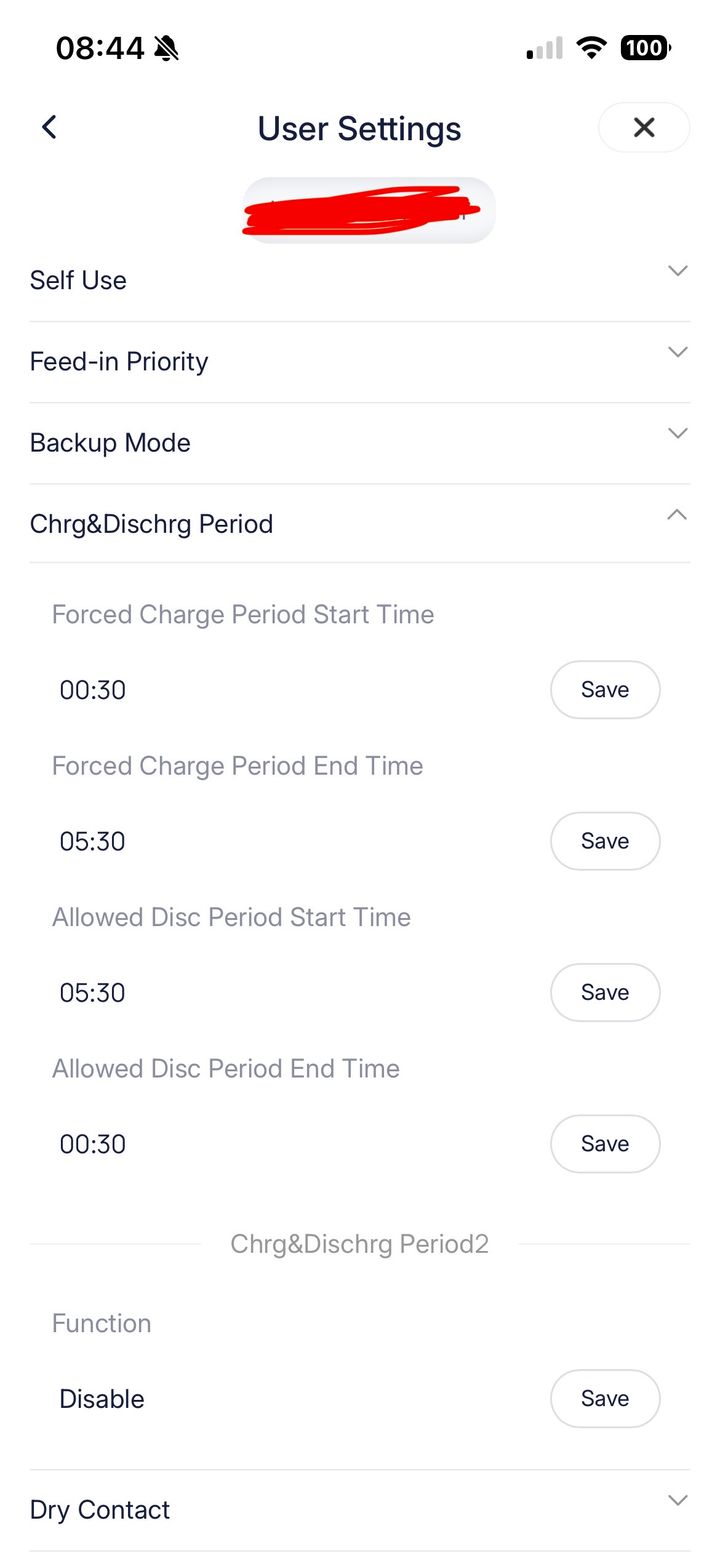
If you are on an intelligent tariff, and you get served some cheap charging windows during the day then you won t easily be able to stop it taking from the house battery before importing from the grid though.
Edited by chrisch77 on Sunday 25th October 08:45
There's two options - configure some sort of time-of-use behaviour in the inverter's firmware, I'd imagine they all support this natively, or use something like Home Assistant to program the behaviour yourself. For what you want, I'm sure the inverter will suffice but for things like Intelligent Octopus Go where the car can randomly start charging at any time, you need something cleverer.
chrisch77 said:
You need to set the self use timings in the Solax settings so that the batteries aren t allowed to discharge in the same time window that the car can be charging. Ie set the charging time of the batteries to be the off peak window, and the discharge times starting when the off peak time ends, until the start of the off peak window.
If you are on an intelligent tariff, and you get served some cheap charging windows during the day then you won t easily be able to stop it taking from the house battery before importing from the grid though.
Exactly this. I have Solax Inverter and batteries and you need to set the allowed discharge time for the batteries not to clash with the car charging time. It’s a very good system once you get the hang of it.If you are on an intelligent tariff, and you get served some cheap charging windows during the day then you won t easily be able to stop it taking from the house battery before importing from the grid though.
Edited by chrisch77 on Sunday 25th October 08:45
My electricity use during the off peak times can be spectacularly high: Recharging home batteries, electric Aga, charging hot water tank, charging car, central heating, shower room floors etc etc. Think 30KW high
 just as well we have a 3 phase supply. The flip side is that we buy virtually no electricity at all during full price periods.
Road2Ruin said:
frisbee said:
Can you relocate the CT for battery so it excludes the car charger?
This is the correct answer. The CT clamp is in the wrong place and should not see the charger. You can fudge it by forcing the battery to charge at night, in which case it won't discharge into the car.Griffith4ever said:
That's odd - on Growatt (Shine app) you can simply set the INverter mode to "grid 1st" - so grid is always used as the priority, even if the battery is charged/charging from the grid too. Then you enable Battery 1st when done. So Grid 1st from 0000 to 0600, then battery 1st. Doesn't matter where the CT is or if you are charging your car.
You can do that on most apps. However, like many inverters, setting it up and keeping it the way you want it os never as straight forward as you think. An inverter firmware update or an app update may mess that up. Also, if you ever want to change it, fornsowm reason, remembering to change it back or how to do it, will be a pain. Road2Ruin said:
This is the correct answer. The CT clamp is in the wrong place and should not see the charger. You can fudge it by forcing the battery to charge at night, in which case it won't discharge into the car.
Correct answer.Just shows the knowledge of some hang & bang installers who don’t test your system before riding off with your cash.
Road2Ruin said:
frisbee said:
Can you relocate the CT for battery so it excludes the car charger?
This is the correct answer. The CT clamp is in the wrong place and should not see the charger. You can fudge it by forcing the battery to charge at night, in which case it won't discharge into the car.Even where the CT clamp can be placed such that the inverter can't see the flow to the EV, there are downsides to such a setup. If you have a decent-sized PV array and it's generating more than your combined house load and G98/G99 export limit and your battery is full, you can't feed the excess to the car because the export limit is effectively applied at the point measured by the CT clamp. Admittedly, that's a pretty niche problem and probably implies your battery is too small.
If you're willing to put the effort in to set the inverter up properly (or better yet an external system like Home Assistant), it's better to have the inverter's CT clamp on the meter side of the EV charger, IMO. If you're not, the setup you suggest is better unless the inverter and EV charger are from the same manufacturer and can talk to each other directly.
Edited by kambites on Monday 26th October 20:56
Surely if the tariff is fixed timings, then the charging of both the car and the battery should be simple fixed timings?
Battery charges and does not discharge at cheap o'clock.
Car charges at cheap o'clock.
No need to complicate it?
If you ever want to charge the car a expensive o'clock, you might want to take that power from the battery?
Isn't the CT partly there to limit the total draw of the premises, so it should sense the whole flow from the grid?
OutInTheShed said:
Surely if the tariff is fixed timings, then the charging of both the car and the battery should be simple fixed timings?
Battery charges and does not discharge at cheap o'clock.
Car charges at cheap o'clock.
No need to complicate it?
If you ever want to charge the car a expensive o'clock, you might want to take that power from the battery?
Isn't the CT partly there to limit the total draw of the premises, so it should sense the whole flow from the grid?
The best tarrifs don't tend to be fixed timings, IOG for example.Battery charges and does not discharge at cheap o'clock.
Car charges at cheap o'clock.
No need to complicate it?
If you ever want to charge the car a expensive o'clock, you might want to take that power from the battery?
Isn't the CT partly there to limit the total draw of the premises, so it should sense the whole flow from the grid?
OutInTheShed said:
Surely if the tariff is fixed timings, then the charging of both the car and the battery should be simple fixed timings?
Battery charges and does not discharge at cheap o'clock.
Car charges at cheap o'clock.
No need to complicate it?
If you ever want to charge the car a expensive o'clock, you might want to take that power from the battery?
Isn't the CT partly there to limit the total draw of the premises, so it should sense the whole flow from the grid?
That's exactly what I do - but a hot tub/spa, not a car.Battery charges and does not discharge at cheap o'clock.
Car charges at cheap o'clock.
No need to complicate it?
If you ever want to charge the car a expensive o'clock, you might want to take that power from the battery?
Isn't the CT partly there to limit the total draw of the premises, so it should sense the whole flow from the grid?
Growatt inverter.
0000-0600 Grid 1st (Everything takes power fro the grid - including the battery charging),
Rest of the say, "battery 1st" - battery is consumed before grid, solar is consumed before grid, and battery charged with solar excess.
If there is an excess in the day, and batteries are full, my diverter heats the hot water (its very simple - it has its own second , wireless, CT clamp on the main power tail) - this watches to see if export exceeds 300w , if so , it kicks in, and ramps up power until export hits zero.
Finally, Home assistant has a main rule that turns my hot tub back on to heat mode IF the batteries are 95% full, and its day time, and the solar forecast for the next day is above a certain threshold. This way my battery energy isnt getting wasted as we'd never use more than 50% in the evening from full.
Even then, with a 4.4kw array (3.6kw inverter) we still give away a good chunk in the summer - dumping it to the grid from early afternoon onwards.
Below - blue bars are energy exported, even after all the above.
Edited by Griffith4ever on Tuesday 27th October 08:42
g40steve said:
Road2Ruin said:
This is the correct answer. The CT clamp is in the wrong place and should not see the charger. You can fudge it by forcing the battery to charge at night, in which case it won't discharge into the car.
Correct answer.Just shows the knowledge of some hang & bang installers who don t test your system before riding off with your cash.
andy43 said:
g40steve said:
Road2Ruin said:
This is the correct answer. The CT clamp is in the wrong place and should not see the charger. You can fudge it by forcing the battery to charge at night, in which case it won't discharge into the car.
Correct answer.Just shows the knowledge of some hang & bang installers who don t test your system before riding off with your cash.
The OP seems to have a simple time based tariff.
But he has solar as well.
Presumably there is an export tariff?
He was complaining about starting the day with an empty battery, this would of course be fine if the export tariff was low compared to the cheap night rate and much sunshine was anticipated.
So you need to decide what power flows you want under what circumstances and program your system accordingly.
If you want a full battery at breakfast time then just program the battery to charge at cheap time.
If you want to store your solar generation, then have space for it in the battery. Your tariffs will dictate whether that's a good idea, in conjunction with your faith in the weather and your expected consumption pattern.
You may want to export from the battery at times, if so, you need 'rules' for that.
Once you have a clear plan of what you want to happen, then you are in a position to work out how to implement it.
(then the nice Mr Octopus will help you make it more complicated....)
Moving the CT is not a big part of a solution.
Sunny here now, is your battery filling up OP?
Road2Ruin said:
The best tarrifs don't tend to be fixed timings, IOG for example.
True, but IOG does present an API which something like home assistant can talk to, so you can automate your battery behaviour around the dynamic windows if you're willing to faff about a bit. Alternatively it's easy enough to use something like home assistant to watch the EV charger and tell the home battery to charge every time the EV charger starts charging.
kambites said:
Road2Ruin said:
The best tarrifs don't tend to be fixed timings, IOG for example.
True, but IOG does present an API which something like home assistant can talk to, so you can automate your battery behaviour around the dynamic windows if you're willing to faff about a bit. Alternatively it's easy enough to use something like home assistant to watch the EV charger and tell the home battery to charge every time the EV charger starts charging.
Which is fine.
But if someone offers you a 'one size fits all' solution on a plate, be sceptical.
kambites said:
True, but IOG does present an API which something like home assistant can talk to, so you can automate your battery behaviour around the dynamic windows if you're willing to faff about a bit.
I found those API slow and unreliableI used a Shelly EM and put a CT clamp on the EV circuit - local, reliable and fast
Gassing Station | Homes, Gardens and DIY | Top of Page | What's New | My Stuff