
Curtain pole fixing
Discussion


Heavy curtains have pulled the pole arm fixings out of dot and dab drywall.
Thought that going deeper (with brown plugs into the blocks) would be the way to go, but have realised there will be a lintel above the window, probably steel (house is up to 30 years old).
Annoyingly there are double sockets directly underneath where I would ideally want to fix the poles and assume that cables route directly up from them and possibly past the end of the lintel.
I have an old Bosch PMD 10 but never found it too reliable.
What to try next?
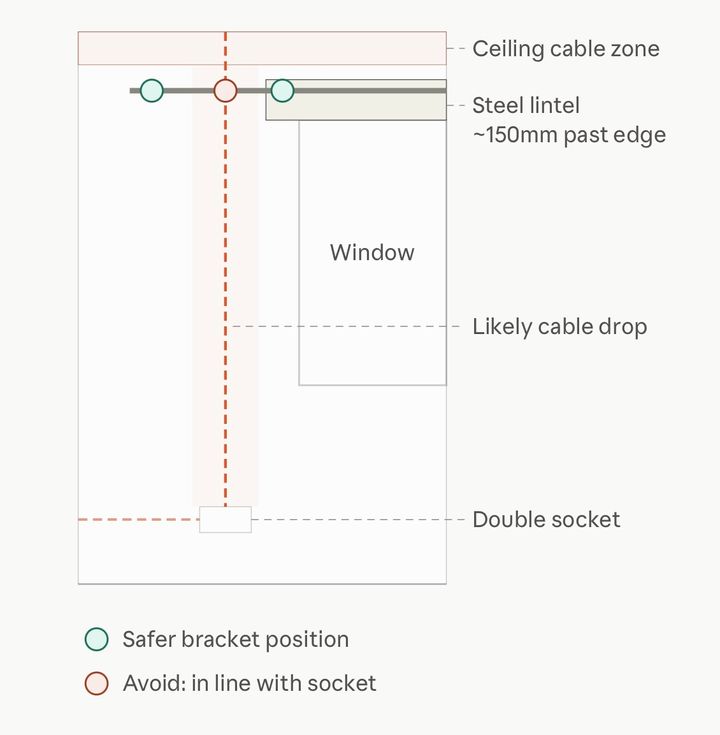
Thought that going deeper (with brown plugs into the blocks) would be the way to go, but have realised there will be a lintel above the window, probably steel (house is up to 30 years old).
Annoyingly there are double sockets directly underneath where I would ideally want to fix the poles and assume that cables route directly up from them and possibly past the end of the lintel.
I have an old Bosch PMD 10 but never found it too reliable.
What to try next?
Red9zero said:
Depending on just how heavy the curtains are, but I have used adhesive (Gripfill, No More Nails etc) to stick a batten to the wall and then screw the curtain rail to that. Paint the batten to make it less noticeable.
This! And if you don't trust the adhesive (I don't, it's very strong but I'm not so sure the layers of plaster etc are up to it) you can use whichever type of fixings you like to fix the batten to the wall, wherever the most suitable points are. Also makes fitting the curtain poles very easy as you're only lining up some wood screws rather than drilling into masonry, and if you want to change the pole for a different one, it's a lot simpler and you're not making holes in the wall to do it
If drilling into the lintel is the only option , this guy explains how to do it
https://youtu.be/ojSjW41_yIU?si=q09hH1g_C27OG8CV
netherfield said:
Why do you think the cables come downwards, standard for sockets is to come up. Lights come down.
Downstairs it's not uncommon for sockets to drop. Spin the faceplate off quickly and you'll know.Every curtain pole I've ever bought the included fixings have been rubbish and gone straight in the bin!
You have a couple of options.
1. Use a wood drill bit to drill a 15mm hole and use Grip It type fixings; provided the plasterboard is not damaged due to the plug pulling out..
2. What I have done is use corefix fixings into the block for the top fixing and just a standard 8mm fischer duo power for the bottom fixing. Only on one window did I actually hit the lintel, where I reverted to using a grip-it.
Do you know if there is a lintel where you are planning to drill?
Do you have a cheap detector that you can use to detect the steel (if it is a steel lintel obviously) and also any wires (unlikely if its the upper floor)
Are you using the right drill bit? I tried doing it all by using generic bosch drill bits, but it wasnt man enough for the core fix job. I only got a cheap toolstation own brand drill at the moment. A proper masonary bit made it a doddle to drill into the blockwork.
Good shout. It’s a ground floor room. I took a socket plate off and that one does indeed go down - I believe there is a small void under the house, but I haven’t seen a hatch which may be in the hall.
The house was built by a builder who lived in it for 20 years before we bought it and overall I believe it is well built for the period.
I will try to drill three holes for the central curtail pole support arm and see if I hit any steel, and could consider easidrive / baypole self tapping screws…
The house was built by a builder who lived in it for 20 years before we bought it and overall I believe it is well built for the period.
I will try to drill three holes for the central curtail pole support arm and see if I hit any steel, and could consider easidrive / baypole self tapping screws…
Fix a wood batten to the wall (painted to match the wall or white). You can use as many fittings as you want spaced however fits your pipes/ cables. Given that you are unlikely to ever want to take this off the wall, fill and paint over the screws. The batten spreads the load (at least that's what my dear, departed Dad taught me).
Then fix the pole to the batten using some decent woodscrews. I have some very heavy thermal/blackout curtains hanging like this and been fine for years.
On the sockets question, our downstairs socket cables go up (solid concrete floor) and upstairs sockets go down, radiator plumbing is the same. Our light switch cables all go up.
Edited by stemll on Tuesday 24th November 19:02
You could cut out a circle or square of plasterboard around the fixing point and see what's behind.
You might have sufficient block to get a plug in. You might be able to glue a small block of wood in there.
It might be a catnic style lintel you can drill or it might be reinforced concrete which just sends your drill off line.
Ideally one would select curtain poles and drill the fixings before decorating....
Fixing a batten is the way to go. My kids both live in new builds and I hate fixing things to the walls with a vengeance, why house builders can’t fit a large piece of timber behind the wall where you are likely to fix a towel rail or toilet roll holder defeats me.
I’ve had to fix battens for them in several rooms to secure a curtain pole. I countersink the screws in the batten and just fill in the holes over the screw heads and paint the batten to match the wall. Personally I wouldn’t rely on just an adhesive as you could be just sticking the batten to paint on the wall.
There are loads of different types of fixings available for plasterboard but I have always got on well with these, I just fix the batten to the wall using several of these along the length,
https://www.screwfix.com/p/plasplugs-all-in-one-wa...
Last time I did this was over a front door and I just used a piece of spare skirting board turned around.
KG63 said:
Fixing a batten is the way to go. My kids both live in new builds and I hate fixing things to the walls with a vengeance, why house builders can t fit a large piece of timber behind the wall where you are likely to fix a towel rail or toilet roll holder defeats me.
I ve had to fix battens for them in several rooms to secure a curtain pole. I countersink the screws in the batten and just fill in the holes over the screw heads and paint the batten to match the wall. Personally I wouldn t rely on just an adhesive as you could be just sticking the batten to paint on the wall.
There are loads of different types of fixings available for plasterboard but I have always got on well with these, I just fix the batten to the wall using several of these along the length,
https://www.screwfix.com/p/plasplugs-all-in-one-wa...
Last time I did this was over a front door and I just used a piece of spare skirting board turned around.
I've always used these or other similar. They screw themselves into the plasterboard using just a screwdriver and then put the screws into these. They do tend to make the plasterboard flake off but if it's going behind a batten, who cares. My battens are 65mmx15mm by whatever length you need.I ve had to fix battens for them in several rooms to secure a curtain pole. I countersink the screws in the batten and just fill in the holes over the screw heads and paint the batten to match the wall. Personally I wouldn t rely on just an adhesive as you could be just sticking the batten to paint on the wall.
There are loads of different types of fixings available for plasterboard but I have always got on well with these, I just fix the batten to the wall using several of these along the length,
https://www.screwfix.com/p/plasplugs-all-in-one-wa...
Last time I did this was over a front door and I just used a piece of spare skirting board turned around.
Drill and countersink the batten wherever you want to (can fit a lot more than the brackets the pole will have) and then mark through onto the wall to insert these (use a spirit level or curse yourself forever more
 ).
https://www.diy.com/departments/diall-plasterboard...
As to why builders don't put a bit of timber behind, the answer is money. It would cost them £1 a house more and that's just wasted profit

Besides which it would always be in the wrong place.
stemll said:
I've always used these or other similar. They screw themselves into the plasterboard using just a screwdriver and then put the screws into these. They do tend to make the plasterboard flake off but if it's going behind a batten, who cares. My battens are 65mmx15mm by whatever length you need.Drill and countersink the batten wherever you want to (can fit a lot more than the brackets the pole will have) and then mark through onto the wall to insert these (use a spirit level or curse yourself forever more ). https://www.diy.com/departments/diall-plasterboard...As to why builders don't put a bit of timber behind, the answer is money. It would cost them £1 a house more and that's just wasted profit Besides which it would always be in the wrong place.
That's what I normally use, but the walls in our new house (built in 2021) are terrible and I have been using adhesives wherever possible. Luckily, the "paint" in most places is still the original and you can get back to bare plaster with a damp rag. ). https://www.diy.com/departments/diall-plasterboard...As to why builders don't put a bit of timber behind, the answer is money. It would cost them £1 a house more and that's just wasted profit Besides which it would always be in the wrong place.I've used these to fix kitchen wall cupboards to dot and dab plasterboard
https://www.screwfix.com/p/corefix-connect-heavy-d...
Also used these to fix radiators to plasterboard stud walls
https://www.screwfix.com/p/bullfix-str-uni-10-univ...
https://www.screwfix.com/p/corefix-connect-heavy-d...
Also used these to fix radiators to plasterboard stud walls
https://www.screwfix.com/p/bullfix-str-uni-10-univ...
Gassing Station | Homes, Gardens and DIY | Top of Page | What's New | My Stuff