
Bernoulli question
Discussion


I’ve been doing some revision from past exam questions and I can across this one question which I really just cant get a solution to so I was hoping that I could throw it open to the forum to have a go. The question states:
A vertical pipe carrying liquid of sp. gr. 0.83 upwards from a pump contracts gradually from dia. 105mm to dia. 35mm over a length of 0.45m. A water manometer (U-tube) is connected to two points 0.6m apart in two sections of the pipe and the head difference registered in two sections of the pipe and the head difference is 0.43m. The connecting pipes to the manometer (U-tube) are filled with a liquid that is flowing. Find the rate of flow in dm^3/min. Ignore energy losses.
I’m a bit embarrassed really, it should be an easy question.
A vertical pipe carrying liquid of sp. gr. 0.83 upwards from a pump contracts gradually from dia. 105mm to dia. 35mm over a length of 0.45m. A water manometer (U-tube) is connected to two points 0.6m apart in two sections of the pipe and the head difference registered in two sections of the pipe and the head difference is 0.43m. The connecting pipes to the manometer (U-tube) are filled with a liquid that is flowing. Find the rate of flow in dm^3/min. Ignore energy losses.
I’m a bit embarrassed really, it should be an easy question.
 Fluid Mechanics!
 I think- if I remember bernoullis is pv1^2+ph1+P1=pv2^2+ph2+P2
therfore p(v1^2-v2^2)=P2-P1+ p(h2-h1)
where p= density
vN=velocity at point N (point 1 or 2)
PN= pressure at point N
hN= height at point N, there for h1-h2= the distance
also-
conservation of mass=
pv1A1=pv2A2 (for incompressible fluid)
Where AN=area at point N
You end up with v1^2-V2^2=alpha
and v1/v2=beta
Which should be solveable.. obviously you need to sort out your units to ensure they are all SI
>> Edited by hiasakite on Wednesday 9th November 23:12
>> Edited by hiasakite on Wednesday 9th November 23:13
therfore p(v1^2-v2^2)=P2-P1+ p(h2-h1)
where p= density
vN=velocity at point N (point 1 or 2)
PN= pressure at point N
hN= height at point N, there for h1-h2= the distance
also-
conservation of mass=
pv1A1=pv2A2 (for incompressible fluid)
Where AN=area at point N
You end up with v1^2-V2^2=alpha
and v1/v2=beta
Which should be solveable.. obviously you need to sort out your units to ensure they are all SI
>> Edited by hiasakite on Wednesday 9th November 23:12
>> Edited by hiasakite on Wednesday 9th November 23:13
I'm not going to do the sums (because I'd only go and get them wrong ) but I think you need to work out the dynamic pressure drop (difference between half Rho V squared before/after, isn't it?) and then subtract the pressure difference due to gravity (I'd hazard a guess at Rho G H).
>> Edited by GreenV8S on Wednesday 9th November 23:12
) but I think you need to work out the dynamic pressure drop (difference between half Rho V squared before/after, isn't it?) and then subtract the pressure difference due to gravity (I'd hazard a guess at Rho G H). >> Edited by GreenV8S on Wednesday 9th November 23:12
GreenV8S said:Well I can work out the head difference in the U-tube but I just cant figure out how to fix the dimensions of the U-tube to the pipe. Until I establish this I don’t see how I can establish flow or dynamics pressure changed.
I'm not going to do the sums (because I'd only go and get them wrong
speedy_thrills said:
I'm not going to do the sums (because I'd only go and get them wrong
The exact position of the u tube doesn't matter - just assume its before and after the constriction - the head difference purely attributable to static pressure differences would be 0.6m*0.83 , converted to relevant units, the rest of the pressure diff will be due to velocity changes - hence solveable .
Not sure where my old 2nd year Fluid Mech textbooks and notes are - I'll see if I can dig them out tomorrow if you havn't solved it by then -( sorry I can't remember the equations from 20 yrs ago )
I was never any good at fluid dynamics, but for some reason i remember Bernoulli's equation
P + (1/2)pv2 + pvh
where
P = Pressure
p = density
v = velocity
h = height
Since fluid is incompressible, this will be equal for 2 points in a flow.
So if you know v(1) and the change in h, you should be able to calculate v(2)?
I'm not going to attempt the maths, but let me know if it works?
P + (1/2)pv2 + pvh
where
P = Pressure
p = density
v = velocity
h = height
Since fluid is incompressible, this will be equal for 2 points in a flow.
So if you know v(1) and the change in h, you should be able to calculate v(2)?
I'm not going to attempt the maths, but let me know if it works?


speedy_thrills said:
About 5?
Am I close?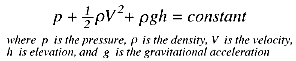
I’ll go and hunt down a lecturer tomorrow, thanks for your help any way.
Use the continuity of mass mdot=pAC to determine the proportions of C1 and C2 and you should be pretty much there. Try it in reality and you will be about 25% off, but that's real life!!!

Gassing Station | The Pie & Piston Archive | Top of Page | What's New | My Stuff