
New bioethanol fuel launched
More power and enviro-friendly?
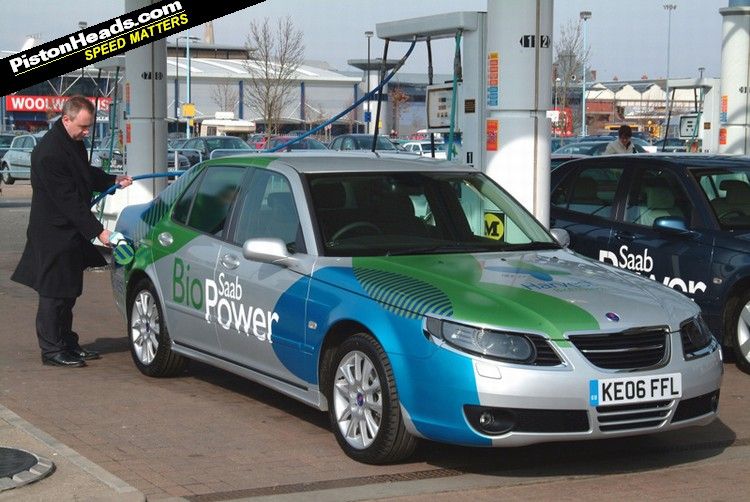
Bio-powered Saab 9-5
As the name suggests, it's a mix of 85 per cent bioethanol and 15 per cent petrol. Derived from plants, bioethanol is said to be more environmentally-friendly than fossil fuels. However, while not all cars can use it, it does offer a higher octane rating and therefore the potential for more power. Saab reckoned that its new 9-5 BioPower shows power gains of up top 20 per cent (see below).
The first BioEthanol E85 pump will be on the forecourt of Morrisons' Albion Way, Norwich site to be immediately followed by supplies of Harvest BioEthanol E85 at another four of its sites in the East of England -- East Dereham, Lowestoft, Diss and Ipswich -- plus five sites in Somerset. Furthermore, Morrisons has already earmarked several other sites across the UK, where Harvest BioEthanol E85 could soon be sold, depending on consumer demand.
Harvest BioEthanol E85 will retail for two pence per litre less than petrol. In Norwich, this means that it will sell for 84.9 pence per litre compared to 86.9 pence per litre for unleaded petrol. Morrisons said it had chosen East Anglia for the launch because of the region’s role in spearheading the fast-emerging UK biofuels industry.
Comment
Morrisons' petrol director Phil Maudsaid: “Morrisons is proud to be the country’s first petrol retailer to open a BioEthanol E85 refuelling pump, reinforcing our position as the UK’s largest forecourt retailer of alternative fuels. We believe that by encouraging the use of BioEthanol E85 we can contribute to a reduction in the harmful effects to the environment caused by the burning of fossil fuels.” Mr Maud went on to comment: “Furthermore, creating demand for this product will, in the medium to long term, present major opportunities for UK farmers, who have always had strong support from Morrisons, to supply their excess cereals capacity to supply BioEthanol manufacturers.”
Futura Petroleum will supply Morrisons with the Harvest BioEthanol E85 in an initiative supported by the Energy Saving Trust and Renewables East.
Simon Davis, Head of Sales at Futura Petroleum, the supplier of Harvest BioEthanol E85 to Morrisons, commented: “We are delighted to be working with Morrisons and Saab to provide Harvest BioEthanol, the first E85 available to the UK public. This launch reinforces Futura’s position as the leading supplier of renewable motor fuels to British motorists.”
Potent Bio-Saab
The launch also ties in with the first deliveries of the Saab 9-5 BioPower flex-fuel car, launched in the UK last November. The turbocharging technology enables the Saab to run on either BioEthanol E85 or petrol, with no adjustment required by the driver. When running on BioEthanol E85, the fossil CO2 emissions of the Saab 9-5 BioPower are typically between 50-70 per cent lower than when running on petrol.
According to Saab, the BioPower is more powerful because of bioethanol's higher octane rating. The Swedish company reckoned that it saw an impressive 20 per cent gain in brake horsepower and a 16 per cent growth in torque when the car runs on BioEthanol E85.
Comment
Saab's UK boss Jonathan Nash said: “Biofuels can play a crucial role in reducing CO2 emissions from passenger cars, and as the Government itself said when it announced plans for a Renewable Transport Fuel Obligation (RTFO) in November, a five per cent use of biofuels today would be equivalent to taking one million cars off the road. Although I welcome the positive steps that the British Government has taken so far in its introduction of a five per cent RTFO and the 20 pence-per-litre tax rebate on biofuels, our experience in other markets shows that the Government needs to take a more strategic approach. Government should show genuine joined-up thinking, by introducing an integrated package of long-term incentives to give consumers the confidence to make the switch to greener fuels, including BioEthanol E85.
“In Sweden, central and local government financial incentives to encourage bioethanol-fuelled cars – including a reduction in company car tax, exemption from Stockholm’s congestion charges and free city parking – have resulted in over five and a half thousand Saab 9-5 BioPower cars already being delivered to Swedish drivers since last summer. Here in the UK, Morrisons has demonstrated its commitment to the fuel – now let's see the Government do the same.”
BioEthanol E85
BioEthanol is produced from a wide variety of agricultural produce, including forest residue, sugar cane, sugar beet and grain, making it a totally renewable and sustainable fuel source. When mixed in high volumes with low volumes of petrol, a potent yet environmentally friendly fuel, known as BioEthanol E85 is created.
Unlike traditional fossil fuels such as petrol and diesel, the consumption of BioEthanol E85 does not significantly raise atmospheric levels of carbon dioxide (CO2), the greenhouse gas that, according to scientific research, contributes to global warming. This is because the emissions that are released during driving have already been cancelled out by the amount of CO2 that was removed from the atmosphere, through nature's photosynthesis process, when the crops for conversion to bioethanol were grown.


Because E85 has a much higher octane rating (104 RON) than petrol, this allows the timing of the engine`s ignition to be advanced, producing more power without risk of harmful ‘knocking`.
The only hardware modifications necessary are more durable valves and valve seats, and the use of bioethanol-compatible materials in the fuel system, including the tank, pump, lines and connectors.
Are the Rovers valves etc. hardy enough ? Is the TVR fuel system compatible ?
IPAddis said:
...20 pence-per-litre tax rebate on biofuelsNews Article said:
...it will sell for 84.9 pence per litre compared to 86.9 pence per litre for unleaded petrol
Eh? Where's my calculator?
Ian A.
 From a global point of view, Africa should be growing the crops (farming too expensive in this country), making money, reducing poverty and reducing dependancy on the middle east.
 Also, here is a link on what has been going on in Brazil for a while...
http://news.bbc.co.uk/1/hi/business/4
IPAddis said:
...20 pence-per-litre tax rebate on biofuels
News Article said:
...it will sell for 84.9 pence per litre compared to 86.9 pence per litre for unleaded petrol
Eh? Where's my calculator?
Ian A.
I'll help.
Bio ethanol is quite expensive to make. Pre tax, petrol at 87p/litre actually costs 27p/litre.
Its a fair bet that bio ethanol (ie alcohol) costs a fair bit more than that.
Its worth noting that E85 isn't quite the bargain it first seems.
It only contains approx 70% of the energy of petrol, so when you burn it the stochiometric ratio goes up.
IIRC you need 1.4 litre of E85 to match 1 litre of petrol.
So the real cost of this stuff is £1.19 litre (equivelant)
Cos Saab can't raise the static compression ratio, due to the fact they still need to run on 95RON muck, all they can do is wind forward the ignition timing when running on E85.
Thats not going to net you a 40% gain in efficiency to reclaim your fuel economy, so you're fuel bill is going to suck.
Not to mention that the only folk that can run on this stuff are brand new Saabs.
Andy
It isn't the energy content of the ethanol that influences the stoichiometric air/fuel ratio, it's the oxygen content (about 35% m/m) of the ethanol.
And it's also the oxygen content of the ethanol that has most impact on performance and economy, not octane rating or ignition advance.
>> Edited by willibetz on Wednesday 15th March 13:35
The VAT is £1.29
At 47.1p/litre fuel duty your tax is £4.71
Thus taxman gets £6
Now for 14 litres of E85, at 85p/litre. That’s £11.90
The VAT is £1.77
For the petrol content (2.1litres):
At 47.1p/litre fuel duty your tax is £0.99
For ethanol content (11.9litre)
At 47.1p/litre less 20p/litre rebate = 27.1p/litre your tax is £3.22
Thus taxman gets £5.98
Not how close the two sums are. You think that is an accident.
Hell no.
Gordon calculated just how much of a rebate he could afford to give without actually losing any money. Plus he gets to look “green” due to his “rebate” that most of the public won’t understand.
That man really is an evil bast.ard
Andy
>> Edited by andytk on Wednesday 15th March 13:32
willibetz said:
Just to clarify a couple of details...
It isn't the energy content of the ethanol that influences the stoichiometric air/fuel ratio, it's the oxygen content (about 35% m/m) of the ethanol.
And it's also the oxygen content of the ethanol that has most impact on performance and economy, not octane rating or ignition advance.
Surely the fuel has Hydrocarbons, the oxygen comes from the air? I'd expect the power output to be limited by the calorific content of the fuel, not by octane rating or 'oxygen content'. The octane rating just has to be enough to enable you to exploit the maximum power, or put another way if the octane rating is too low you will have to sacrifice power to avoid pinking, but as long as the octane rating is high enough the calorific value is what limits how much energy can be got from a given quantity of fuel.
The Brazilian farmers see that growing crops for bio fuel pays more than crops for food. They increase the rate of deforestation in the rainforest to provide rich farmland for bio fuel crops.
The bio fuel pumps out less CO2 when burnt, that is then turned back to oxygen by the few remaining trees.
Clever, but thank god we dont have the surface area on this planet to grow enough bio fuel crops to supply all our energy needs.
GreenV8S said:
Just to clarify a couple of details...
It isn't the energy content of the ethanol that influences the stoichiometric air/fuel ratio, it's the oxygen content (about 35% m/m) of the ethanol.
And it's also the oxygen content of the ethanol that has most impact on performance and economy, not octane rating or ignition advance.
Surely the fuel has Hydrocarbons, the oxygen comes from the air? I'd expect the power output to be limited by the calorific content of the fuel, not by octane rating or 'oxygen content'. The octane rating just has to be enough to enable you to exploit the maximum power, or put another way if the octane rating is too low you will have to sacrifice power to avoid pinking, but as long as the octane rating is high enough the calorific value is what limits how much energy can be got from a given quantity of fuel.
Fuels with higher calorific values can provide more power, but power is also determined by the amount of fuel that can be burnt. Ethanol is an oxygenate (C2H5OH) with a lower stoichiometric ratio than for a standard HydroCarbon fuel (roughly 9:1 plays 14.5:1). You can burn more ethanol than HC fuel for a given mass of induced air, providing better performance and worse fuel economy...
andytk said:
...20 pence-per-litre tax rebate on biofuels
News Article said:
...it will sell for 84.9 pence per litre compared to 86.9 pence per litre for unleaded petrol
Eh? Where's my calculator?
Ian A.
I'll help.
Bio ethanol is quite expensive to make. Pre tax, petrol at 87p/litre actually costs 27p/litre.
Its a fair bet that bio ethanol (ie alcohol) costs a fair bit more than that.
Its worth noting that E85 isn't quite the bargain it first seems.
It only contains approx 70% of the energy of petrol, so when you burn it the stochiometric ratio goes up.
IIRC you need 1.4 litre of E85 to match 1 litre of petrol.
So the real cost of this stuff is £1.19 litre (equivelant)
Cos Saab can't raise the static compression ratio, due to the fact they still need to run on 95RON muck, all they can do is wind forward the ignition timing when running on E85.
Thats not going to net you a 40% gain in efficiency to reclaim your fuel economy, so you're fuel bill is going to suck.
Not to mention that the only folk that can run on this stuff are brand new Saabs.
Andy
Not true - there are actually two vehicles that can use E85 and that are now on sale in the UK: the £25,000 Saab and the Focus FFV (Flexi Fuel Vehicle) which costs £14,095 and which went on sale last August. Saab has only sold one or two of their cars so far, but Ford has sold over 100 - and is even selling a fleet to the Somerset police. The Focus uses a 1.8 litre engine rated at 125PS. It was on Breakfast TV this morning...

Gassing Station | Motoring News | Top of Page | What's New | My Stuff