
aramid composite carbon fibre......
Discussion


Wotcha Chaps!
Can anyone direct me to that excellent thread some while back where we discussed the virtues of aramid composite, carbon fibre and other such exotic materials and what they really are. I seem to recall that one of you was particularly knowledgeable on the subject and was able to describe in detail the characteristics of the different materials, colours in the raw etc.?
If not - is there an article somewhere?
Many thanks.
JJ
Can anyone direct me to that excellent thread some while back where we discussed the virtues of aramid composite, carbon fibre and other such exotic materials and what they really are. I seem to recall that one of you was particularly knowledgeable on the subject and was able to describe in detail the characteristics of the different materials, colours in the raw etc.?
If not - is there an article somewhere?
Many thanks.
JJ
Bump.
Anyone know the thread?
Or can you point me in the direction of an article or feature that will explain the differences between the various materials - kevlar, carbon fibre, aramid composite, glass fibre?
There was someone on here who gave chapter and verse on the varius materials. I've spent some time trying to find the thread, so I would be most grateful for your help.
cheers!
JJ
Anyone know the thread?
Or can you point me in the direction of an article or feature that will explain the differences between the various materials - kevlar, carbon fibre, aramid composite, glass fibre?
There was someone on here who gave chapter and verse on the varius materials. I've spent some time trying to find the thread, so I would be most grateful for your help.
cheers!
JJ


Kevlar is an aramid
http://en.wikipedia.org/wiki/Aramid
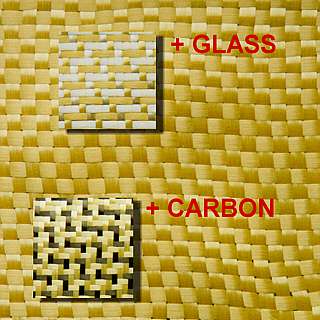
It is yellow and has a definite weave
Fibreglass is dull yellowy/green/white resin that has randomly distributed glass fibres
Carbon fibre is very dark:

I think they also mixed the materials - the main pic is aramid
JJ - know a man who knows your car
http://en.wikipedia.org/wiki/Aramid
It is yellow and has a definite weave
Fibreglass is dull yellowy/green/white resin that has randomly distributed glass fibres
Carbon fibre is very dark:
I think they also mixed the materials - the main pic is aramid
JJ - know a man who knows your car
Edited by cuneus on Tuesday 26th June 12:44
cuneus said:
Fibreglass is dull yellowy/green/white resin that has randomly distributed glass fibres.
Fibreglass is white. The resin can come in various colours and dyes can be added (such as the black for the wheel arch linings.) Fibeglass can also come in woven sheets (most commonly 280 grade) as used for the lightweight T350s and by most boat manufacturers.JR said:
cuneus said:
Fibreglass is dull yellowy/green/white resin that has randomly distributed glass fibres.
Fibreglass is white. The resin can come in various colours and dyes can be added (such as the black for the wheel arch linings.) Fibeglass can also come in woven sheets (most commonly 280 grade) as used for the lightweight T350s and by most boat manufacturers.
Try this website, i work with CF everyday and it has a good insight into various fibre reinforced plastics.
http://www.netcomposites.co.uk/education.asp?seque...
http://www.netcomposites.co.uk/education.asp?seque...
Composite Guru said:
Try this website, i work with CF everyday and it has a good insight into various fibre reinforced plastics.
http://www.netcomposites.co.uk/education.asp?seque...
Thanks - that's interesting..http://www.netcomposites.co.uk/education.asp?seque...
Composite Guru said:
So it seems that Kevlar is to arimid what Hoover is to the vacuum cleaner!leorest said:
Composite Guru said:
So it seems that Kevlar is to arimid what Hoover is to the vacuum cleaner!Thank you for your submissions.
Please feel free to say more. That'll give me a little studying to do!
I wonder if I can find my old 'A' Level chemistry and physics books and notebooks - but then I don't think we went into things like this then!
JJ
Please feel free to say more. That'll give me a little studying to do!
I wonder if I can find my old 'A' Level chemistry and physics books and notebooks - but then I don't think we went into things like this then!
JJ
Edited by firefox1712 on Wednesday 27th June 08:53
HI All
Carbon fibre is black comes in variety of different grades but is generally has a high tensile strength, you can get very stiff grades aswell but they are generally a bit more exotic/expensive and very delicate.
Glass fibre is white and has a much lower tensile strength and has a lower stiffness and is the best fibre for absorbing energy as it wll extend under load and return to its original dimensions.
Aramid is a yellow fibre (Kevlar is the Dupont trade name for Aramid there is another less well know supplier)which has properties halfway between carbon and glass from both a tensile strength and stiffness point of view. Aramid is also widely accepted as the 'toughest' fibre which is why it is used in 'stab vests' and trousers to provide protection against chain saws!
The resin around fibres is generally to hold it in place and provide protection to the fibres against things like chemical attack (glass gets attacked by alkaline materials)The properties of the resin can be improved by applying heat after after mixing and applying, this is generally done by putting them in oven, same principle as paint for cars!
The point to remember with composites is that they only give strength or stiffness in the direction of the fibre which is why you see woven fabrics with fibres in 2 directions, steel obviously has properties in all directions!
I only wish I new all this because I had a really exciting job such as being an F1 designer!
Found this thread from quite a while ago! http://www.pistonheads.com/gassing/topic.asp?h=0&a...
Carbon fibre is black comes in variety of different grades but is generally has a high tensile strength, you can get very stiff grades aswell but they are generally a bit more exotic/expensive and very delicate.
Glass fibre is white and has a much lower tensile strength and has a lower stiffness and is the best fibre for absorbing energy as it wll extend under load and return to its original dimensions.
Aramid is a yellow fibre (Kevlar is the Dupont trade name for Aramid there is another less well know supplier)which has properties halfway between carbon and glass from both a tensile strength and stiffness point of view. Aramid is also widely accepted as the 'toughest' fibre which is why it is used in 'stab vests' and trousers to provide protection against chain saws!
The resin around fibres is generally to hold it in place and provide protection to the fibres against things like chemical attack (glass gets attacked by alkaline materials)The properties of the resin can be improved by applying heat after after mixing and applying, this is generally done by putting them in oven, same principle as paint for cars!
The point to remember with composites is that they only give strength or stiffness in the direction of the fibre which is why you see woven fabrics with fibres in 2 directions, steel obviously has properties in all directions!
I only wish I new all this because I had a really exciting job such as being an F1 designer!
Found this thread from quite a while ago! http://www.pistonheads.com/gassing/topic.asp?h=0&a...
Edited by islander on Wednesday 27th June 21:19
Gassing Station | Wedges | Top of Page | What's New | My Stuff