
500BHP from just a CAM change?
Discussion


http://www.gmhightechperformance.com/tech/0604htp_...
Regards.
said:
Our numbers for just the Stage I Livernois cam uncovered impressive potential in the LS2. Peak numbers rang out at 494.4 hp at 6,400 rpm and 450 lb-ft of torque at 5,200 rpm. That's a quick, 90hp pop for just a cam change! Torque numbers were up at peak, with only a slight loss down low--369.8 lb-ft at 3,000 rpm, showing that the engine will still offer good grunt with the cam. More interesting is the usable area under the curve and how much more usable rpm the engine picks up. With this cam, you won't need to shift the car until well past 6,500 versus peak numbers of 5,300 rpm for the stocker. Not only will you gain big power, but with an additional 1,000 rpm to use in each gear, the car will feel stupid fast.
Their base LS2 was dynoed at 402 bhp (bonnet up I guess ). Anyone know of garages doing these types of conversions in the UK? I'd be interested in a price. Wouldn't this be a cheaper option than circa 4k for a super charger? Am I missing something?Regards.
Edited by Ston on Tuesday 27th November 14:25
supercharger will give a good boost <sic> to the engine throughout the rev range. It will feel like you are driving an N/A engine thats alot bigger than you actually have.
Without funky variable valve timing and lift control, aggressive cam profiles always cause the low to mid power band to suffer. Also, the power is shifted up the rev range which increases other stresses on the engine.
Finally - with a cam change even if you assume no penalty to low-mid range torque then 99% of the time the only difference between stock and a cam'd engine is when the revs build to a point where on the stock engine torque starts to fall but on the cam'd engine it doesn't. What this means in the real world is that when accelerating both cars (assuming all other things the same) will accelerate exactly the same until the top end of the rev range.
Don't get me wrong - I love aggressive cams and the way they sound but as with most things in life it's all a compromise. I've no doubt the LS2 could be benefit from a cam change but you will lose drivability lower down.
For those geeky enough, check out the cams used on moderen ferrari engines. They are super cool 3d cam profiles with the whole cam shaft slid along it's rotating axis to change them.
Lotus have (apparently) a cam-less valve system which allows infinite timing but this has not been released to the public yet.
Ads
Without funky variable valve timing and lift control, aggressive cam profiles always cause the low to mid power band to suffer. Also, the power is shifted up the rev range which increases other stresses on the engine.
Finally - with a cam change even if you assume no penalty to low-mid range torque then 99% of the time the only difference between stock and a cam'd engine is when the revs build to a point where on the stock engine torque starts to fall but on the cam'd engine it doesn't. What this means in the real world is that when accelerating both cars (assuming all other things the same) will accelerate exactly the same until the top end of the rev range.
Don't get me wrong - I love aggressive cams and the way they sound but as with most things in life it's all a compromise. I've no doubt the LS2 could be benefit from a cam change but you will lose drivability lower down.
For those geeky enough, check out the cams used on moderen ferrari engines. They are super cool 3d cam profiles with the whole cam shaft slid along it's rotating axis to change them.
Lotus have (apparently) a cam-less valve system which allows infinite timing but this has not been released to the public yet.
Ads
The other big hurdle in the UK is emissions, which can increase significantly with cam changes.
Less of a problem in the US and in Aus last week under a Liberal government.
When little kevin signs Kyoto lots of things will change in Aus including having to pay more than £0.50p per litre for fuel.
Less of a problem in the US and in Aus last week under a Liberal government.
When little kevin signs Kyoto lots of things will change in Aus including having to pay more than £0.50p per litre for fuel.
phrich said:
The other big hurdle in the UK is emissions, which can increase significantly with cam changes.
Less of a problem in the US and in Aus last week under a Liberal government.
When little kevin signs Kyoto lots of things will change in Aus including having to pay more than £0.50p per litre for fuel.
Less of a problem in the US and in Aus last week under a Liberal government.
When little kevin signs Kyoto lots of things will change in Aus including having to pay more than £0.50p per litre for fuel.
Very good point - most high performance cams use big lift, big duration and most importantly (from a emmissions point of view) a big overlap on intake and exhaust. That kills the emissions big time - my old Catalytic converter used to last 2 years max due to the tuning of the engine. As for MOT's well... some whistling and shrugging of shoulders required

ads_green said:
Without funky variable valve timing and lift control, aggressive cam profiles always cause the low to mid power band to suffer. Also, the power is shifted up the rev range which increases other stresses on the engine.
Finally - with a cam change even if you assume no penalty to low-mid range torque then 99% of the time the only difference between stock and a cam'd engine is when the revs build to a point where on the stock engine torque starts to fall but on the cam'd engine it doesn't. What this means in the real world is that when accelerating both cars (assuming all other things the same) will accelerate exactly the same until the top end of the rev range.
Don't get me wrong - I love aggressive cams and the way they sound but as with most things in life it's all a compromise. I've no doubt the LS2 could be benefit from a cam change but you will lose drivability lower down.
Ads
Not true dude. Finally - with a cam change even if you assume no penalty to low-mid range torque then 99% of the time the only difference between stock and a cam'd engine is when the revs build to a point where on the stock engine torque starts to fall but on the cam'd engine it doesn't. What this means in the real world is that when accelerating both cars (assuming all other things the same) will accelerate exactly the same until the top end of the rev range.
Don't get me wrong - I love aggressive cams and the way they sound but as with most things in life it's all a compromise. I've no doubt the LS2 could be benefit from a cam change but you will lose drivability lower down.
Ads
Consider stock profile with more lift for example.
Consider stock profile with more lift and a bit more duration, not too much, just enough to get the magic 5th cycle http://www.popularhotrodding.com/enginemasters/art...
Here is my cam dyno on vixpy's dyno

Here is bo55's 6L Supercharged VXR

Tell me where I lost power, or compare with 6L setups and tell me where I lost torque? (Yes I know the supercharger has more, but the 5.7L with cam isn't exactly asthmatic as you infer) Plus it beats all the 6L stock setups easy. My car can pull itself along in 3rd gear at idle without stalling too.
Also consider that the stock cam closes its intake valve quite late resulting in a dynamic compression of 6.9:1 and that an aftermarket cam can set this closing point to a more optimal level resulting in excess of 8:1 dynamic compression. In that case you will gain low end torque and power throughout.
An OEM cam is not the most optimal grind.
It is true to say a badly chosen aggressive grind will lose you low end power, but the answer to that is to do your research first. You do need to keep overlap at 0.050 under 0* for emissions compliance, but that still lets you find a decent amount of extra power. To dismiss a cam out of hand is silly.
Edited by ringram on Tuesday 27th November 21:27
Ditto Rich.
I can say wiht plenty of confidence there is no way a non cam'd car would keep up acclerating and it ceratinly did not have any low down issues - yes peak power moved up teh rev range and we extended the rev range but low to mid range (in particular) was ballistic.
My 70 -100mph times in 4th gear were very close to a well known FI car when it was running approx 550fwhp. Would despatch stock 6.0 no probs and embarassed the odd DB9.
Fi do have more grunt that counts once above 110 or so (MPH on a trsck of course)
I can say wiht plenty of confidence there is no way a non cam'd car would keep up acclerating and it ceratinly did not have any low down issues - yes peak power moved up teh rev range and we extended the rev range but low to mid range (in particular) was ballistic.
My 70 -100mph times in 4th gear were very close to a well known FI car when it was running approx 550fwhp. Would despatch stock 6.0 no probs and embarassed the odd DB9.
Fi do have more grunt that counts once above 110 or so (MPH on a trsck of course)
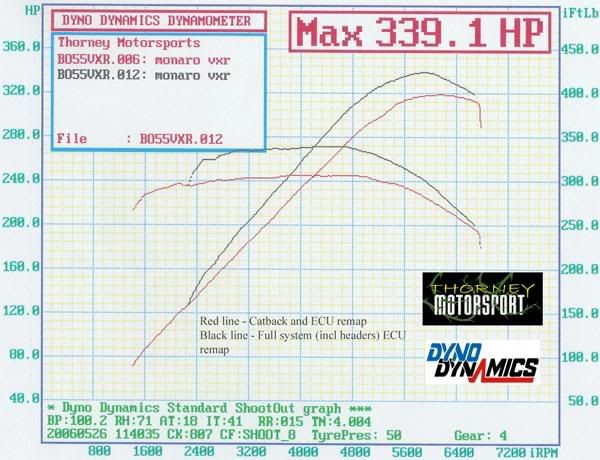

But that says it's got a lot more than just a cam change...
Going the full hog with headers, exhaust, induction, ECU and cam change will obviously give best all round performance.
I'm new to LS2's and big V8's and am quite happy to accept it's different from what I'm used too (small high revving units) and it looks like that standard tune is very very conservative but I've never seen an engine that didn't suffer low down with extreme performance cam's.
Going the full hog with headers, exhaust, induction, ECU and cam change will obviously give best all round performance.
I'm new to LS2's and big V8's and am quite happy to accept it's different from what I'm used too (small high revving units) and it looks like that standard tune is very very conservative but I've never seen an engine that didn't suffer low down with extreme performance cam's.
Thunderracing cam compared to stock for low end comparison Not much gain low down true, but no loss either.

Agreed extreme cams are not whats required to maintain low end or emissions. A mild cam and add heads for even more benefit.
Depends on the goals you are after. If its more power you want while retaining low end and emissions its supercharger time, not much choice there, unless you fancy a 7L engine but a small cam is just going to choke it off much like the stock cam in the stock engine does.
Bloody emissions!
Not much gain low down true, but no loss either.Agreed extreme cams are not whats required to maintain low end or emissions. A mild cam and add heads for even more benefit.
Depends on the goals you are after. If its more power you want while retaining low end and emissions its supercharger time, not much choice there, unless you fancy a 7L engine but a small cam is just going to choke it off much like the stock cam in the stock engine does.
Bloody emissions!
Edited by ringram on Tuesday 27th November 22:22
as Richard knows this is the route I'm going down with heads/cam/intake manifold/3" exhaust with headers and having spoken to the guy doing the heads I reckon its going to make some interesting numbers. Didn't clarify what cam profile he's suggesting but its custom matched to the heads and apparently will be fine for emissions at mot test......Mark at Rapid wanted me to consider the Harrop intake with its 8 throttle bodies but its just too much for now. Probably stick with the FAST and a decent 90mm throttle body with some form of OTRCAI.
Even with all that I'm not sure how close I'll get to 500fwhp - circa 420ish at the wheels from the 5.7. Sitting around 325rwhp atm so expecting +10-15 from intake, +30-40 from cam, +10-15 from exhaust and headers + whatever the heads/valvetrain/otrcai etc all add to the mix. Should give a few cars a surprise anyway. Wonder how much for a stroker kit - a decent one that is as found a cheap one for 1400US$ today but always of the opinion you get what you pay for and that sounds a bit too cheap!!
Even with all that I'm not sure how close I'll get to 500fwhp - circa 420ish at the wheels from the 5.7. Sitting around 325rwhp atm so expecting +10-15 from intake, +30-40 from cam, +10-15 from exhaust and headers + whatever the heads/valvetrain/otrcai etc all add to the mix. Should give a few cars a surprise anyway. Wonder how much for a stroker kit - a decent one that is as found a cheap one for 1400US$ today but always of the opinion you get what you pay for and that sounds a bit too cheap!!
ringram said:
You do need to keep overlap at 0.050 under 0* for emissions compliance
How do you determine if that is the case given a cam spec of say:| Intake | Exhaust | |
| Valve Adjustment: | .000 | .000 |
| Lobe Lift: | .351 | .348 |
| Gross Valve Lift 1.70 Ratio: | .597 | .592 |
| Duration @ .050 Tappet Lift: | 220* | 224* |
| Lobe Separation: 111* | ||
| Recommended Intake Centerline: 108* | ||
| Specs at 108 Degree Intake Centerline: | ||
| Valve Timing at: | Open: | Close: |
| .050 Tappet Lift: | Intake: 2* BTDC | 38* ABDC |
| Exhaust:46* BBDC | (-2*) ATDC | |
| Specs at 110 Degree Intake Centerline: | ||
| Valve Timing at | Open | Close |
| .050 Tappet Lift: | Intake: 0* BTDC | 40* ABDC |
| Exhaust:44* BBDC | 0* ATDC |
Edited by jimb0 on Wednesday 28th November 09:39
jimb0 said:
How do you determine if that is the case given a cam spec of say:
Easy with the cam specs above you can look at intake opening and exhaust closing, in the cam above its 0* because the both open and close at the same point.
      Intake  Exhaust
Valve Adjustment:   .000”  .000”
Lobe Lift:    .351”  .348”
Gross Valve Lift 1.70 Ratio:  .597”  .592”
Duration @ .050” Tappet Lift: 220*  224*
.
Lobe Separation:                        111*
Recommended Intake Centerline:          108*
.
Specs at 108 Degree Intake Centerline:
Valve Timing at  Open  Close
.050” Tappet Lift: Intake:  2* BTDC 38* ABDC
   Exhaust:46* BBDC (-2*) ATDC
.
Specs at 110 Degree Intake Centerline:
Valve Timing at  Open  Close
.050” Tappet Lift: Intake:  0* BTDC 40* ABDC
   Exhaust:44* BBDC  0* ATDC
.
But thats at 0.050 valve lift, which means under that lift there will be overlap. With good cats you "should" make it with that cam.
I used one of similar spec from crane
Cam Timing: TAPPET @.050
Lift: Opens Closes Max Lift Duration
Intake 0.0 TDC 40.0 ABDC 110 220.0 °
Exhaust 50.0 BBDC (6.0) BTDC 118 224.0 °
That has -6* overlap, but actual overlap was 56* as shown below
Cam Timing: TAPPET @.004
Lift: Opens Closes ADV Duration
Intake 27.0 BTDC 75.0 ABDC 282.0 °
Exhaust 77.0 BBDC 29.0 ATDC 286.0 °
But the crane has fairly slow ramp rates compared to the comp cams stuff, meaning is spends more time at low lift and therefore overlap. You can check if you get the ADV duration. But I like the lift more on the cam you posted. Mine didnt have as much as I would have liked.
I tried without cats and missed out with mine, but it was very close. US blokes in California say a 224/224-114 is right on the limit and Ive been told UK emissions are more lenient. As with anything Empirical would be nice. I think Roger has done a few cams with somewhere around 216/220 which "should" be comfortably inside emissions.
Edited by ringram on Wednesday 28th November 09:58
Ston said:
So from those dyno charts posted, there is in fact no lose of power, just gains all round (just less of a gain at lower RPM).
Yes, Unless like ads_green says you chose a cam without due care and consideration and get a leary one. (ie) Think low 22x duration and under with as much lift as possible, usually near/under 0.600 lift. Keep LSA up to reduce overlap, say 114+Of course you wont get the big numbers that the hairy cams will give, but it will be more driveable, should pass emissions and be good at low rpm. Roger does cam fitting as he fit mine. Mark probably does too. Both those guys have worked on the Holdens for years.
Gassing Station | HSV & Monaro | Top of Page | What's New | My Stuff