
Discussion


I thought the British were rubbish at complaining but the good old US taxpayer appears even worse.
So that looks like $1.3 trillion dollars!!
I particularly like the way the US taxpayer will bail out European banks, jolly generous of them.
This is a country that fought a war of independence about tax but now are quite happy for their government to cripple them for years.
source 1
source 2
| Organisation | Cost in Billions |
|---|---|
| The Federal Reserver | 10 |
| Student Loans | 20 |
| Pension Benefit Guarantee Corporation | 30 |
| Federal Housing Administration | 20 |
| Small Business Administration | 20 |
| Federal Home Loan Banks | 50 |
| Federal Deposit Insurance Corporation | 150 |
| Fannie and Freddie | 300 |
| Pulson's latest idea | 700 |
| Total | 1300 |
So that looks like $1.3 trillion dollars!!
I particularly like the way the US taxpayer will bail out European banks, jolly generous of them.
This is a country that fought a war of independence about tax but now are quite happy for their government to cripple them for years.
source 1
source 2
Fittster said:
JagLover said:
Bear in mind though that the latest moves may not result in a permanant increase in the debt. It depends how much these 'toxic' assets can eventually be sold for.
If they are good value and can be sold for a profit in the future why is no one else willing to buy them?Add another $25 billion to the debt!
"The Bush Administration approved a package of $25 billion in federal loans to automakers and suppliers to offset investments in building cleaner, greener vehicles. Federal officials recently said the money would not likely be available to the automakers until the end of 2009. But Michigan legislators said they would move to speed up the process to rescue their largest employers."
"The Bush Administration approved a package of $25 billion in federal loans to automakers and suppliers to offset investments in building cleaner, greener vehicles. Federal officials recently said the money would not likely be available to the automakers until the end of 2009. But Michigan legislators said they would move to speed up the process to rescue their largest employers."
Michael Pento of Delta Global Advisors says, "One of the major ramifications of having our national debt move above the $10 trillion mark is that the sustainability of the government, consumer spending and the economy rests on the continuation of artificially low interest rates. In fact, low rates that are the result of money printing have become our addiction."
It goes on "it now takes about 10 cents on every tax dollar collected just to pay the interest on the debt", which doesn't seem so bad until you realize that "As bad as that is, it is only because interest rates are at record lows that the debt service is still manageable."
an example, he notes that "The yield on the 10 year note as of this writing is 4.01%. To illustrate how low that yield is in historical terms, the average constant yield on the ten year treasury going back 46 years is 7.04%."
So if the yield returns to the long term average then servicing the debt would be 20 cents on every tax dollar.
It goes on "it now takes about 10 cents on every tax dollar collected just to pay the interest on the debt", which doesn't seem so bad until you realize that "As bad as that is, it is only because interest rates are at record lows that the debt service is still manageable."
an example, he notes that "The yield on the 10 year note as of this writing is 4.01%. To illustrate how low that yield is in historical terms, the average constant yield on the ten year treasury going back 46 years is 7.04%."
So if the yield returns to the long term average then servicing the debt would be 20 cents on every tax dollar.
Todays little nugget.
According to CMA DataVision, the 10-year credit default swap spread (a form of insurance on US treasury bonds) has risen from 1.6 basis points (0.016%) in July 2007, to 16 basis points in March 2008, to 30 basis points in September, to over 40 basis points on October 27 – see the chart below for the spread history so far this year. In other words the cost of insuring against a US government default has risen by 25 times in little over a year.
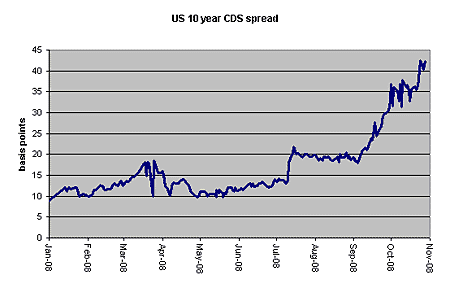
Can the US taxpayer really afford Obama's welfare or McCains military? A few people must have some doubts.
According to CMA DataVision, the 10-year credit default swap spread (a form of insurance on US treasury bonds) has risen from 1.6 basis points (0.016%) in July 2007, to 16 basis points in March 2008, to 30 basis points in September, to over 40 basis points on October 27 – see the chart below for the spread history so far this year. In other words the cost of insuring against a US government default has risen by 25 times in little over a year.
Can the US taxpayer really afford Obama's welfare or McCains military? A few people must have some doubts.
turbobloke said:
Fittster said:
Can the US taxpayer really afford Obama's welfare
No but he can make a good speech, that's all that matters, miracles will follow (not).
Slowly creeping up:
"the fact remains that CDS spreads on 10-year US treasuries (yes, US government risk) have widened, from a low of 1.6 basis points in mid-2007 to about 52 basis points today."
And what point does it become an issue and suggest people think there is a real risk of a default?
http://seekingalpha.com/article/106027-ge-s-divide...
"the fact remains that CDS spreads on 10-year US treasuries (yes, US government risk) have widened, from a low of 1.6 basis points in mid-2007 to about 52 basis points today."
And what point does it become an issue and suggest people think there is a real risk of a default?
http://seekingalpha.com/article/106027-ge-s-divide...
Those good old American taxpayers has now been lined up to come up with $7.7 trillion dollars!
"The U.S. government is prepared to provide more than $7.76 trillion on behalf of American taxpayers after guaranteeing $306 billion of Citigroup Inc. debt yesterday. The pledges, amounting to half the value of everything produced in the nation last year, are intended to rescue the financial system after the credit markets seized up 15 months ago.
The unprecedented pledge of funds includes $3.18 trillion already tapped by financial institutions in the biggest response to an economic emergency since the New Deal of the 1930s, according to data compiled by Bloomberg"
http://bloomberg.com/apps/news?pid=20601109&si...
"The U.S. government is prepared to provide more than $7.76 trillion on behalf of American taxpayers after guaranteeing $306 billion of Citigroup Inc. debt yesterday. The pledges, amounting to half the value of everything produced in the nation last year, are intended to rescue the financial system after the credit markets seized up 15 months ago.
The unprecedented pledge of funds includes $3.18 trillion already tapped by financial institutions in the biggest response to an economic emergency since the New Deal of the 1930s, according to data compiled by Bloomberg"
http://bloomberg.com/apps/news?pid=20601109&si...
The sharp slowdown in the US economy will push the federal budget deficit to more than $1 trillion, the non-partisan Congressional Budget Office (CBO) says.
The deficit of $1.186 trillion for the fiscal year ending on 30 September would be the largest on record.
The projected deficit does not include the extra $800bn spending being planned by US President-elect Barack Obama.
But it highlights the deep economic difficulties facing Mr Obama when he is inaugurated on 20 January.
The CBO says that the slowing economy will lead to the US budget deficit more than doubling from last year's figure of $455bn.
WHY DEFICITS MATTER
Increased debt costs for government
Increased risk of inflation
Long-term pressure on dollar
Could lead to higher taxes and spending cuts later
And it says that, although the economy may recover by 2010, the deficit will still be more than $700bn, and it projects an accumulated deficit of nearly $2 trillion over the next five years.
As a percentage of total economic output, the deficit will be 8.3% of GDP. The previous record was 6% of GDP, set in 1983.
The major reason for the deficit is the sharp decline in tax revenues, projected to fall by 6.6%, as well as the increase in spending due to the cost of the recession and the bail-out.
http://news.bbc.co.uk/1/hi/business/7816035.stm
Going yo be tough to sort that out.
The deficit of $1.186 trillion for the fiscal year ending on 30 September would be the largest on record.
The projected deficit does not include the extra $800bn spending being planned by US President-elect Barack Obama.
But it highlights the deep economic difficulties facing Mr Obama when he is inaugurated on 20 January.
The CBO says that the slowing economy will lead to the US budget deficit more than doubling from last year's figure of $455bn.
WHY DEFICITS MATTER
Increased debt costs for government
Increased risk of inflation
Long-term pressure on dollar
Could lead to higher taxes and spending cuts later
And it says that, although the economy may recover by 2010, the deficit will still be more than $700bn, and it projects an accumulated deficit of nearly $2 trillion over the next five years.
As a percentage of total economic output, the deficit will be 8.3% of GDP. The previous record was 6% of GDP, set in 1983.
The major reason for the deficit is the sharp decline in tax revenues, projected to fall by 6.6%, as well as the increase in spending due to the cost of the recession and the bail-out.
http://news.bbc.co.uk/1/hi/business/7816035.stm
Going yo be tough to sort that out.
Fittster said:
Add another $25 billion to the debt!
"The Bush Administration approved a package of $25 billion in federal loans to automakers and suppliers to offset investments in building cleaner, greener vehicles. Federal officials recently said the money would not likely be available to the automakers until the end of 2009. But Michigan legislators said they would move to speed up the process to rescue their largest employers."
That 25B was already figured in for the auto-guys as a "green car" research fund, they simply diverted it, IIRC."The Bush Administration approved a package of $25 billion in federal loans to automakers and suppliers to offset investments in building cleaner, greener vehicles. Federal officials recently said the money would not likely be available to the automakers until the end of 2009. But Michigan legislators said they would move to speed up the process to rescue their largest employers."
JagLover said:
Bear in mind though that the latest moves may not result in a permanant increase in the debt. It depends how much these 'toxic' assets can eventually be sold for.
Eric is right. Much of that will be sold, offsetting a large amount of the costs. These bailouts are really loans. Guess what, the Feds DO get paid back with more certainty than a Mafia loanshark. Obama has said part of his stimulus package will include a hugh business tax cut. If so, businesses will feel better about expanding, hiring, etc. That means more commerce, more taxes collected due to more consumer spending....the deficit gets whittled a little more. Huge debts still? Surely; not as bad as the numbers show, possibly.Fittster said:
The sharp slowdown in the US economy will push the federal budget deficit to more than $1 trillion, the non-partisan Congressional Budget Office (CBO) says.
The deficit of $1.186 trillion for the fiscal year ending on 30 September would be the largest on record.
The projected deficit does not include the extra $800bn spending being planned by US President-elect Barack Obama.
But it highlights the deep economic difficulties facing Mr Obama when he is inaugurated on 20 January.
The CBO says that the slowing economy will lead to the US budget deficit more than doubling from last year's figure of $455bn.
WHY DEFICITS MATTER
Increased debt costs for government
Increased risk of inflation
Long-term pressure on dollar
Could lead to higher taxes and spending cuts later
And it says that, although the economy may recover by 2010, the deficit will still be more than $700bn, and it projects an accumulated deficit of nearly $2 trillion over the next five years.
As a percentage of total economic output, the deficit will be 8.3% of GDP. The previous record was 6% of GDP, set in 1983.
The major reason for the deficit is the sharp decline in tax revenues, projected to fall by 6.6%, as well as the increase in spending due to the cost of the recession and the bail-out.
http://news.bbc.co.uk/1/hi/business/7816035.stm
Going yo be tough to sort that out.
Help me see things in relative terms please. What is the U.K. economic situation? Also, due to your smaller size and GDP, what debt would the U.K. have to have to be on par with ours per capita speaking?The deficit of $1.186 trillion for the fiscal year ending on 30 September would be the largest on record.
The projected deficit does not include the extra $800bn spending being planned by US President-elect Barack Obama.
But it highlights the deep economic difficulties facing Mr Obama when he is inaugurated on 20 January.
The CBO says that the slowing economy will lead to the US budget deficit more than doubling from last year's figure of $455bn.
WHY DEFICITS MATTER
Increased debt costs for government
Increased risk of inflation
Long-term pressure on dollar
Could lead to higher taxes and spending cuts later
And it says that, although the economy may recover by 2010, the deficit will still be more than $700bn, and it projects an accumulated deficit of nearly $2 trillion over the next five years.
As a percentage of total economic output, the deficit will be 8.3% of GDP. The previous record was 6% of GDP, set in 1983.
The major reason for the deficit is the sharp decline in tax revenues, projected to fall by 6.6%, as well as the increase in spending due to the cost of the recession and the bail-out.
http://news.bbc.co.uk/1/hi/business/7816035.stm
Going yo be tough to sort that out.
Jimbeaux said:
JagLover said:
Bear in mind though that the latest moves may not result in a permanant increase in the debt. It depends how much these 'toxic' assets can eventually be sold for.
Eric is right. Much of that will be sold, offsetting a large amount of the costs. These bailouts are really loans. Guess what, the Feds DO get paid back with more certainty than a Mafia loanshark. Fittster said:
Jimbeaux said:
JagLover said:
Bear in mind though that the latest moves may not result in a permanant increase in the debt. It depends how much these 'toxic' assets can eventually be sold for.
Eric is right. Much of that will be sold, offsetting a large amount of the costs. These bailouts are really loans. Guess what, the Feds DO get paid back with more certainty than a Mafia loanshark.  The fact that are set to get a return alone, however, shows "bailout" to be a misnomer.
the U.S.A., with its $14 trillion economy, has a federal government that is going to spend, over the next year, all the money in their usual $3 trillion-plus budget, but also another $2 trillion or so over the next year! $5 trillion in government spending, at a cost of $3 trillion in new debt, all in a $14 trillion economy! Gahhhhh! We’re freaking dooooooooomed!
I did not mention that there are only about 100 million non-government, non-taxpayer paid workers in the U.S.A., which means that there are only 100 million workers who can make a profit with which to pay taxes, which means that $5 trillion in government spending is a staggering $50,000 for Every Freaking One (EFO) of those non-government, non-taxpayer paid positions! And you think THAT is going to work out for the best?
source
Hmm, even in the US being a taxpayer sucks.
I did not mention that there are only about 100 million non-government, non-taxpayer paid workers in the U.S.A., which means that there are only 100 million workers who can make a profit with which to pay taxes, which means that $5 trillion in government spending is a staggering $50,000 for Every Freaking One (EFO) of those non-government, non-taxpayer paid positions! And you think THAT is going to work out for the best?
source
Hmm, even in the US being a taxpayer sucks.
Gassing Station | The Pie & Piston Archive | Top of Page | What's New | My Stuff