
Space Week (Nat Geo)
Discussion


Anyone been watching this? Pretty cool if not extremely confusing at times. It’s amazing how Einstein was the first person to show that black holes were possible using equations and then eventually proven correct in his hypothesis when a black hole was discovered in the mid 90’s.
Just a quicky to any space buffs – when I look up at the sky, sometimes I’ll see a really dense cluster of very, very faint stars. I can only really see them when I am not looking directly at the cluster. I’m pretty sure it’s the same cluster when ever I’ve spotted it. Is it an asteroid belt? Another galaxy? Another solar system?
I find astronomy fascinating!
Just a quicky to any space buffs – when I look up at the sky, sometimes I’ll see a really dense cluster of very, very faint stars. I can only really see them when I am not looking directly at the cluster. I’m pretty sure it’s the same cluster when ever I’ve spotted it. Is it an asteroid belt? Another galaxy? Another solar system?
I find astronomy fascinating!
AndyKH said:
Yup, been watching a couple of things on nat geo, recorded the programme about the hubble from last night . Looking forward to watching it tonight.
You won’t be disappointed with the Hubble’s Final Frontier! I think they are fixing Hubble at the moment, or just repaired it as things were starting to go wrong. It only had a 20 year life expectancy which is up in the next couple of years but I think they’re hoping to keep it going as it’s still the most important tool for astronomers. The Hubble Ultra Deep Field is amazing and shows just how HUGE our universe is and how small we really are!I also find it interesting that the calcium in your bones, the gold in your wedding finger and the iron which makes up your haemoglobin is all because of super-novas; stars exploding! Without this phenomenon we wouldn’t have these important elements!
I’d like the know more about worm holes as they only really touched on it. I assume like black holes, a scientist (I don’t know if it was Einstein or not) has produced equations which prove that worm holes COULD exist. Worm holes are often talked about in the same breath as black holes, but they think that black holes are way too chaotic for worm holes to exist in them. So how else would a worm hole exist? What makes scientists believe that worm holes are even a possibility?
ytrebil said:
Just a quicky to any space buffs – when I look up at the sky, sometimes I’ll see a really dense cluster of very, very faint stars. I can only really see them when I am not looking directly at the cluster. I’m pretty sure it’s the same cluster when ever I’ve spotted it. Is it an asteroid belt? Another galaxy? Another solar system?
I find astronomy fascinating!
If you're talking about this particular time of year, and you're not in the depths of the countryside away from street lights, I'd bet you're seeing the Pleiades ('Seven Sisters') star cluster. if you know your constellations, it's in Taurus.I find astronomy fascinating!
Ahhh you could be right TB. I just googled it. I thought it was more dense than Pleiades. I usually see it most year round but the sky has to be really clear and the cluster is probably at about 50 or so degrees vertically. As I say, I can’t usually see the cluster if I look straight at it, I have to look slightly away and I can see it, white and very faint.
ytrebil said:
Ahhh you could be right TB. I just googled it. I thought it was more dense than Pleiades. I usually see it most year round but the sky has to be really clear and the cluster is probably at about 50 or so degrees vertically. As I say, I can’t usually see the cluster if I look straight at it, I have to look slightly away and I can see it, white and very faint.
I reckon it's the Pleiades, and averted vision will always work best with faint fuzzies. The eyeball view is just a fuzzy blob with what looks like a few stars embedded, if you look at photos the appearance is deceptive i.e. different to the naked eye view. if you have a pair of binoculars take another look and the star pattern should be like the pics, but you won't see any of the reflection nebulosity that some photos reveal.turbobloke said:
ytrebil said:
Ahhh you could be right TB. I just googled it. I thought it was more dense than Pleiades. I usually see it most year round but the sky has to be really clear and the cluster is probably at about 50 or so degrees vertically. As I say, I can’t usually see the cluster if I look straight at it, I have to look slightly away and I can see it, white and very faint.
I reckon it's the Pleiades, and averted vision will always work best with faint fuzzies. The eyeball view is just a fuzzy blob with what looks like a few stars embedded, if you look at photos the appearance is deceptive i.e. different to the naked eye view. if you have a pair of binoculars take another look and the star pattern should be like the pics, but you won't see any of the reflection nebulosity that some photos reveal.There are loads of globular star clusters and visable galaxies up there, get yourself well dark adjusted and have a slow scan along the Milky Way with some binos and you will be amazed. You are seeing this cluster with what is called averted vision - it's a trick that uses a more sensitive part of the eye for seeing dim objects.

ytrebil said:
Ahhh you could be right TB. I just googled it. I thought it was more dense than Pleiades. I usually see it most year round but the sky has to be really clear and the cluster is probably at about 50 or so degrees vertically. As I say, I can’t usually see the cluster if I look straight at it, I have to look slightly away and I can see it, white and very faint.
It won't be the Pleiades if you see it all year round, that is really a winter sight. By the way, do you know that a Scooby badge is a representation of the Pleiades?
I fell asleep last night and so missed a part of a programme which I think was talking about dark matter. What I don’t understand is why do they think dark matter exists? They say that they know there is something there which is not visible because it keeps galaxies together so they don’t stray which I understand. But then I also understand that most galaxies have a black hole in the centre. Could this not be a logical explanation as to why galaxies stay ‘in form’? The gravitational pull of the black hole keeping the stars and other physical matter bound?
Edited by ytrebil on Tuesday 6th January 11:59
ytrebil said:
Nice, thanks. I assume you're into astronomy? I would like to turn back time and taken a degree in physics or astro physics. Highly fascinating stuff. I like indulging in thoughts about space as it makes our daily lives seem very insignificant and is a good way to forget about the stresses of 'every day life'.
Into astronomy, yes, you could say so! On the theory side I still train postgrads in astrophysics as part of my training company's business activities, on the practical side I used to have a small private observatory until the ex had other ideas, and in addition to taking lots of pretty pics with a range of telescopes I've owned over the years I also took part in pro-am research on extragalactic supernovae, also BL Lac & QSO (active galactic nuclei) stuff. I'm still active in solar obs / research but not as much as I used to be. A couple of books on astronomy have also come and gone.Meanwhile, M45 aka The Pleiades, still very different from the naked eye view though:

tonyvid said:
ytrebil said:
Ahhh you could be right TB. I just googled it. I thought it was more dense than Pleiades. I usually see it most year round but the sky has to be really clear and the cluster is probably at about 50 or so degrees vertically. As I say, I can’t usually see the cluster if I look straight at it, I have to look slightly away and I can see it, white and very faint.
It won't be the Pleiades if you see it all year round, that is really a winter sight. By the way, do you know that a Scooby badge is a representation of the Pleiades?I would recommend general introduction books by people like Patrick Moore, Heather Cooper, Nigel Redpath or David Whitehouse.
They write in fairly plain English and do not indulge in too much mathematical formulae.
Obviously, there is more advanced stuff out there if you want to delve deeper.
Some of the astronomy mags are worth picking up - Astronomy Now and The Sky at Night are the two most generally available UK mags. Sky and Telescope and Astronomy tend to be a bit more tecchie and are American.
They write in fairly plain English and do not indulge in too much mathematical formulae.
Obviously, there is more advanced stuff out there if you want to delve deeper.
Some of the astronomy mags are worth picking up - Astronomy Now and The Sky at Night are the two most generally available UK mags. Sky and Telescope and Astronomy tend to be a bit more tecchie and are American.
AndyKH said:
Turbobloke, can you recommend any books for someone wanting to get into this field?
There are so many...I'd say that, as with advice on buying a telescope, you could do a lot worse than join the local astronomical society and see what books members enjoy reading and using, as there are so many publications with different purposes. Looking at the night sky with the naked eye or binoculars, I still use Norton's Star Atlas if there's something new or unusual to locate quickly, but there are now digital star catalogues and maps that turn your computer into a planetarium and more besides, while at the other end of the experience spectrum there's software that can drive modern telescopes (and also drive amateur observatories remotely too) so objects can be located automatically once a permanent mount is accurately polar aligned. That takes a lot of the knowledge out of it but a lot of effort is taken out too.
As for general astronomy books, just about anything by (Sir) Patrick Moore will be very readable. You'll appreciate that my own general interest books are getting a bit old now, even the glossies by Patrick Moore that I have aren't hot off the press but they have added value as freebies as I contributed a few images to them.
The Society for Popular Atronomy and the British Astronomical Association are always there for beginners and more experienced observers:
http://www.popastro.com/
http://britastro.org/baa/
Have a look online in their sales section for current titles.
ytrebil said:
Is there anything notable coming up at all TB? Such as awaiting photos from a space mission, any sort of alignments or visible planets/phenomenon with the naked eye? Also, any space launches due? Anything exciting on the horizon?
Do you participate in SETI@Home?
I keep an eye on www.spaceflightnow.com which has almost daily updates on the latest space and astronomy news. Some of the site is subscription only but the main news headlines are free to read. There are often links through to new pictures from current operating space probes too. There's always something going on "up there".Do you participate in SETI@Home?
In fact, I have never known a period where major astronomical discoveries are being made at such a pace. I would suggest that this is probably the most exciting time EVER for space science and astronomy.
Edited by Eric Mc on Tuesday 6th January 12:32
ytrebil said:
Is there anything notable coming up at all TB? Such as awaiting photos from a space mission, any sort of alignments or visible planets/phenomenon with the naked eye? Also, any space launches due? Anything exciting on the horizon?
NASA's inventory is here:http://www.nasa.gov/missions/current/
If we get into planetary alignments somebody will shout 'astrology' and we'll be in trouble...as for other events, there are always predictable evnts like eclipses and meteor showers, while the night sky is reviewed each month for interesting objects in the magazine titles mentioned by EricMc. Anything on the shelf of WH Smith should do the job in that regard but there's variable quality in other aspects.
The most exciting views for me include a lot of the unpredictable kind, such as novae or comets, these will also be discussed in magazines and online.
ytrebil said:
Do you participate in SETI@Home?
No, as it happens. I don't feel guilty btw AndyKH said:
Brilliant, i'm hoping to convince my neighbor to sell me his telescope i spotted in the back of his garage.
Great. Cheaper than new At which point that local astronomical society will (hopefully) get you in touch with somebody who knows about telescopes. There are some impressive looking but next-to-useless 'scopes out there which aren't worth accepting even for free as they just take up valuable space - and time, before they're ditched.tonyvid said:
ytrebil said:
Ahhh you could be right TB. I just googled it. I thought it was more dense than Pleiades. I usually see it most year round but the sky has to be really clear and the cluster is probably at about 50 or so degrees vertically. As I say, I can’t usually see the cluster if I look straight at it, I have to look slightly away and I can see it, white and very faint.
It won't be the Pleiades if you see it all year round, that is really a winter sight. By the way, do you know that a Scooby badge is a representation of the Pleiades?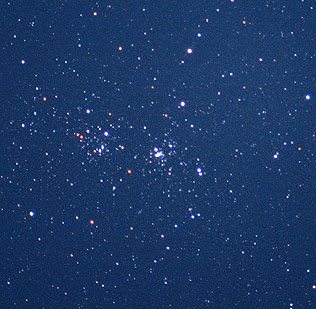
Ytrebil do you know the sky at all (constellations)? Apart from enything else the slight complication here is that the Pleiades and Double Cluster aren't that far apart in the night sky.
Gassing Station | The Pie & Piston Archive | Top of Page | What's New | My Stuff