
castor / camber angles
Discussion


right!! firstly a quick hello to the forum.. after viewing for a while i decided it was time to get a little more involved as quite frankly you all seem a lot smarter than the average small hatchback forum!!
i will try to keep this introduction brief... i`m in the process of taking my peugeot 106 from everyday car to track toy.. a photo history can be found here:
http://smg.photobucket.com/albums/v11/slammed106/?...
in an effort to expand my knowledge from "low and stiff = good" to things a little more technical ive been reading a few books 1 of which is *competition car suspension by allen staniforth* and 1 topic that particularly got me thinking was castor/camber angles!!
for those not familiar with the 106 turrets there are 2 std positions for the topmounts- NON PAS vs PAS ..
NON PAS positioning = top mounts further forward= lighter steering + less castor...
PAS positioning = top mount further back + heavier steering (counteracted by power steering) but greater castor angle which results in dynamic camber???
it would seem that increasing the castor is indeed a very worthwhile act as during turning the dynamic camber is increased.. buying swanky billet top mounts and yanking the sturt tops inwards (static camber???) just results in inside edge tire wear...
the thing is the limiting factor is the fact peugeot placement of the holes in the turret top...
seeings as my shell is currently recieving much welding/cage/rust repairs/strut top reinforement the more i think about the latter the more it seems an ideal opportunity to possibly relocate the std positions back another 10mm (which my very poor maths works out at an extra degree (possibly just over) extra from the PAS position)
at first i didnt think there`d be enough room but now i`ve removed the scuttle panel (for extra throttle body trumpet/filter room) its free`d up a fair bit of space around the area:
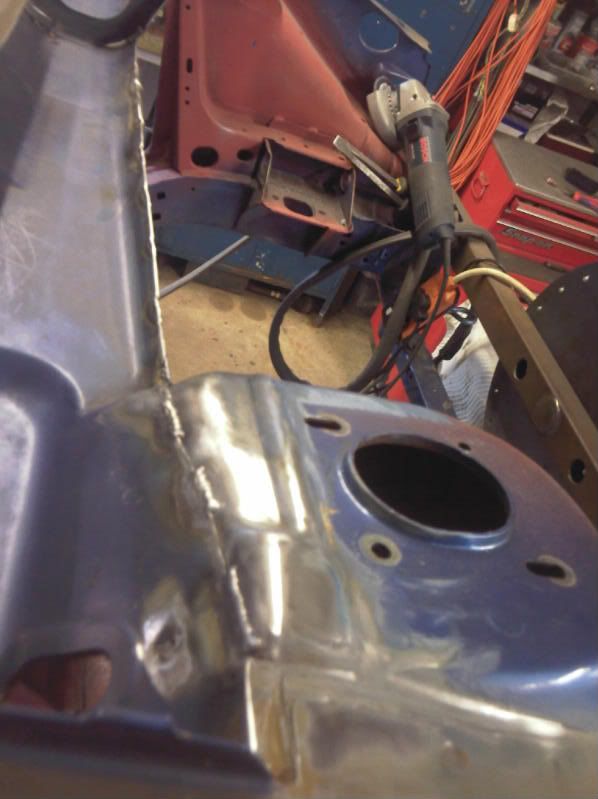
now am i on the right track with this train of thought? or are there far more important things i should address first??
also during my research.. (i use that term loosely as its just surfing the net fueled by stella!) i came across the pug sport official documents.. in which i found this:
-A cette assiette, les reglages preconises sont:
carrosage - 2deg 30` de negatif
chasse - 3deg 40` avec DA
chasse - 2deg 40` sans DA
parallelisme - 2mm e pincement
which i THINK!!!! translates to:
2degrees and 30 minutes negative camber
3 degrees and 40 minutes castor WITH power steering
2 degrees and 40 minutes cator WITHOUT power steering-
so would another degree or 2 castor be a good idea or have i been staring at this poxy book for too long???
many thanks in advance for any help and for taking the time to read all of the above ramblings
stu
i will try to keep this introduction brief... i`m in the process of taking my peugeot 106 from everyday car to track toy.. a photo history can be found here:
http://smg.photobucket.com/albums/v11/slammed106/?...
in an effort to expand my knowledge from "low and stiff = good" to things a little more technical ive been reading a few books 1 of which is *competition car suspension by allen staniforth* and 1 topic that particularly got me thinking was castor/camber angles!!
for those not familiar with the 106 turrets there are 2 std positions for the topmounts- NON PAS vs PAS ..
NON PAS positioning = top mounts further forward= lighter steering + less castor...
PAS positioning = top mount further back + heavier steering (counteracted by power steering) but greater castor angle which results in dynamic camber???
it would seem that increasing the castor is indeed a very worthwhile act as during turning the dynamic camber is increased.. buying swanky billet top mounts and yanking the sturt tops inwards (static camber???) just results in inside edge tire wear...
the thing is the limiting factor is the fact peugeot placement of the holes in the turret top...
seeings as my shell is currently recieving much welding/cage/rust repairs/strut top reinforement the more i think about the latter the more it seems an ideal opportunity to possibly relocate the std positions back another 10mm (which my very poor maths works out at an extra degree (possibly just over) extra from the PAS position)
at first i didnt think there`d be enough room but now i`ve removed the scuttle panel (for extra throttle body trumpet/filter room) its free`d up a fair bit of space around the area:
now am i on the right track with this train of thought? or are there far more important things i should address first??
also during my research.. (i use that term loosely as its just surfing the net fueled by stella!) i came across the pug sport official documents.. in which i found this:
-A cette assiette, les reglages preconises sont:
carrosage - 2deg 30` de negatif
chasse - 3deg 40` avec DA
chasse - 2deg 40` sans DA
parallelisme - 2mm e pincement
which i THINK!!!! translates to:
2degrees and 30 minutes negative camber
3 degrees and 40 minutes castor WITH power steering
2 degrees and 40 minutes cator WITHOUT power steering-
so would another degree or 2 castor be a good idea or have i been staring at this poxy book for too long???
many thanks in advance for any help and for taking the time to read all of the above ramblings
stu
From the pictures it looks like you're doing a very thorough job!
What you're saying is clever and makes sense, however i would consider more than just static and steering camber. Since your car will now be lower and stiffer, it will roll less when cornering (will you have a front/rear anti-roll bar?), and therefore more camber change when turning may not be required.
Of course, this is all speculation. To calculate what is actually happening you would need to know how much the car will roll, how much bump will occur at the outside front wheel for that roll, how much camber is present at that level of bump (static camber and +ve or -ve camber change due to lower wishbone/macpherson strut layout), and what the camber change is due to caster and king pin inclination at a specific steering angle, all for a specific lateral acceleration (sideways G). Quite a long, tricky and impractical process.
I think the best course of action is to either:
-Leave the strut mount for the moment, test the car and observe the tyres (preferably by measuring temperature of the inner, middle and outer section of the tyre) after a few laps at the track to see what areas are hottest and hence working the hardest. If the outside of the tire is being worked excessively, then perhaps modifying the top mount for more caster (maybe some static camber too) would be beneficial.
-Alternatively, and preferably, since you're evidently capable of fabrication, put together (or buy if they're available) a pair of adjustable pillow ball top mounts that will allow you to adjust static camber and caster easily. This will allow you to test, adjust and optimise your camber and caster settings.

I'm no expert remember, so be wary of my advice (as with any internet advice). I've got the same Allan Staniforth book on my coffee table!
For my curiosity, any chance of more information about the car in general? Particularly engine work, there is mention of throttle bodies???
What you're saying is clever and makes sense, however i would consider more than just static and steering camber. Since your car will now be lower and stiffer, it will roll less when cornering (will you have a front/rear anti-roll bar?), and therefore more camber change when turning may not be required.
Of course, this is all speculation. To calculate what is actually happening you would need to know how much the car will roll, how much bump will occur at the outside front wheel for that roll, how much camber is present at that level of bump (static camber and +ve or -ve camber change due to lower wishbone/macpherson strut layout), and what the camber change is due to caster and king pin inclination at a specific steering angle, all for a specific lateral acceleration (sideways G). Quite a long, tricky and impractical process.
I think the best course of action is to either:
-Leave the strut mount for the moment, test the car and observe the tyres (preferably by measuring temperature of the inner, middle and outer section of the tyre) after a few laps at the track to see what areas are hottest and hence working the hardest. If the outside of the tire is being worked excessively, then perhaps modifying the top mount for more caster (maybe some static camber too) would be beneficial.
-Alternatively, and preferably, since you're evidently capable of fabrication, put together (or buy if they're available) a pair of adjustable pillow ball top mounts that will allow you to adjust static camber and caster easily. This will allow you to test, adjust and optimise your camber and caster settings.
I'm no expert remember, so be wary of my advice (as with any internet advice). I've got the same Allan Staniforth book on my coffee table!
For my curiosity, any chance of more information about the car in general? Particularly engine work, there is mention of throttle bodies???
the cars had a few incarnations over the past few years mate to be honest..
it started with the std 1.6 8v engine (dyno`d at 114bhp (ish)) and peugeot sport suspension f+r..
22mm torsion bars
25mm rear ARB
"gravel" rear dampers
250lb F springs
gravel F dampers
18mm F arb
and the obligatory polyrace bushes where ever possible...
this then progresed into
300lb F springs
"tarmac" F dampers
and "some engine work" carrid out by shenpar motorsport up near derby..
lightened + balanced bottom end
alcon paddle clutch
new rings/shells/mains
hi pressure oil pump
3 angle valve seats
port and polish
piper 285 cam
yamaha R6 carbs and a dizzy off an old AX fitted...
that took things up to 142 (ish) bhp...
now i`ll be the first to say i take rolling road readings with a pinch of salt but its a guide.....
the engone is not being put onto GSXR1000 throttle bodies and will be mapped using an emerald M3D ecu.. this will also be linked into a racetech dash2 display that`ll replace all the std dials/guages..
like most projects its kind of gotten out of hand but you only live once and i dont have the urge or skills to warrant a uber BHP turbo thing.. so the 106 is staying...
many thanks for the suspension advice.. i have seen a similar set of topmounts intended for a bmw in the states but am always worried about having everything adjustable (i`m paranoid i`ll find myself in every layby between point A and point B titting about in an attempt to eeek out another 2mph on the next roundabout....
it started with the std 1.6 8v engine (dyno`d at 114bhp (ish)) and peugeot sport suspension f+r..
22mm torsion bars
25mm rear ARB
"gravel" rear dampers
250lb F springs
gravel F dampers
18mm F arb
and the obligatory polyrace bushes where ever possible...
this then progresed into
300lb F springs
"tarmac" F dampers
and "some engine work" carrid out by shenpar motorsport up near derby..
lightened + balanced bottom end
alcon paddle clutch
new rings/shells/mains
hi pressure oil pump
3 angle valve seats
port and polish
piper 285 cam
yamaha R6 carbs and a dizzy off an old AX fitted...
that took things up to 142 (ish) bhp...
now i`ll be the first to say i take rolling road readings with a pinch of salt but its a guide.....
the engone is not being put onto GSXR1000 throttle bodies and will be mapped using an emerald M3D ecu.. this will also be linked into a racetech dash2 display that`ll replace all the std dials/guages..
like most projects its kind of gotten out of hand but you only live once and i dont have the urge or skills to warrant a uber BHP turbo thing.. so the 106 is staying...
many thanks for the suspension advice.. i have seen a similar set of topmounts intended for a bmw in the states but am always worried about having everything adjustable (i`m paranoid i`ll find myself in every layby between point A and point B titting about in an attempt to eeek out another 2mph on the next roundabout....
Extra caster will work very well to create more grip and traction. You will probably find that 5-6 degrees will be ideal. If you go further, the steering will become a bit 'wooden' and the self centering will become a bit forceful.
You already mentioned the increase in negative camber on the outside front wheel during turns with more caster. The bit that is even more important is the increased loading on the inside front wheel during cornering. More caster will 'push' the inside front wheel down more, resulting in more grip as well as traction. Just to visualise, think of a kart. They normally run fairly high caster angles. When standing next to a kart and turning the steering wheel will result in the kart being pushed onto 3 wheels, because the inside front wheel is being pushed down.
Without going too deeply into the dynamics and maths, caster is mainly a good thing.
You already mentioned the increase in negative camber on the outside front wheel during turns with more caster. The bit that is even more important is the increased loading on the inside front wheel during cornering. More caster will 'push' the inside front wheel down more, resulting in more grip as well as traction. Just to visualise, think of a kart. They normally run fairly high caster angles. When standing next to a kart and turning the steering wheel will result in the kart being pushed onto 3 wheels, because the inside front wheel is being pushed down.
Without going too deeply into the dynamics and maths, caster is mainly a good thing.
Gassing Station | Suspension, Brakes & Tyres | Top of Page | What's New | My Stuff